Laws of Motion — Flashcards
NIOS · Class 12 · Physics
35 flashcards for Laws of Motion (NIOS Class 12 Physics) to test yourself on key terms and facts. Sample: "State Newton's First Law of Motion. What"
Interactive on Super Tutor
Studying Laws of Motion? Get the full interactive chapter.
Quizzes, flashcards, AI doubt-solver and a step-by-step study plan — built for flashcards and more.
Free trial, no card needed.
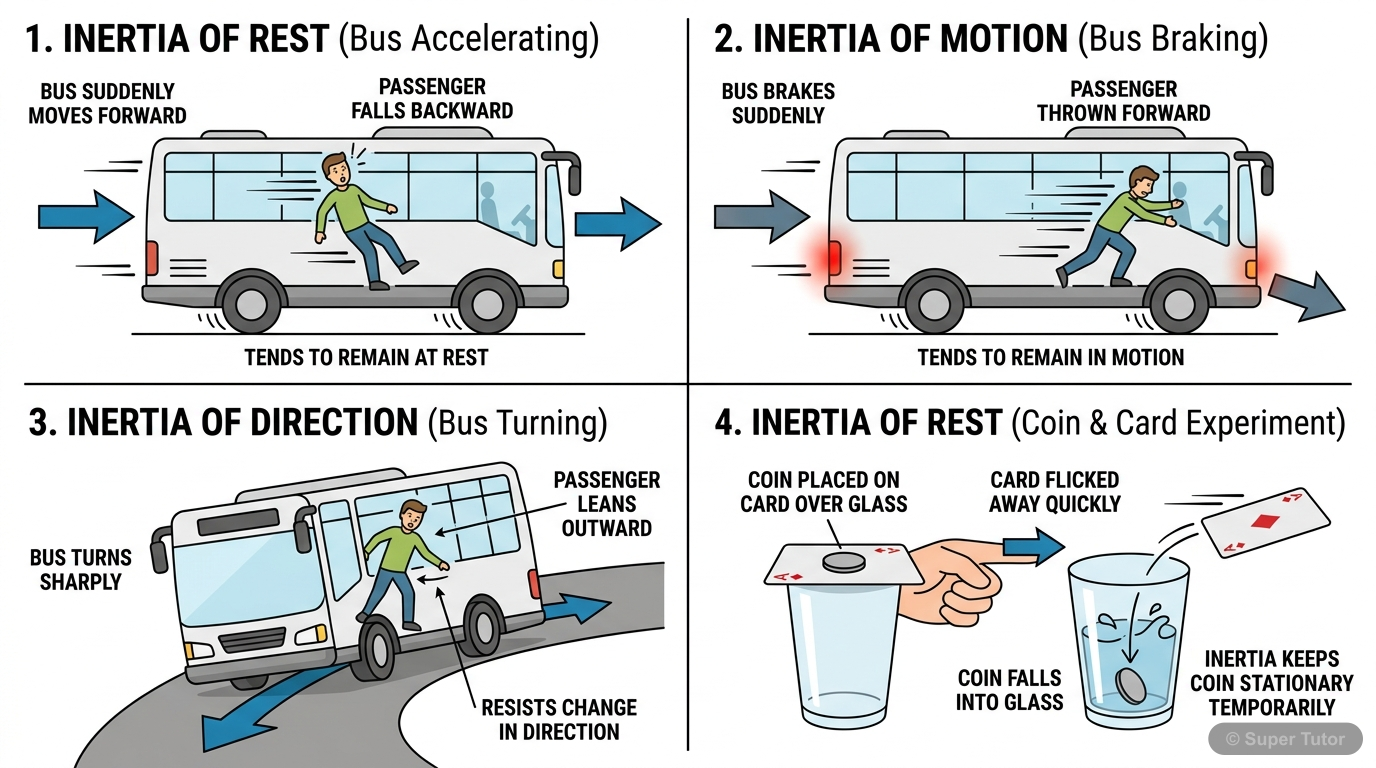
One of 8 illustrations for Laws of Motion in Super Tutor — alongside flashcards, concept maps and practice questions.
State Newton's First Law of Motion. What physical property does it introduce?
Answer
Newton's First Law: A body continues to be in a state of rest or of uniform motion in a straight line unless acted upon by a net external force. Physical Property Introduced: INERTIA — the tendency o…
What is Inertia? How does mass relate to inertia? Give two real-life examples.
Answer
Inertia: The property of a body by which it resists any change in its state of rest or uniform motion in a straight line. Relation with Mass: Mass is the quantitative measure of inertia. A heavier bo…
State Newton's Second Law of Motion and derive F = ma.
Answer
Newton's Second Law: The rate of change of momentum of a body is directly proportional to the net external force acting on it, and the change occurs in the direction of the force. Derivation: Step 1:…
A ball of mass 0.4 kg starts rolling at 20 m/s and stops after 10 s. Find the stopping force.
Answer
Given: • m = 0.4 kg • Initial velocity u = 20 m/s • Final velocity v = 0 m/s • t = 10 s Find: Force F Formula: F = m·a = m·(v – u)/t Solution: Step 1: a = (0 – 20)/10 = –2 m/s² Step 2: F = 0.4 × (–…
A 50 N constant force acts on a 10 kg body moving at 10 m/s in the opposite direction. How long does it take to stop?
Answer
Given: • F = –50 N (opposite to motion) • m = 10 kg • u = 10 m/s • v = 0 m/s Find: time t Formula: F = m·(v – u)/t → t = m·(v – u)/F Solution: Step 1: t = 10 × (0 – 10) / (–50) Step 2: t = –100 / –…
What is Linear Momentum? Write its formula, SI unit, and nature (scalar/vector).
Answer
Linear Momentum (p): The product of the mass and velocity of a body. Formula: p = m·v SI Unit: kg·m/s (kilogram metre per second) Nature: VECTOR quantity — direction is same as velocity. Key Point…
A rubber ball of mass 0.2 kg hits a wall at 10 m/s and rebounds at the same speed. Find the change in momentum.
Answer
Given: • m = 0.2 kg • Speed before hitting = 10 m/s (take as +x direction) • Speed after rebound = 10 m/s (in –x direction) Find: Change in momentum Δp Solution: Step 1: Initial momentum pᵢ = 0.2 × …
A 2 kg object is dropped from rest. Find its momentum at t = 0 s, t = 1 s, and t = 2 s. (g = 9.8 m/s²)
Answer
Given: m = 2 kg, u = 0 m/s, g = 9.8 m/s² (downward) Formula: v = u + gt, then p = mv At t = 0 s: • v = 0 m/s → p = 2 × 0 = 0 kg·m/s At t = 1 s: • v = 0 + 9.8 × 1 = 9.8 m/s ↓ • p = 2 × 9.8 = 19.6 kg…
+27 more flashcards
Practise AllFrequently Asked Questions
What are the important topics in Laws of Motion for NIOS Class 12 Physics?
How many flashcards are available for Laws of Motion?
How should I revise Laws of Motion for the NIOS Class 12 board exam?
Sources & Official References
Content is aligned to the official syllabus. Refer to the board website for the latest curriculum.
More resources for Laws of Motion
Practice Quiz
Test yourself with a quick quiz
Important Questions
Exam-style questions with answers
Revision Notes
Key points for last-minute revision
Formula Sheet
The chapter's formulas in one place
Chapter Summary
Understand the chapter at a glance
Concept Maps
See how topics connect
Study Plan
Step-by-step plan for this chapter
Syllabus
What topics to cover
For serious students
Get the full Laws of Motion chapter — start free.
Quizzes, flashcards, an AI doubt solver and a study plan for NIOS Class 12 Physics. Free to start, no card needed.