Nuclei and Radioactivity — Chapter Summary
NIOS · Class 12 · Physics
Summary of Nuclei and Radioactivity for NIOS Class 12 Physics. Part of the NIOS Class 12 Physics syllabus. The atomic nucleus is the tiny, dense core.
Interactive on Super Tutor
Studying Nuclei and Radioactivity? Get the full interactive chapter.
Quizzes, flashcards, AI doubt-solver and a step-by-step study plan — built for chapter summary and more.
Free trial, no card needed.
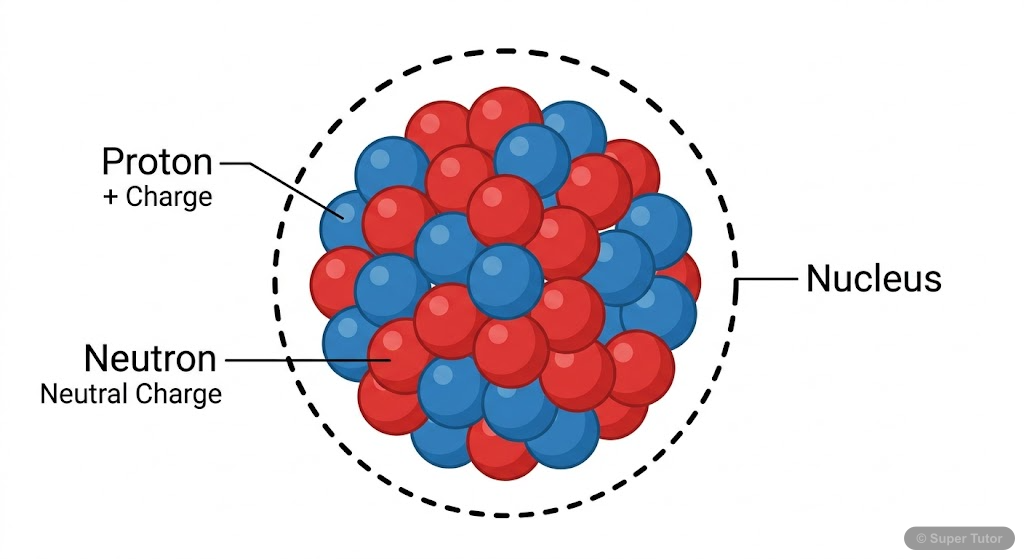
One of 7 illustrations for Nuclei and Radioactivity in Super Tutor — alongside flashcards, concept maps and practice questions.
Overview
The atomic nucleus is the tiny, dense core of every atom, yet it holds enormous energy and fascinating complexity. This chapter takes you deep into the world of the nucleus — exploring what it is made of, how its constituents are held together, and what happens when unstable nuclei break apart. The
Key Concepts
The nucleus is the extremely tiny
The nucleus is the extremely tiny, dense central core of an atom. It contains two types of particles: protons (positively charged) and neutrons (neutr
These three terms describe relationships between
These three terms describe relationships between different nuclei: (1) Isotopes: Atoms of the SAME element (same Z) but DIFFERENT mass numbers (differ
The radius of a nucleus
The radius of a nucleus is given by the empirical formula: R = r₀A^(1/3), where r₀ = 1.2 fermi = 1.2 × 10⁻¹⁵ m (1 fermi = 10⁻¹⁵ m). Since volume V = (
Since nuclear masses are extremely small
Since nuclear masses are extremely small numbers when expressed in kg, scientists use a convenient unit called the unified atomic mass unit (u). It is
A nucleus weighs LESS than
A nucleus weighs LESS than the sum of its individual free nucleons. This difference in mass is called the Mass Defect (Δm). Formula: Δm = [Z·mₚ + (A−Z
Learning Objectives
- Determine the number of neutrons, protons, and electrons in nuclei of different atoms using atomic number (Z) and mass number (A)
- Calculate the sizes of atomic nuclei using the formula R = r₀A^(1/3)
- Explain the nature, properties, and characteristics of nuclear forces between nucleons
- Define mass defect and binding energy, and calculate them for given nuclei
- Draw and interpret the binding energy per nucleon versus mass number curve
Frequently Asked Questions
What are the important topics in Nuclei and Radioactivity for NIOS Class 12 Physics?
How should I revise Nuclei and Radioactivity for the NIOS Class 12 board exam?
Sources & Official References
Content is aligned to the official syllabus. Refer to the board website for the latest curriculum.
More resources for Nuclei and Radioactivity
Practice Quiz
Test yourself with a quick quiz
Important Questions
Exam-style questions with answers
Revision Notes
Key points for last-minute revision
Formula Sheet
The chapter's formulas in one place
Concept Maps
See how topics connect
Study Plan
Step-by-step plan for this chapter
Flashcards
Quick-fire cards for active recall
Syllabus
What topics to cover
For serious students
Get the full Nuclei and Radioactivity chapter — start free.
Quizzes, flashcards, an AI doubt solver and a study plan for NIOS Class 12 Physics. Free to start, no card needed.