Nuclei and Radioactivity — Revision Notes
NIOS · Class 12 · Physics
Nuclei and Radioactivity revision notes for NIOS Class 12 Physics: 4 topics in quick points. Part of the NIOS Class 12 Physics syllabus.
Interactive on Super Tutor
Studying Nuclei and Radioactivity? Get the full interactive chapter.
Quizzes, flashcards, AI doubt-solver and a step-by-step study plan — built for revision notes and more.
Free trial, no card needed.
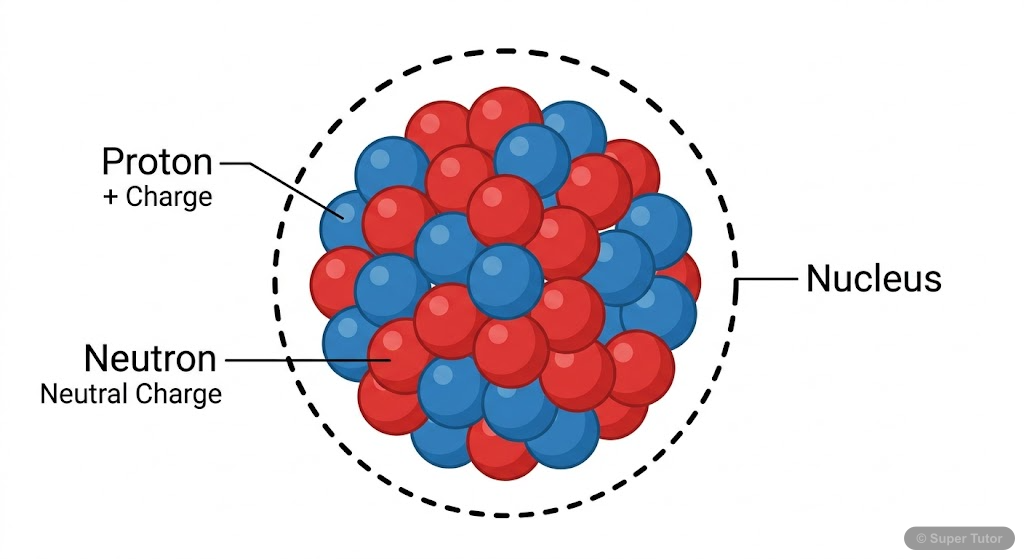
One of 7 illustrations for Nuclei and Radioactivity in Super Tutor — alongside flashcards, concept maps and practice questions.
Key Topics to Revise
1. The Atomic Nucleus – Structure and Properties
- The nucleus contains two types of particles: positively charged protons and neutral neutrons. Together they are called NUCLEONS.
- Atomic Number (Z) = Number of protons in the nucleus = Number of electrons in the atom.
- Mass Number (A) = Total number of nucleons (protons + neutrons). So, Number of neutrons N = A – Z.
2. Mass Defect and Binding Energy
- The measured mass of a nucleus is ALWAYS LESS than the sum of masses of its individual nucleons. This difference is called MASS DEFECT (Δm).
- Mass defect: Δm = [Z·mₚ + (A–Z)·mₙ] – M, where M is the actual mass of the nucleus.
- By Einstein's mass-energy equivalence (E = mc²), this lost mass appears as the energy that binds the nucleons together — called BINDING ENERGY (BE).
3. Nuclear Forces
- The force that holds nucleons together inside the nucleus is called NUCLEAR FORCE (also called Strong Nuclear Force).
- Nuclear forces CANNOT be gravitational — gravitational forces between nucleons are about 10³⁹ times weaker and cannot account for the large binding energies.
- Nuclear forces CANNOT be electrostatic — protons repel each other electrostatically; if only electrostatic forces existed, the nucleus would fly apart.
4. Radioactivity – Discovery and Nature of Radiation
- Radioactivity was DISCOVERED BY ACCIDENT by Henri Becquerel in 1896, when he found that uranium salt fogged his photographic plates even in the dark.
- Marie Curie and Pierre Curie isolated radium and polonium — two new radioactive elements — from uranium ore.
- RADIOACTIVITY is the spontaneous emission of radiation (α, β, or γ) from unstable atomic nuclei to achieve stability.
Get complete notes with diagrams and examples
Full NotesKey Concepts
Frequently Asked Questions
What are the important topics in Nuclei and Radioactivity for NIOS Class 12 Physics?
How should I revise Nuclei and Radioactivity for the NIOS Class 12 board exam?
Sources & Official References
Content is aligned to the official syllabus. Refer to the board website for the latest curriculum.
More resources for Nuclei and Radioactivity
Practice Quiz
Test yourself with a quick quiz
Important Questions
Exam-style questions with answers
Formula Sheet
The chapter's formulas in one place
Chapter Summary
Understand the chapter at a glance
Concept Maps
See how topics connect
Study Plan
Step-by-step plan for this chapter
Flashcards
Quick-fire cards for active recall
Syllabus
What topics to cover
For serious students
Get the full Nuclei and Radioactivity chapter — start free.
Quizzes, flashcards, an AI doubt solver and a study plan for NIOS Class 12 Physics. Free to start, no card needed.