Structure of Atom — Revision Notes
NIOS · Class 12 · Physics
Structure of Atom revision notes for NIOS Class 12 Physics: 4 topics in quick points. Key terms: J, Geiger and Marsden and To explain large.
Interactive on Super Tutor
Studying Structure of Atom? Get the full interactive chapter.
Quizzes, flashcards, AI doubt-solver and a step-by-step study plan — built for revision notes and more.
Free trial, no card needed.
One of 6 illustrations for Structure of Atom in Super Tutor — alongside flashcards, concept maps and practice questions.
Key Topics to Revise
Historical Development of Atomic Models
- John Dalton (1808) proposed atoms as the smallest, indivisible particles — the building blocks of matter.
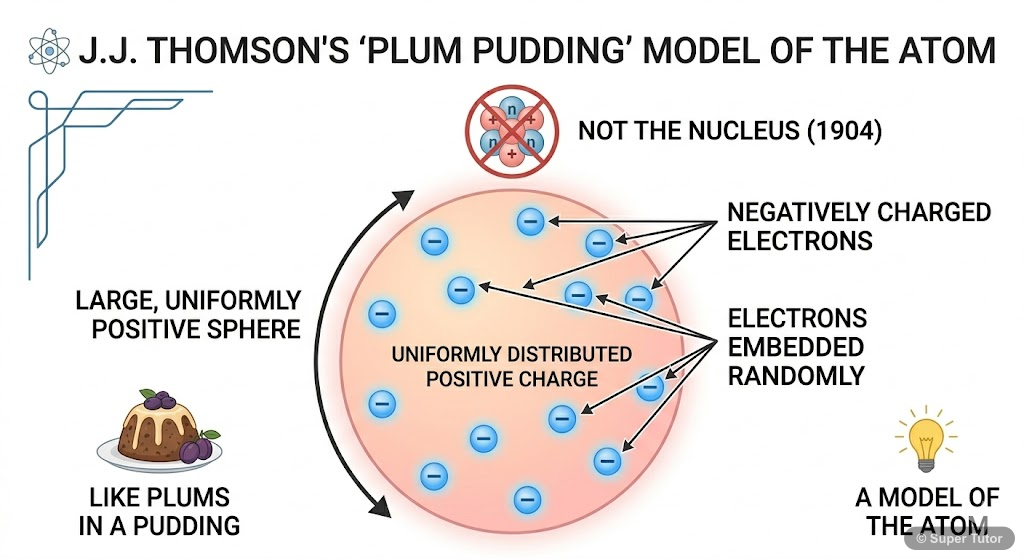
- J.J. Thomson (1897) discovered the electron while studying cathode rays. Since atoms are neutral, he proposed the 'Plum Pudding Model': a positively charged sphere with electrons embedded in it like r
- Thomson's model could NOT explain large-angle scattering of alpha particles.
Rutherford's Alpha Particle Scattering Experiment
- Geiger and Marsden (on Rutherford's advice) bombarded a thin gold foil (~100 nm thick) with alpha particles from a radioactive source.
- Alpha particles (α-particles) are doubly ionised helium atoms (He²⁺), positively charged, with mass about 4 amu.
- The detector was a ZnS (zinc sulphide) fluorescent screen that produced a flash of light when struck by an alpha particle.
Rutherford's Nuclear Model and Its Limitations
- Rutherford proposed the Nuclear Model of Atom based on the scattering experiment results.
- POSTULATES of Rutherford's model: (1) The entire positive charge and almost all the mass of the atom is concentrated in a tiny central region called the nucleus. (2) Electrons revolve around the nucle
- LIMITATION 1 — Instability of Atom: A revolving electron is an accelerating charge (centripetal acceleration). According to classical electromagnetic theory, an accelerating charge continuously emits
Bohr's Model of Hydrogen Atom
- In 1913, Niels Bohr proposed a modified model by combining classical physics with quantum ideas (from Planck's quantum theory).
- Bohr's model successfully explained the stability of the atom AND the line spectrum of hydrogen.
- BOHR'S FOUR POSTULATES:
Get complete notes with diagrams and examples
Full NotesKey Concepts
Frequently Asked Questions
What are the important topics in Structure of Atom for NIOS Class 12 Physics?
How should I revise Structure of Atom for the NIOS Class 12 board exam?
Sources & Official References
Content is aligned to the official syllabus. Refer to the board website for the latest curriculum.
More resources for Structure of Atom
Practice Quiz
Test yourself with a quick quiz
Important Questions
Exam-style questions with answers
Formula Sheet
The chapter's formulas in one place
Chapter Summary
Understand the chapter at a glance
Concept Maps
See how topics connect
Study Plan
Step-by-step plan for this chapter
Flashcards
Quick-fire cards for active recall
Syllabus
What topics to cover
For serious students
Get the full Structure of Atom chapter — start free.
Quizzes, flashcards, an AI doubt solver and a study plan for NIOS Class 12 Physics. Free to start, no card needed.