Structure of Atom — Chapter Summary
NIOS · Class 12 · Physics
Summary of Structure of Atom for NIOS Class 12 Physics. Key concepts: J, Geiger and Marsden and To explain large.
Interactive on Super Tutor
Studying Structure of Atom? Get the full interactive chapter.
Quizzes, flashcards, AI doubt-solver and a step-by-step study plan — built for chapter summary and more.
Free trial, no card needed.
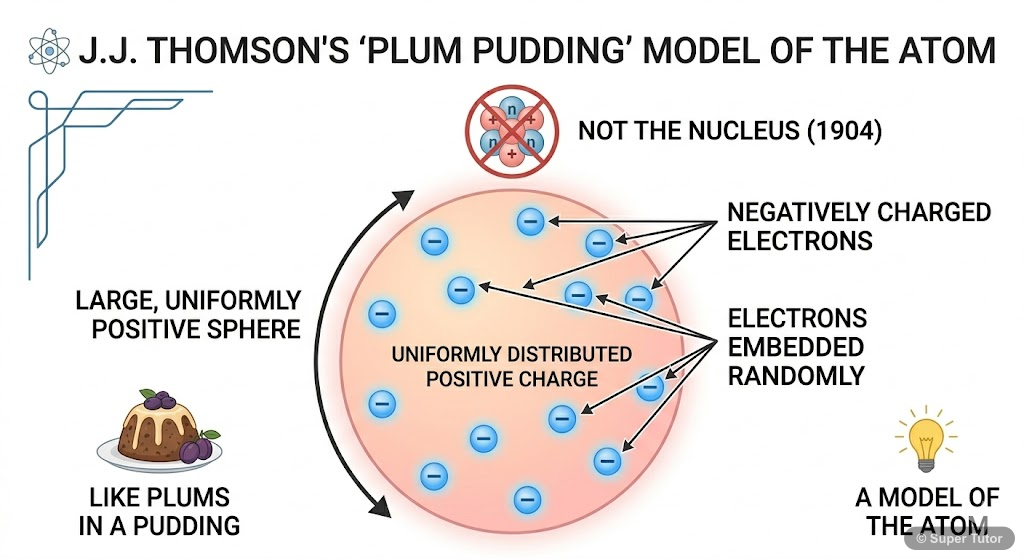
One of 6 illustrations for Structure of Atom in Super Tutor — alongside flashcards, concept maps and practice questions.
Overview
Everything around us — from a piece of chalk to a sheet of aluminium — is made of atoms. But why do different materials behave so differently? The answer lies deep inside the atom itself. The study of atomic structure is a fascinating journey that began with simple ideas and evolved into one of the
Key Concepts
J
J.J. Thomson discovered the electron in 1897 while studying electrical discharge through gases. Since atoms are electrically neutral, Thomson proposed
Geiger and Marsden (on Rutherford's advice)
Geiger and Marsden (on Rutherford's advice) bombarded a thin gold foil with a beam of alpha particles (helium nuclei, charge +2e). A zinc sulphide (Zn
To explain large
To explain large-angle scattering, Rutherford proposed: (1) The entire positive charge and almost all the mass of an atom is concentrated in a tiny ce
Rutherford's model had two serious problems
Rutherford's model had two serious problems: (1) STABILITY PROBLEM: Classical electromagnetism says that an accelerated charged particle must radiate
Bohr (1913) combined classical and quantum
Bohr (1913) combined classical and quantum ideas to propose a new model: POSTULATE 1 (Classical): Electrons move in circular orbits around the nucleus
Learning Objectives
- Describe Rutherford's alpha particle scattering experiment, its observations, and conclusions
- Explain Rutherford's nuclear model of the atom and identify its two main shortcomings
- State Bohr's four postulates and understand how they overcome Rutherford's problems
- Calculate the radius of Bohr's orbits and the velocity of an electron in any given orbit
- Derive and apply the expression for energy of an electron in the nth orbit of hydrogen atom
Frequently Asked Questions
What are the important topics in Structure of Atom for NIOS Class 12 Physics?
How should I revise Structure of Atom for the NIOS Class 12 board exam?
Sources & Official References
Content is aligned to the official syllabus. Refer to the board website for the latest curriculum.
More resources for Structure of Atom
Practice Quiz
Test yourself with a quick quiz
Important Questions
Exam-style questions with answers
Revision Notes
Key points for last-minute revision
Formula Sheet
The chapter's formulas in one place
Concept Maps
See how topics connect
Study Plan
Step-by-step plan for this chapter
Flashcards
Quick-fire cards for active recall
Syllabus
What topics to cover
For serious students
Get the full Structure of Atom chapter — start free.
Quizzes, flashcards, an AI doubt solver and a study plan for NIOS Class 12 Physics. Free to start, no card needed.