Units, Dimensions and Vectors — Chapter Summary
NIOS · Class 12 · Physics
Summary of Units, Dimensions and Vectors for NIOS Class 12 Physics. Part of the NIOS Class 12 Physics syllabus.
Interactive on Super Tutor
Studying Units, Dimensions and Vectors? Get the full interactive chapter.
Quizzes, flashcards, AI doubt-solver and a step-by-step study plan — built for chapter summary and more.
Free trial, no card needed.
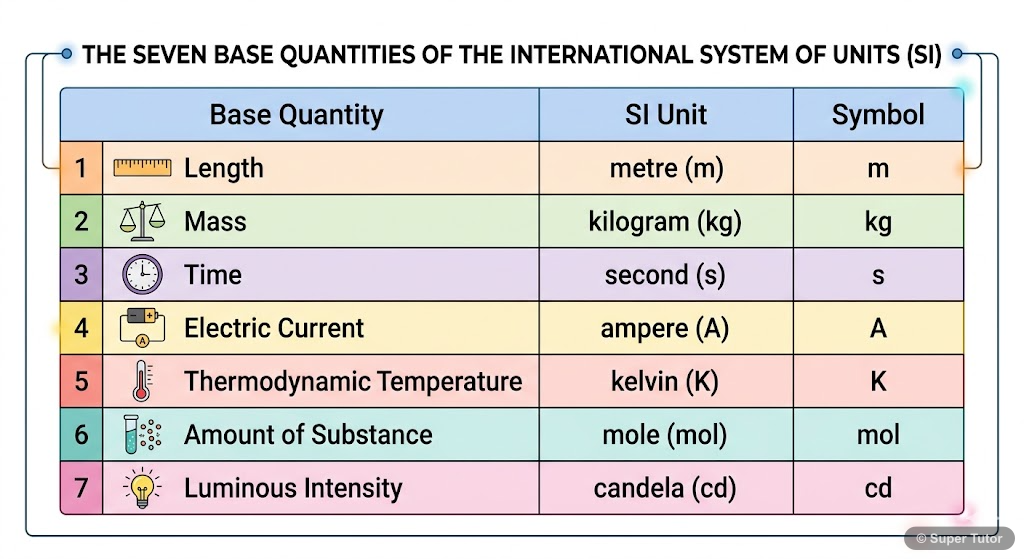
Learn better with visuals Super Tutor pairs illustrations like this with notes and quizzes for Units, Dimensions and Vectors.
Overview
Physics is the most fundamental of all sciences, and at its heart lies the art of precise measurement. Every physical quantity must be measured and expressed in agreed-upon units so that scientists across the world can communicate their findings clearly. This chapter introduces you to the SI system
Key Concepts
Physics studies natural phenomena across
Physics studies natural phenomena across an enormous range of scales — from subatomic particles (size ~10⁻¹⁵ m) to the entire observable universe (siz
The 14th General Conference on Weights
The 14th General Conference on Weights and Measures (1971) adopted seven base SI units. The three most important for mechanics are: kilogram (kg) for
Significant figures are the digits
Significant figures are the digits that are known with certainty plus the first uncertain digit in a measurement. Rules: (1) All non-zero digits are s
Derived units are obtained by combining
Derived units are obtained by combining base units through multiplication or division. Examples: velocity = m s⁻¹, acceleration = m s⁻², force (newton
Dimensions express a physical quantity
Dimensions express a physical quantity in terms of the fundamental quantities M (mass), L (length), T (time), I (electric current), and θ (temperature
Learning Objectives
- Describe the scope of physics and the nature of physical laws
- Identify the number of significant figures in a measurement and understand their importance for accuracy
- Distinguish between fundamental (base) and derived quantities and state their SI units
- Write the dimensional formula of various physical quantities using M, L, T, I, and θ
- Apply dimensional analysis to check the correctness of equations and derive relationships between physical quantities
Frequently Asked Questions
What are the important topics in Units, Dimensions and Vectors for NIOS Class 12 Physics?
How should I revise Units, Dimensions and Vectors for the NIOS Class 12 board exam?
Sources & Official References
Content is aligned to the official syllabus. Refer to the board website for the latest curriculum.
More resources for Units, Dimensions and Vectors
Practice Quiz
Test yourself with a quick quiz
Important Questions
Exam-style questions with answers
Revision Notes
Key points for last-minute revision
Formula Sheet
The chapter's formulas in one place
Concept Maps
See how topics connect
Study Plan
Step-by-step plan for this chapter
Flashcards
Quick-fire cards for active recall
Syllabus
What topics to cover
For serious students
Get the full Units, Dimensions and Vectors chapter — start free.
Quizzes, flashcards, an AI doubt solver and a study plan for NIOS Class 12 Physics. Free to start, no card needed.