The Union Legislature The Union Parliament
ICSE · Class 10 · History & Civics
Summary of The Union Legislature The Union Parliament for ICSE Class 10 History & Civics. Key concepts, important points, and chapter overview.
Interactive on Super Tutor
Studying The Union Legislature The Union Parliament? Get the full interactive chapter.
Quizzes, flashcards, AI doubt-solver and a step-by-step study plan — built for chapter summary and more.
1,000+ Class 10 students started this chapter today
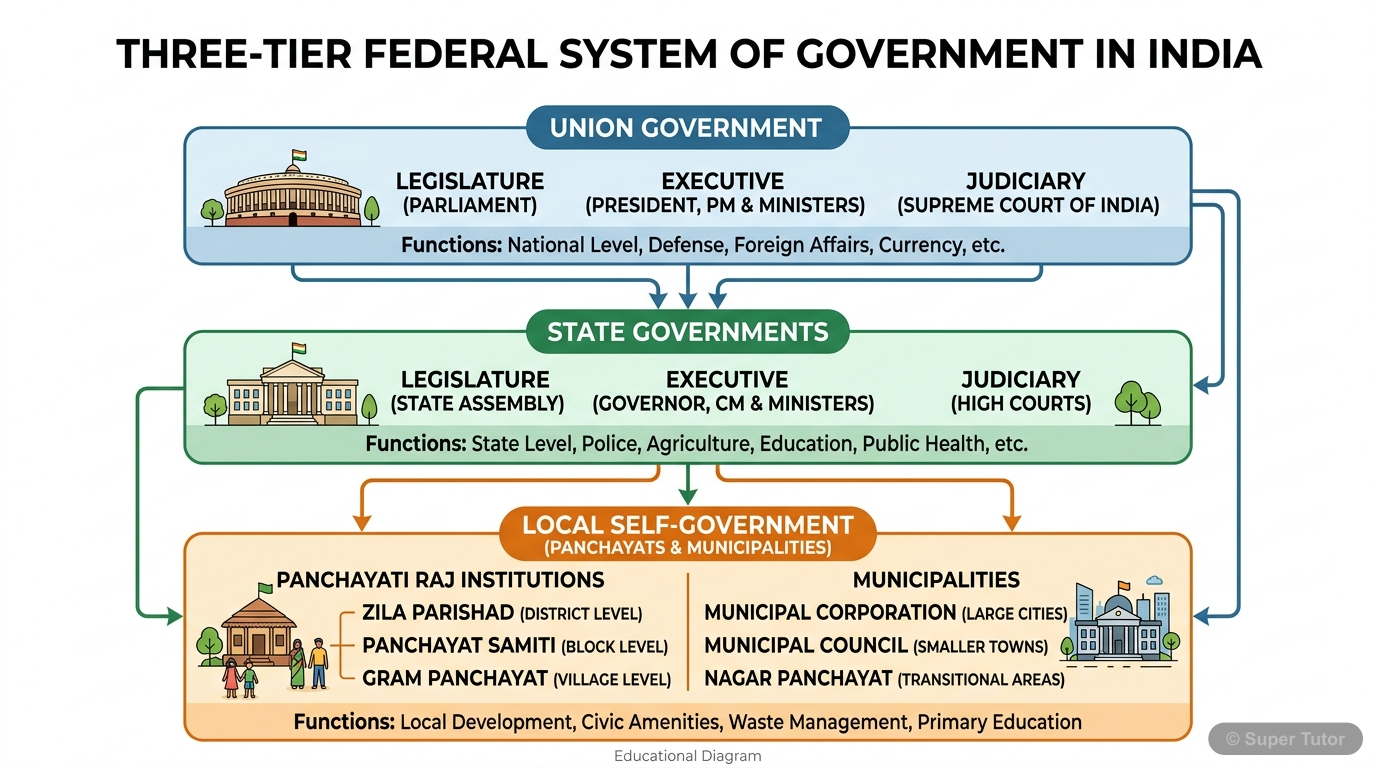
This is just one of 8+ visuals inside Super Tutor's The Union Legislature The Union Parliament chapter
Explore the full setOverview
The Union Parliament is the legislative organ of the Union Government. It consists of three constituents: the Lok Sabha, the Rajya Sabha, and the President. India has a federal system, but the Constitution never uses the word federation. The Indian system combines federal features with strong unitar
Key Concepts
India has a federal system
India has a federal system with a clear division of powers between the Centre and the States. At the same time, it has unitary features such as one ci
The Union Parliament consists of
The Union Parliament consists of the Lok Sabha, the Rajya Sabha, and the President. It is the central law-making body and also controls the executive
The Lok Sabha is the Lower
The Lok Sabha is the Lower House, also called the House of the People. Its members are directly elected by citizens on Universal Adult Franchise. It h
The Rajya Sabha is the Upper
The Rajya Sabha is the Upper House, also called the Council of States. It represents the States of India. It is a permanent House, and one-third of it
The Speaker is the Chairman
The Speaker is the Chairman of the Lok Sabha and is elected by Lok Sabha members from among themselves. The Deputy Speaker acts when the Speaker is ab
Learning Objectives
- Understand the federal nature of India and the structure of the Union Parliament
- Identify the composition and powers of the Lok Sabha, Rajya Sabha, and President
- Explain the role of the Speaker, Deputy Speaker, Vice-President, and Deputy Chairman
- Describe parliamentary procedures such as oath, quorum, question hour, motions, and casting vote
- Differentiate between Money Bills and Ordinary Bills
Frequently Asked Questions
What are the important topics in The Union Legislature The Union Parliament for ICSE Class 10 History & Civics?
How to score full marks in The Union Legislature The Union Parliament — ICSE Class 10 History & Civics?
Sources & Official References
Content is aligned to the official syllabus. Refer to the board website for the latest curriculum.
More resources for The Union Legislature The Union Parliament
Practice Quiz
Test yourself with a quick quiz
Important Questions
Practice with board exam-style questions
Revision Notes
Key points for last-minute revision
Formula Sheet
All formulas in one place
Concept Maps
See how topics connect visually
Study Plan
Step-by-step plan to ace this chapter
Flashcards
Quick-fire cards for active recall
Syllabus
What topics to cover
NCERT Solutions
Every textbook question solved step by step
For serious students
Get the full The Union Legislature The Union Parliament chapter — for free.
Quizzes, flashcards, AI doubt-solver and a step-by-step study plan for ICSE Class 10 History & Civics.