The United Nations
ICSE · Class 10 · History & Civics
Summary of The United Nations for ICSE Class 10 History & Civics. Key concepts, important points, and chapter overview.
Interactive on Super Tutor
Studying The United Nations? Get the full interactive chapter.
Quizzes, flashcards, AI doubt-solver and a step-by-step study plan — built for chapter summary and more.
1,000+ Class 10 students started this chapter today
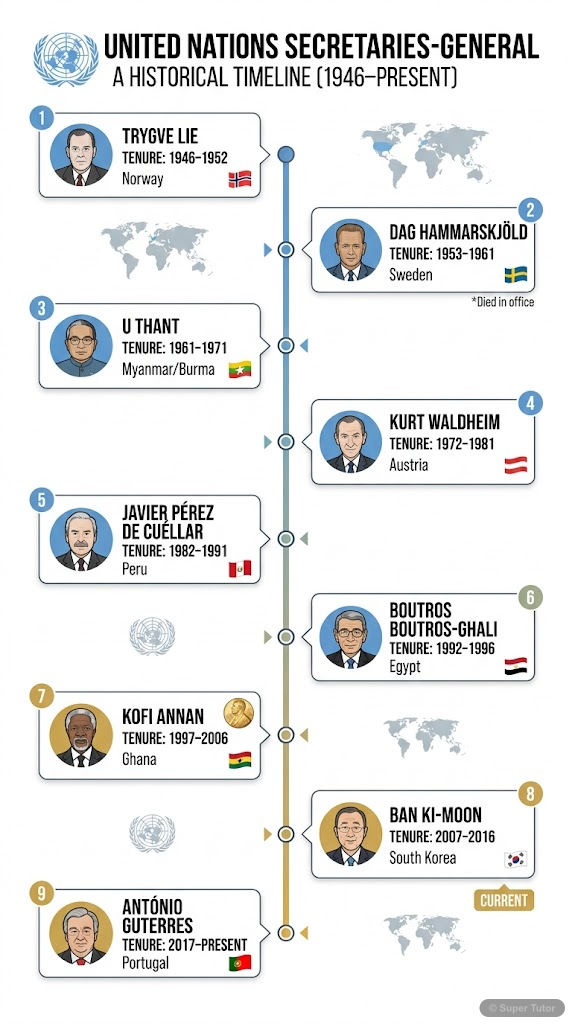
Learn better with visuals Super Tutor has hundreds of illustrations like this across every chapter — all free to try.
Get startedOverview
The United Nations Organisation is a world organisation made up of many countries. It was set up after the Second World War on October 24, 1945, to stop wars, maintain permanent peace, and promote economic and cultural development. Its headquarters are in New York city, USA, and its membership is 19
Key Concepts
The United Nations Organisation is
The United Nations Organisation is a world organisation comprising a large number of countries. It was formed on October 24, 1945, after the Second Wo
The main objectives are to maintain
The main objectives are to maintain international peace and security, develop friendly relations among nations, achieve cooperation in economic, socia
The U
The U.N.O. is based on sovereign equality of all members, peaceful settlement of disputes, non-use of threat and violence, support for UN actions, and
The General Assembly is the chief
The General Assembly is the chief deliberative organ and is considered the parliament of the U.N.O. All 193 member states are its members. Each countr
The Security Council is the executive
The Security Council is the executive body of the U.N.O. It has 15 members, including 5 permanent members and 10 non-permanent members elected for 2 y
Learning Objectives
- Understand the meaning and purpose of the United Nations Organisation
- Learn the main objectives and principles of the U.N.O.
- Identify the six main organs of the United Nations
- Understand the composition and functions of the General Assembly, Security Council, and International Court of Justice
- Know the names and terms of the Secretaries-General of the UN
Frequently Asked Questions
What are the important topics in The United Nations for ICSE Class 10 History & Civics?
How to score full marks in The United Nations — ICSE Class 10 History & Civics?
Sources & Official References
Content is aligned to the official syllabus. Refer to the board website for the latest curriculum.
More resources for The United Nations
Practice Quiz
Test yourself with a quick quiz
Important Questions
Practice with board exam-style questions
Revision Notes
Key points for last-minute revision
Formula Sheet
All formulas in one place
Concept Maps
See how topics connect visually
Study Plan
Step-by-step plan to ace this chapter
Flashcards
Quick-fire cards for active recall
Syllabus
What topics to cover
NCERT Solutions
Every textbook question solved step by step
For serious students
Get the full The United Nations chapter — for free.
Quizzes, flashcards, AI doubt-solver and a step-by-step study plan for ICSE Class 10 History & Civics.