Rise of Dictatorship Fascism and Nazism
ICSE · Class 10 · History & Civics
Summary of Rise of Dictatorship Fascism and Nazism for ICSE Class 10 History & Civics. Key concepts, important points, and chapter overview.
Interactive on Super Tutor
Studying Rise of Dictatorship Fascism and Nazism? Get the full interactive chapter.
Quizzes, flashcards, AI doubt-solver and a step-by-step study plan — built for chapter summary and more.
1,000+ Class 10 students started this chapter today
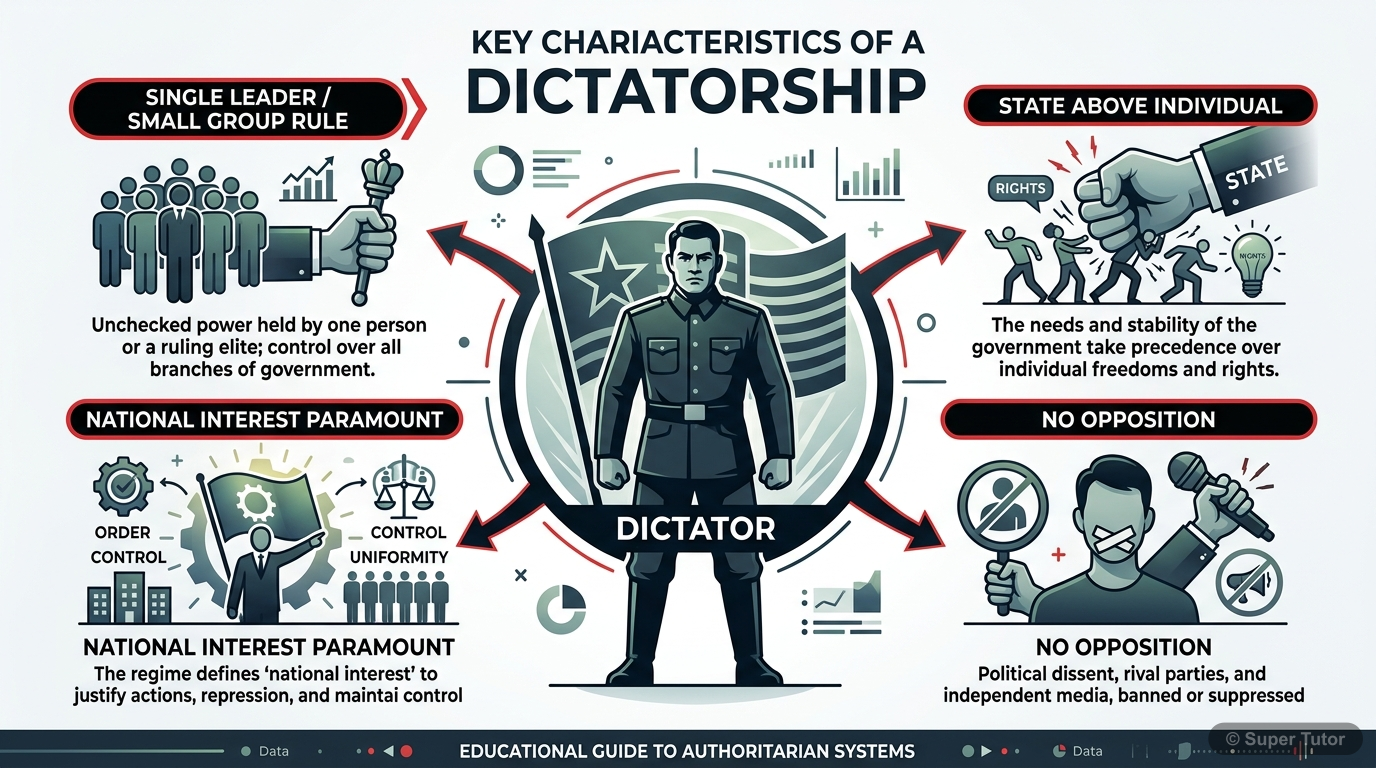
Super Tutor has 6+ illustrations like this for Rise of Dictatorship Fascism and Nazism alone — flashcards, concept maps, and step-by-step visuals.
See them allOverview
After the First World War, democracy weakened in several European countries and dictatorships rose in its place. Fascism developed in Italy under Benito Mussolini, while Nazism rose in Germany under Adolf Hitler. Both ideologies gave supreme importance to the state, demanded obedience to one leader,
Key Concepts
A form of government in
A form of government in which power is held by one man or a small group of men, and the masses have little say in administration. The state is placed
A dictatorial form of government
A dictatorial form of government that rose in Italy under Benito Mussolini. It stood for unity, strength and authority, and opposed democracy.
A dictatorship that rose in Germany
A dictatorship that rose in Germany under Adolf Hitler. It believed in strong state control, German superiority, anti-Jewish propaganda, and expansion
The word Fascism comes from fasces
The word Fascism comes from fasces, meaning a bundle of rods. The bundle symbolised unity and strength, while the axe symbolised state authority.
The democratic republic set up
The democratic republic set up in Germany by the Weimar Constitution. It was introduced on 10 August 1919 after the Constituent Assembly was formed on
Learning Objectives
- Understand why dictatorships rose in Europe after the First World War
- Explain the rise of Fascism in Italy under Benito Mussolini
- Explain the rise of Nazism in Germany under Adolf Hitler
- Compare the main ideas of Fascism and Nazism
- Identify the causes that helped these ideologies gain support
Frequently Asked Questions
What are the important topics in Rise of Dictatorship Fascism and Nazism for ICSE Class 10 History & Civics?
How to score full marks in Rise of Dictatorship Fascism and Nazism — ICSE Class 10 History & Civics?
Sources & Official References
Content is aligned to the official syllabus. Refer to the board website for the latest curriculum.
More resources for Rise of Dictatorship Fascism and Nazism
Practice Quiz
Test yourself with a quick quiz
Important Questions
Practice with board exam-style questions
Revision Notes
Key points for last-minute revision
Formula Sheet
All formulas in one place
Concept Maps
See how topics connect visually
Study Plan
Step-by-step plan to ace this chapter
Flashcards
Quick-fire cards for active recall
Syllabus
What topics to cover
NCERT Solutions
Every textbook question solved step by step
For serious students
Get the full Rise of Dictatorship Fascism and Nazism chapter — for free.
Quizzes, flashcards, AI doubt-solver and a step-by-step study plan for ICSE Class 10 History & Civics.