Cell: The Unit of Life — Chapter Summary
ICSE · Class 11 · Biology
Summary of Cell: The Unit of Life for ICSE Class 11 Biology. Part of the ICSE Class 11 Biology syllabus. The cell is the basic structural and functional.
Interactive on Super Tutor
Studying Cell: The Unit of Life? Get the full interactive chapter.
Quizzes, flashcards, AI doubt-solver and a step-by-step study plan — built for chapter summary and more.
Free trial, no card needed.
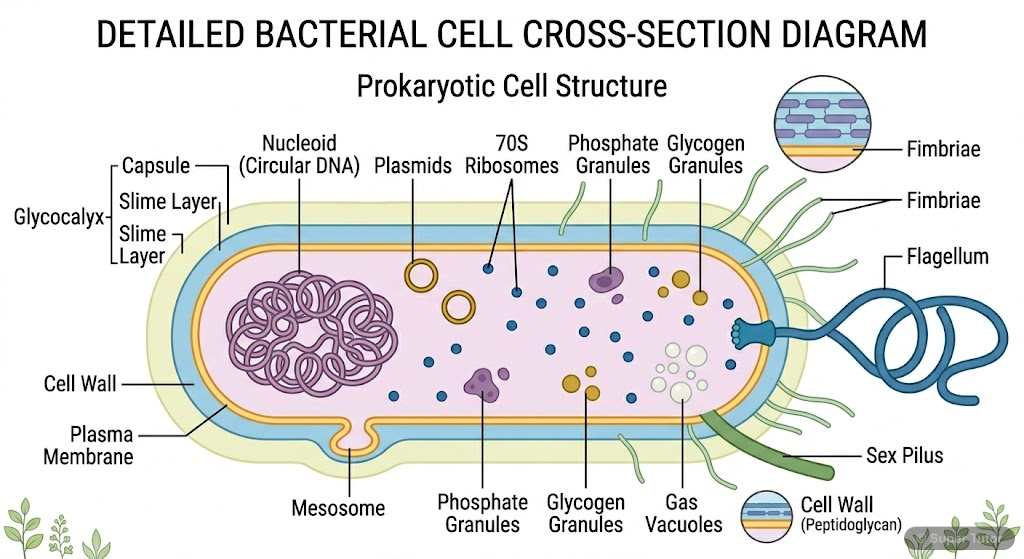
Learn better with visuals Super Tutor pairs illustrations like this with notes and quizzes for Cell: The Unit of Life.
Overview
The cell is the basic structural and functional unit of all living beings. Unicellular organisms perform all vital functions within a single cell, while multicellular organisms show division of labour through specialized cells, tissues, organs, and organ systems. Cell biology studies the structure,
Key Concepts
A cell is the fundamental structural
A cell is the fundamental structural and functional unit of all living beings. In unicellular organisms, one cell performs all life functions. In mult
Schleiden and Schwann gave coherence
Schleiden and Schwann gave coherence to the idea that living organisms are cellular. Virchow extended it by stating that all living cells arise from p
Viruses are acellular and lack cellular
Viruses are acellular and lack cellular organisation and metabolic machinery. Coenocytic organisms such as Rhizopus and Vaucheria have multinucleate c
Prokaryotic cells are simple in structure
Prokaryotic cells are simple in structure and are found in bacteria, cyanobacteria, mycoplasma, and PPLO. They lack a true nucleus and membrane-bound
Eukaryotic cells are found in all
Eukaryotic cells are found in all organisms other than bacteria and cyanobacteria. They have a true nucleus, membrane-bound organelles, and linear chr
Learning Objectives
- Understand the cell as the basic unit of life
- Trace the historical development of cell study from Hooke to modern cell biology
- Differentiate between prokaryotic and eukaryotic cells
- Compare plant cells and animal cells
- Explain the structure and function of the plasma membrane and cell wall
Frequently Asked Questions
What are the important topics in Cell: The Unit of Life for ICSE Class 11 Biology?
How should I revise Cell: The Unit of Life for Class 11 exams?
Sources & Official References
Content is aligned to the official syllabus. Refer to the board website for the latest curriculum.
More resources for Cell: The Unit of Life
Practice Quiz
Test yourself with a quick quiz
Important Questions
Exam-style questions with answers
Revision Notes
Key points for last-minute revision
Formula Sheet
The chapter's formulas in one place
Concept Maps
See how topics connect
Study Plan
Step-by-step plan for this chapter
Flashcards
Quick-fire cards for active recall
Syllabus
What topics to cover
For serious students
Get the full Cell: The Unit of Life chapter — start free.
Quizzes, flashcards, an AI doubt solver and a study plan for ICSE Class 11 Biology. Free to start, no card needed.