Biological Classification — Chapter Summary
ICSE · Class 11 · Biology
Summary of Biological Classification for ICSE Class 11 Biology. Part of the ICSE Class 11 Biology syllabus. Biological classification is the scientific.
Interactive on Super Tutor
Studying Biological Classification? Get the full interactive chapter.
Quizzes, flashcards, AI doubt-solver and a step-by-step study plan — built for chapter summary and more.
Free trial, no card needed.
Learn better with visuals Super Tutor pairs illustrations like this with notes and quizzes for Biological Classification.
Overview
Biological classification is the scientific arrangement of living organisms into groups based on shared features and evolutionary relationships. Early systems were simple and used visible traits, while modern systems use cell structure, body organisation, nutrition, reproduction, and phylogeny. The
Key Concepts
Living organisms are extremely diverse
Living organisms are extremely diverse, so grouping them helps in studying, identifying, and comparing them. Early classification was based on simple
Aristotle used simple morphological characters
Aristotle used simple morphological characters to group plants into trees, shrubs, and herbs, and animals into those with red blood and those without.
Ernst Haeckel added Protista in 1866
Ernst Haeckel added Protista in 1866 to include bacteria, algae, fungi, and protozoa with cellular grade organisation. H.F. Copeland later proposed th
R
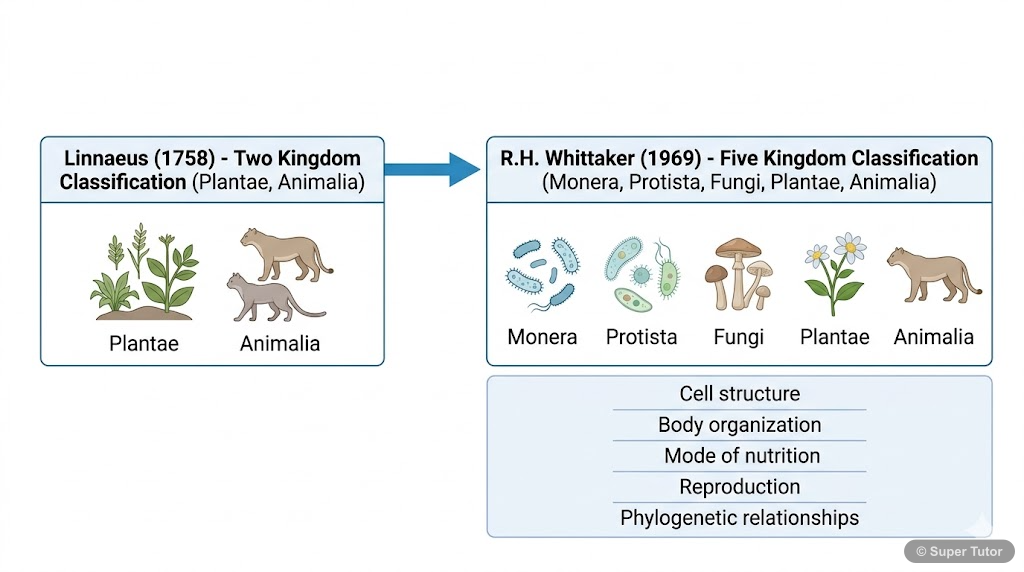
R.H. Whittaker proposed the five-kingdom system in 1969 based on cell structure, body complexity, nutrition, reproduction, and phylogeny. The kingdoms
Monera includes prokaryotic
Monera includes prokaryotic, single-celled organisms such as bacteria and cyanobacteria. They lack a true nucleus and membrane-bound organelles, and t
Learning Objectives
- Understand the need for classification in biology
- Recall the historical development of classification systems
- Describe the five-kingdom system and its basis
- Explain the major features of kingdom Monera
- Classify bacteria by shape, nutrition, and respiration
Frequently Asked Questions
What are the important topics in Biological Classification for ICSE Class 11 Biology?
How should I revise Biological Classification for Class 11 exams?
Sources & Official References
Content is aligned to the official syllabus. Refer to the board website for the latest curriculum.
More resources for Biological Classification
For serious students
Get the full Biological Classification chapter — start free.
Quizzes, flashcards, an AI doubt solver and a study plan for ICSE Class 11 Biology. Free to start, no card needed.