Photosynthesis in Higher Plants — Chapter Summary
ICSE · Class 11 · Biology
Summary of Photosynthesis in Higher Plants for ICSE Class 11 Biology. Part of the ICSE Class 11 Biology syllabus.
Interactive on Super Tutor
Studying Photosynthesis in Higher Plants? Get the full interactive chapter.
Quizzes, flashcards, AI doubt-solver and a step-by-step study plan — built for chapter summary and more.
Free trial, no card needed.
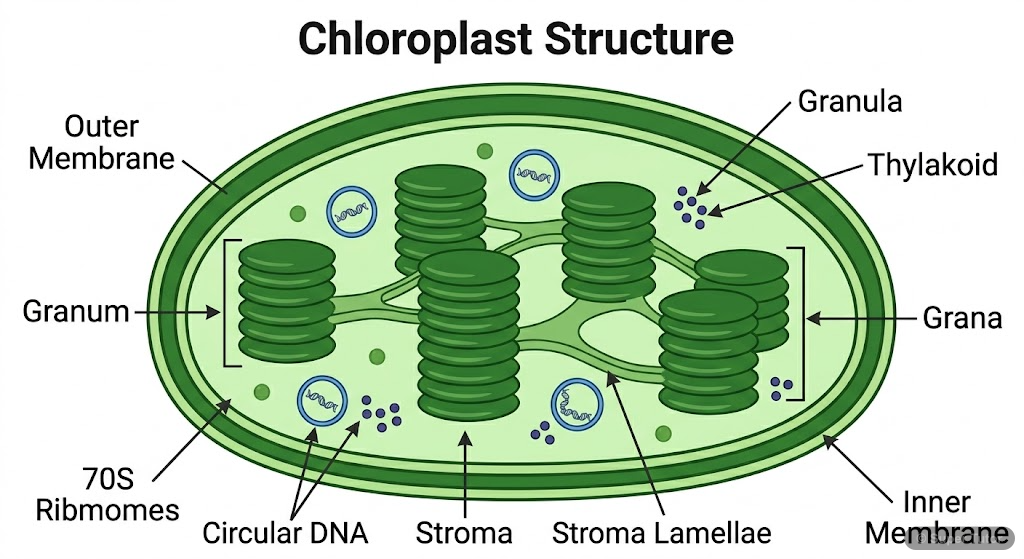
Learn better with visuals Super Tutor pairs illustrations like this with notes and quizzes for Photosynthesis in Higher Plants.
Overview
Photosynthesis is the light energy trapping process in which sunlight is converted into chemical energy. This chemical energy becomes the basis of food for almost all living organisms. In higher plants, the process takes place in chloroplasts and involves pigments such as chlorophylls and carotenoid
Key Concepts
Photosynthesis is the light energy trapping
Photosynthesis is the light energy trapping process that converts light energy into chemical energy. It is the ultimate source of food for almost all
Chloroplasts are disc
Chloroplasts are disc-shaped organelles found mainly in leaf cells. They have a double membrane, stroma, grana, thylakoids, and stroma lamellae. Light
Chlorophyll a is the primary photosynthetic
Chlorophyll a is the primary photosynthetic pigment, and chlorophyll b is an accessory pigment. Carotene and xanthophyll are carotenoids that help abs
Absorption spectrum shows the wavelengths
Absorption spectrum shows the wavelengths of light absorbed by a pigment, while action spectrum shows the effectiveness of different wavelengths in ph
The light reaction includes excitation
The light reaction includes excitation of chlorophyll, photolysis of water, electron transport, ATP formation, and NADPH formation. Oxygen is released
Learning Objectives
- To understand photosynthesis as the basic process of autotrophic nutrition
- To identify chloroplast as the site of photosynthesis and describe its internal structure
- To explain the function of chlorophylls and carotenoids in light absorption
- To compare absorption spectrum and action spectrum
- To describe the light reaction, photolysis of water, and photophosphorylation
Frequently Asked Questions
What are the important topics in Photosynthesis in Higher Plants for ICSE Class 11 Biology?
How should I revise Photosynthesis in Higher Plants for Class 11 exams?
Sources & Official References
Content is aligned to the official syllabus. Refer to the board website for the latest curriculum.
More resources for Photosynthesis in Higher Plants
Practice Quiz
Test yourself with a quick quiz
Important Questions
Exam-style questions with answers
Revision Notes
Key points for last-minute revision
Formula Sheet
The chapter's formulas in one place
Concept Maps
See how topics connect
Study Plan
Step-by-step plan for this chapter
Flashcards
Quick-fire cards for active recall
Syllabus
What topics to cover
For serious students
Get the full Photosynthesis in Higher Plants chapter — start free.
Quizzes, flashcards, an AI doubt solver and a study plan for ICSE Class 11 Biology. Free to start, no card needed.