Trigonometric Ratios Of Some Special Angles — Syllabus
NIOS · Class 10 · Maths
What Trigonometric Ratios Of Some Special Angles covers in NIOS Class 10 Maths: 4 topics, for the 2026-27 session.
Interactive on Super Tutor
Studying Trigonometric Ratios Of Some Special Angles? Get the full interactive chapter.
Quizzes, flashcards, AI doubt-solver and a step-by-step study plan — built for syllabus and more.
Free trial, no card needed.
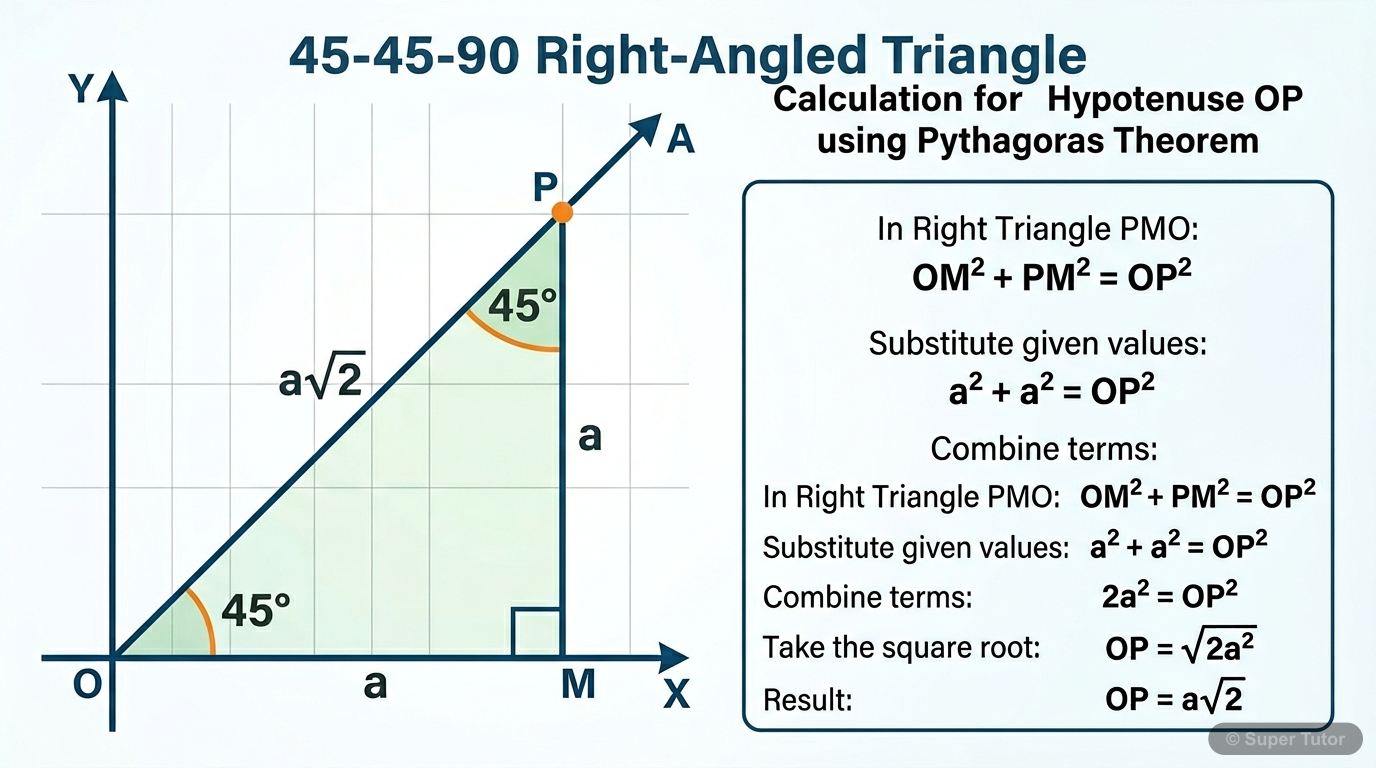
Learn better with visuals Super Tutor pairs illustrations like this with notes and quizzes for Trigonometric Ratios Of Some Special Angles.
Topics in Trigonometric Ratios Of Some Special Angles
1. Right-Triangle Trigonometric Ratios
- In a right triangle, the trigonometric ratios of an acute angle are defined using the opposite side, adjacent side, and hypotenuse.
- For an acute angle C in right triangle ABC right-angled at B: sin C = opposite/hypotenuse, cos C = adjacent/hypotenuse, tan C = opposite/adjacent.
- The reciprocal ratios are cosec C = hypotenuse/opposite, sec C = hypotenuse/adjacent, cot C = adjacent/opposite.
2. Values of 45°, 30°, and 60°
- The 45° values come from an isosceles right triangle.
- The 30° values come from an equilateral triangle split into two right triangles.
- The 60° values come from the same equilateral-triangle construction.
3. How the special-angle values are obtained
- The 45° triangle is formed by taking a point on a ray making 45° with the x-axis and dropping a perpendicular to the x-axis.
- In the 45° construction, the right triangle is isosceles, so the two legs are equal.
- The 30° construction uses a point P, the foot M on the x-axis, and a point P prime so that triangle OPP prime becomes equilateral.
4. Ratios of 0° and 90°
- Some ratios at 0° and 90° are defined, and some are not defined.
- sin 0° = 0 and cos 0° = 1.
- sin 90° = 1 and cos 90° = 0.
Key Concepts
Central concept: Special angle trigonometric ratios and their use in geometry and heights and distances
Work through every topic in Trigonometric Ratios Of Some Special Angles with notes and quizzes
Start This ChapterFrequently Asked Questions
What are the important topics in Trigonometric Ratios Of Some Special Angles for NIOS Class 10 Maths?
How should I revise Trigonometric Ratios Of Some Special Angles for the NIOS Class 10 board exam?
Sources & Official References
Content is aligned to the official syllabus. Refer to the board website for the latest curriculum.
More resources for Trigonometric Ratios Of Some Special Angles
Practice Quiz
Test yourself with a quick quiz
Important Questions
Exam-style questions with answers
Revision Notes
Key points for last-minute revision
Formula Sheet
The chapter's formulas in one place
Chapter Summary
Understand the chapter at a glance
Concept Maps
See how topics connect
Study Plan
Step-by-step plan for this chapter
Flashcards
Quick-fire cards for active recall
For serious students
Get the full Trigonometric Ratios Of Some Special Angles chapter — start free.
Quizzes, flashcards, an AI doubt solver and a study plan for NIOS Class 10 Maths. Free to start, no card needed.