Food Production and Animal-Husbandry — Chapter Summary
NIOS · Class 10 · Science & Tech
Summary of Food Production and Animal-Husbandry for NIOS Class 10 Science & Tech. Part of the NIOS Class 10 Science & Tech syllabus.
Interactive on Super Tutor
Studying Food Production and Animal-Husbandry? Get the full interactive chapter.
Quizzes, flashcards, AI doubt-solver and a step-by-step study plan — built for chapter summary and more.
Free trial, no card needed.
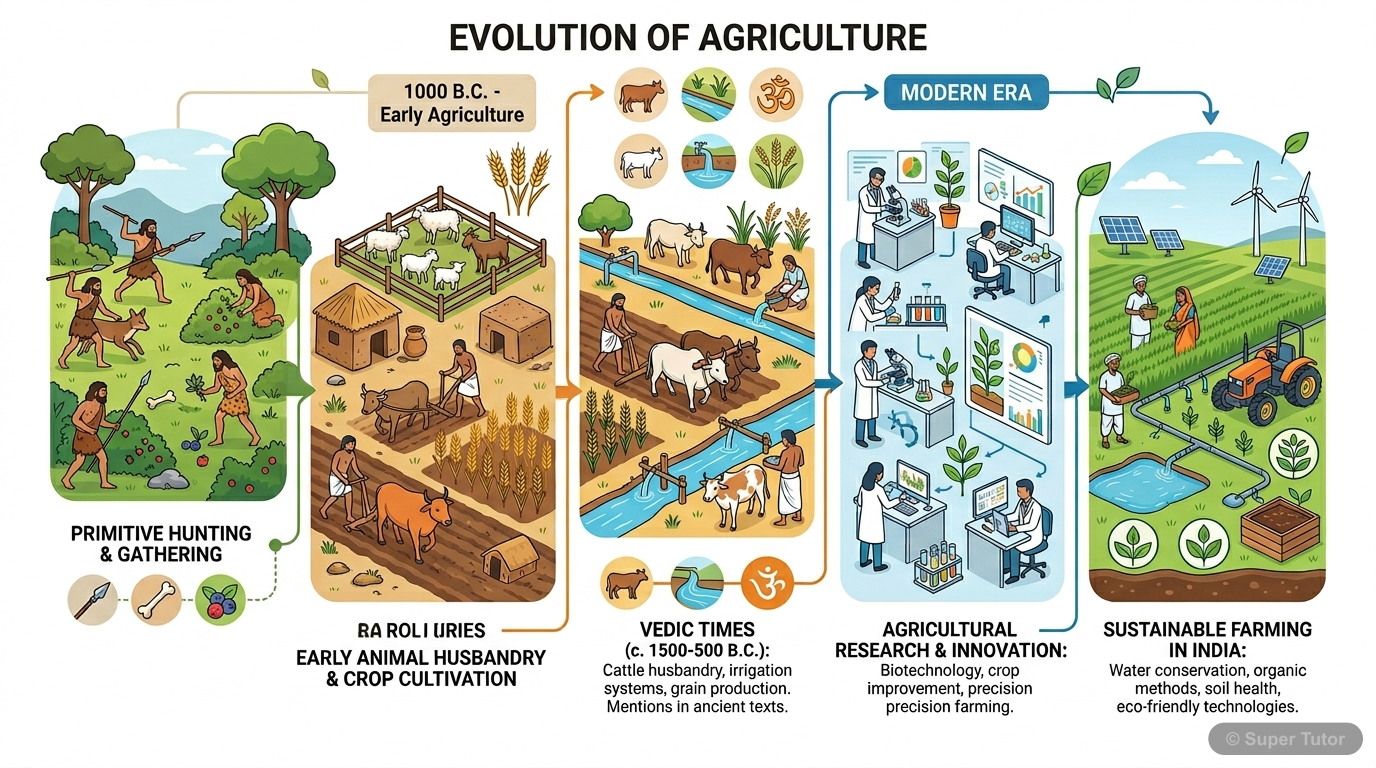
Learn better with visuals Super Tutor pairs illustrations like this with notes and quizzes for Food Production and Animal-Husbandry.
Overview
Food production depends on crop farming, animal husbandry, fisheries, storage, and fair distribution. Agriculture covers the use of land and natural resources for food, fodder, fibre, and fuel. Animal husbandry adds milk, eggs, meat, wool, and fish to the food supply. The chapter also shows how scie
Key Concepts
Agricultural practices began around 1000 B
Agricultural practices began around 1000 B.C. Agricultural universities were established in India between 1905 and 1907. The Indian Agricultural Resea
The Green Revolution in India took
The Green Revolution in India took place between 1968 and 1988 and is called the golden age of agriculture. It raised crop production, especially whea
Dr
Dr. M.S. Swaminathan was credited with India’s Green Revolution and was awarded the World Food Prize. Sustainable agriculture was described as step-by
The main methods are crop rotation
The main methods are crop rotation, mixed farming, multiple cropping, and organic farming. Crop rotation means growing crops in a fixed sequence. Mixe
Crops are classified as Kharif
Crops are classified as Kharif, Rabi, and Zaid crops. Kharif crops include rice, barley, cotton, groundnut, sugarbeet, urad, moong, lobia, millets, ti
Learning Objectives
- Understand the development of agriculture and the Green Revolution.
- Explain the main methods of crop production and farm management.
- Recognize weeds, pests, and crop diseases and their control methods.
- Describe organic manure, fertilizers, and biofertilizers.
- Explain animal husbandry, poultry farming, and fisheries.
Frequently Asked Questions
What are the important topics in Food Production and Animal-Husbandry for NIOS Class 10 Science & Tech?
How should I revise Food Production and Animal-Husbandry for the NIOS Class 10 board exam?
Sources & Official References
Content is aligned to the official syllabus. Refer to the board website for the latest curriculum.
More resources for Food Production and Animal-Husbandry
For serious students
Get the full Food Production and Animal-Husbandry chapter — start free.
Quizzes, flashcards, an AI doubt solver and a study plan for NIOS Class 10 Science & Tech. Free to start, no card needed.