Human Impact on Environment — Chapter Summary
NIOS · Class 10 · Science & Tech
Summary of Human Impact on Environment for NIOS Class 10 Science & Tech. Part of the NIOS Class 10 Science & Tech syllabus.
Interactive on Super Tutor
Studying Human Impact on Environment? Get the full interactive chapter.
Quizzes, flashcards, AI doubt-solver and a step-by-step study plan — built for chapter summary and more.
Free trial, no card needed.
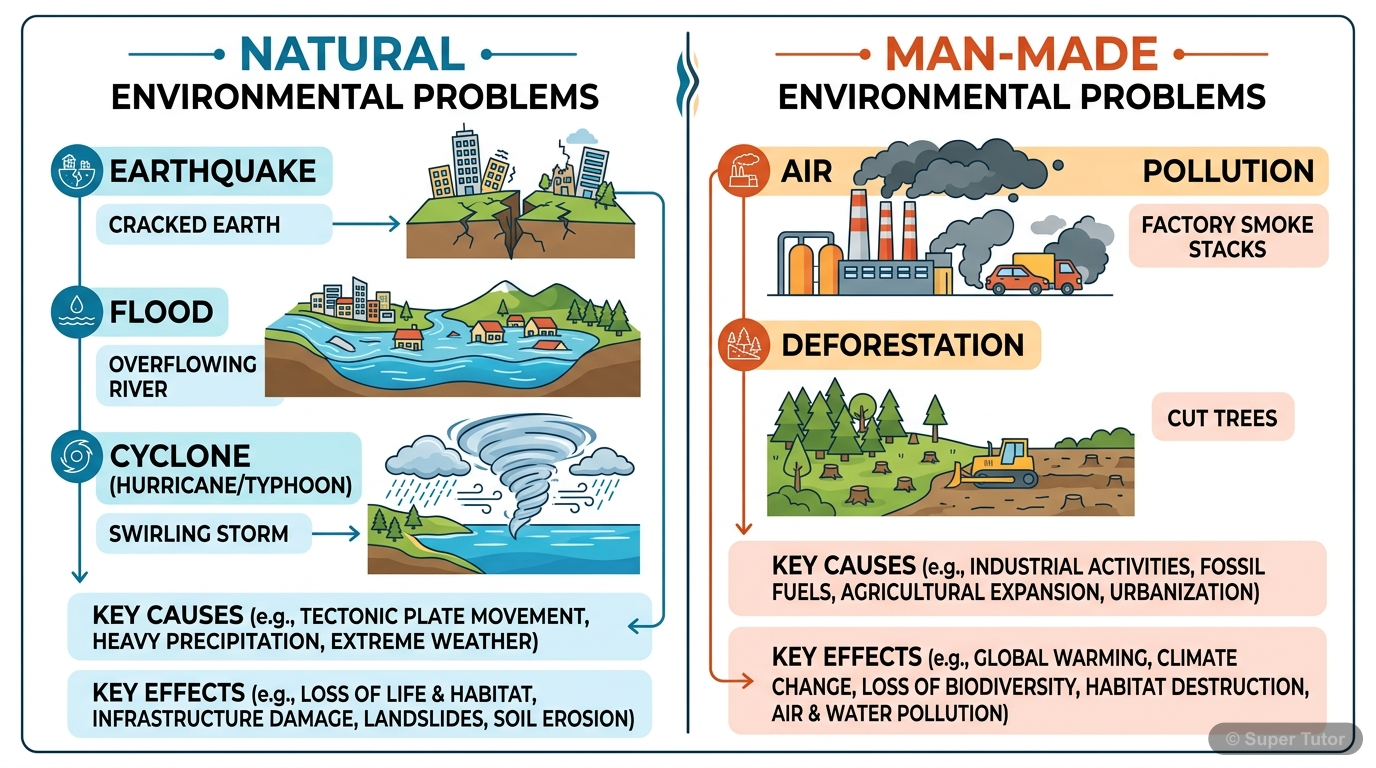
One of 19 illustrations for Human Impact on Environment in Super Tutor — alongside flashcards, concept maps and practice questions.
Overview
Human activities and natural processes both create environmental problems. Floods, cyclones, earthquakes, forest fires, tsunamis, landslides, cloudbursts, deforestation, pollution, waste generation, ozone depletion, global warming, photochemical smog, and acid rain all affect life, property, and nat
Key Concepts
Natural disasters are harmful events caused
Natural disasters are harmful events caused by natural processes. Important examples include floods, cyclones, earthquakes, forest fires, tsunamis, la
Floods happen when rivers or drainage
Floods happen when rivers or drainage systems cannot contain excess water, often during heavy rainfall. India is highly flood-prone, and on average 75
Cyclones are intense low
Cyclones are intense low-pressure systems that affect coastal regions. India has two cyclone seasons: pre-monsoon and post-monsoon. Balasore district
Earthquakes are sudden shocks or shaking
Earthquakes are sudden shocks or shaking of the earth’s surface. They are measured with a seismograph and the Richter scale, invented by C.F. Richter.
Forest fires may be natural
Forest fires may be natural or controlled, caused by heat in dry litter, or caused by human negligence. They destroy timber, biodiversity, vegetation,
Learning Objectives
- Classify environmental problems into natural and manmade categories
- Explain major natural disasters and their effects
- Describe the impact of population growth on resources and pollution
- Distinguish between biodegradable and non-biodegradable wastes
- Explain deforestation, reforestation, afforestation, silviculture, and the Chipko Movement
Frequently Asked Questions
What are the important topics in Human Impact on Environment for NIOS Class 10 Science & Tech?
How should I revise Human Impact on Environment for the NIOS Class 10 board exam?
Sources & Official References
Content is aligned to the official syllabus. Refer to the board website for the latest curriculum.
More resources for Human Impact on Environment
For serious students
Get the full Human Impact on Environment chapter — start free.
Quizzes, flashcards, an AI doubt solver and a study plan for NIOS Class 10 Science & Tech. Free to start, no card needed.