Atoms and Molecules — Chapter Summary
NIOS · Class 10 · Science & Tech
Summary of Atoms and Molecules for NIOS Class 10 Science & Tech. Key concepts: Ancient Indian and Greek, In a chemical reaction and A pure compound always.
Interactive on Super Tutor
Studying Atoms and Molecules? Get the full interactive chapter.
Quizzes, flashcards, AI doubt-solver and a step-by-step study plan — built for chapter summary and more.
Free trial, no card needed.
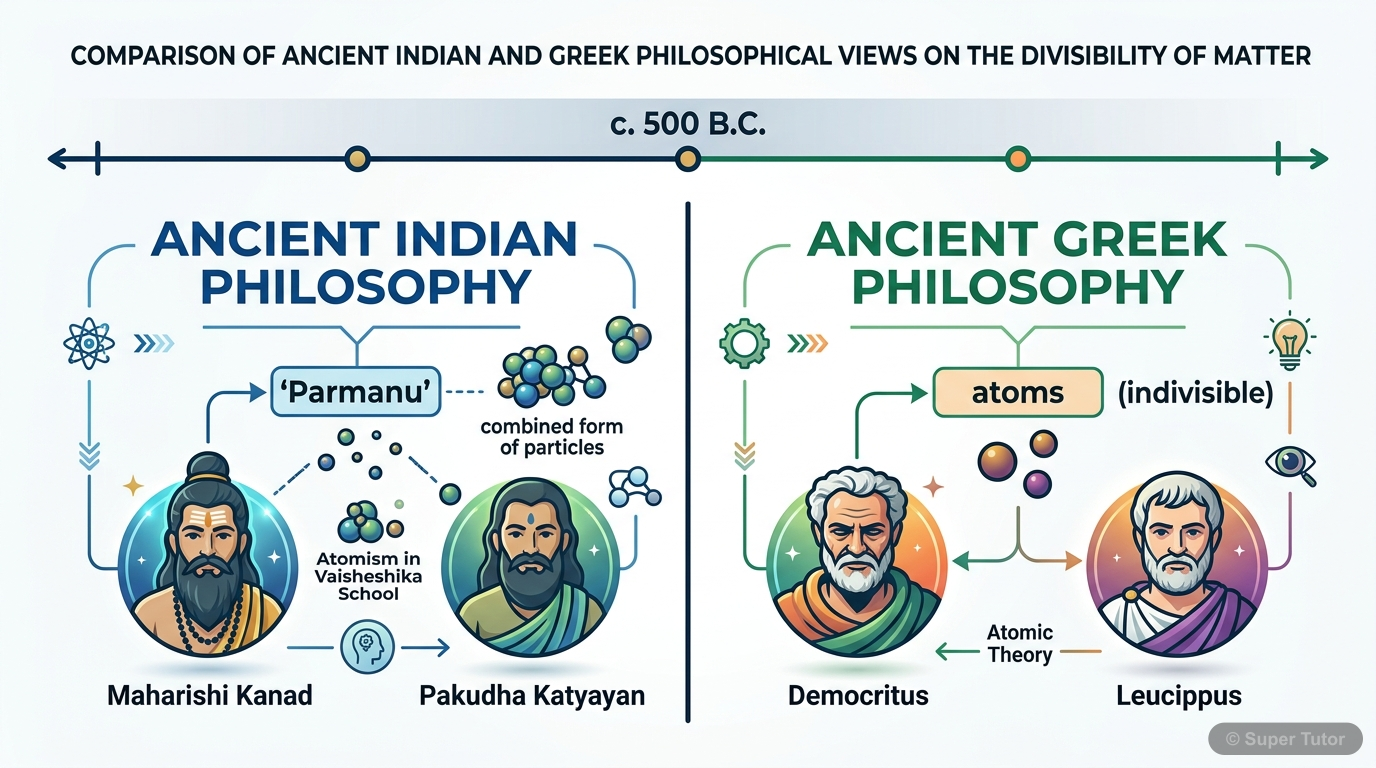
One of 13 illustrations for Atoms and Molecules in Super Tutor — alongside flashcards, concept maps and practice questions.
Overview
Matter is made of tiny particles called atoms and molecules. The chapter explains how scientists understood the divisibility of matter, how laws of chemical combination were established, how atomic theory developed, and how atomic mass, molecular mass, mole, molar mass, valency, and chemical formula
Key Concepts
Ancient Indian and Greek thinkers proposed
Ancient Indian and Greek thinkers proposed that matter can be divided into smaller and smaller particles until a stage is reached beyond which further
In a chemical reaction
In a chemical reaction, the total mass of reactants is equal to the total mass of products. Lavoisier established this using careful balance-based exp
A pure compound always contains
A pure compound always contains the same elements combined in the same proportion by mass, no matter where it is obtained from or how it is prepared.
Dalton arranged earlier atomic ideas into
Dalton arranged earlier atomic ideas into a theory in 1803. He stated that matter consists of atoms, atoms of the same element are identical, atoms of
When two elements form more than
When two elements form more than one compound, the masses of one element that combine with a fixed mass of the other are in simple whole-number ratios
Learning Objectives
- State the law of conservation of mass and the law of constant proportions
- Explain Dalton's atomic theory and its main postulates
- Differentiate between atoms and molecules
- Define atomic number, mass number, isotopes, atomic mass, molecular mass, mole, and molar mass
- Write chemical formulae of compounds using valency and ionic charges
Frequently Asked Questions
What are the important topics in Atoms and Molecules for NIOS Class 10 Science & Tech?
How should I revise Atoms and Molecules for the NIOS Class 10 board exam?
Sources & Official References
Content is aligned to the official syllabus. Refer to the board website for the latest curriculum.
More resources for Atoms and Molecules
Practice Quiz
Test yourself with a quick quiz
Important Questions
Exam-style questions with answers
Revision Notes
Key points for last-minute revision
Formula Sheet
The chapter's formulas in one place
Concept Maps
See how topics connect
Study Plan
Step-by-step plan for this chapter
Flashcards
Quick-fire cards for active recall
Syllabus
What topics to cover
For serious students
Get the full Atoms and Molecules chapter — start free.
Quizzes, flashcards, an AI doubt solver and a study plan for NIOS Class 10 Science & Tech. Free to start, no card needed.