Periodic Classification of Elements — Chapter Summary
NIOS · Class 10 · Science & Tech
Summary of Periodic Classification of Elements for NIOS Class 10 Science & Tech. Part of the NIOS Class 10 Science & Tech syllabus.
Interactive on Super Tutor
Studying Periodic Classification of Elements? Get the full interactive chapter.
Quizzes, flashcards, AI doubt-solver and a step-by-step study plan — built for chapter summary and more.
Free trial, no card needed.
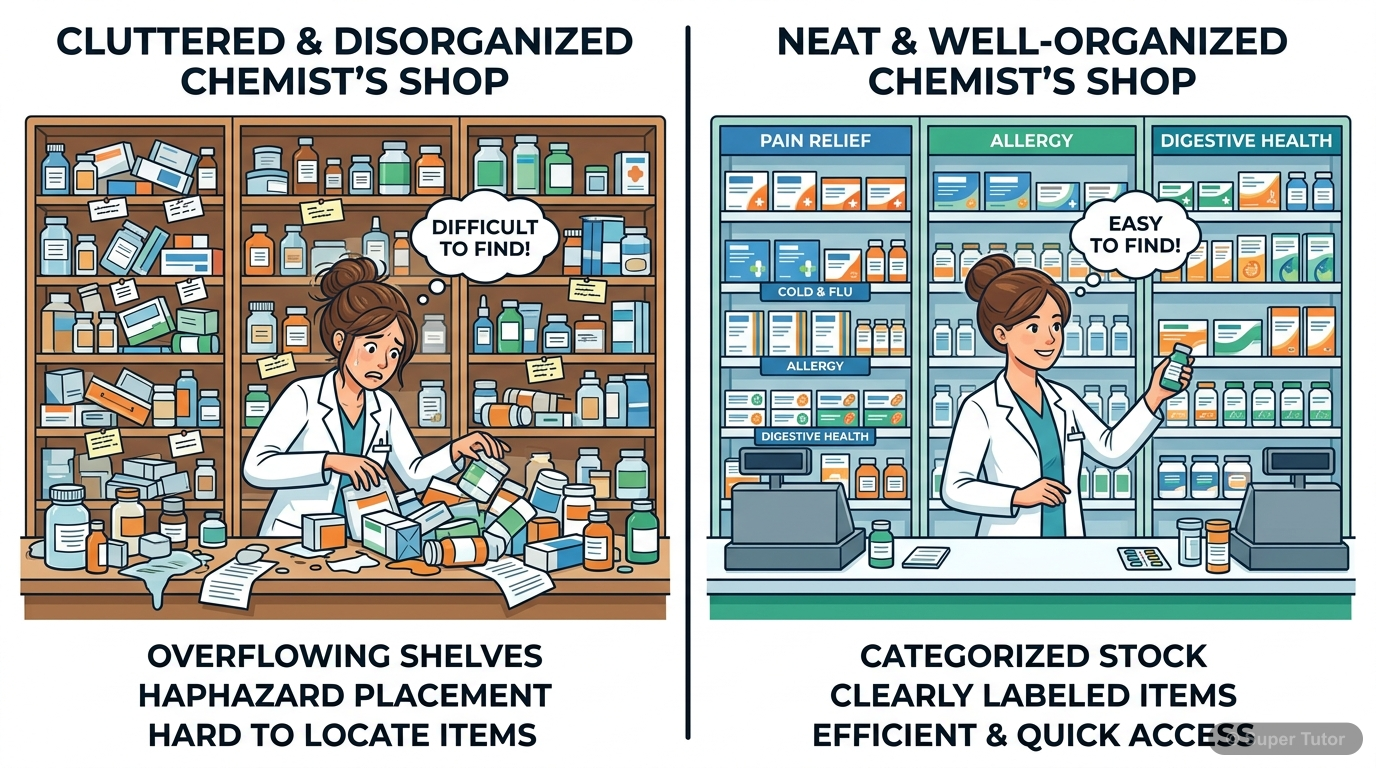
One of 15 illustrations for Periodic Classification of Elements in Super Tutor — alongside flashcards, concept maps and practice questions.
Overview
Periodic classification of elements organizes elements so that similar properties can be studied together. The need for classification became important when nearly 60 elements were known by the middle of the nineteenth century. Early attempts used atomic mass and later atomic number, leading from si
Key Concepts
The first classification of elements
The first classification of elements was into metals and non-metals. This was useful only in a limited way because some elements, such as germanium an
William Prout's work in 1815 showed
William Prout's work in 1815 showed that the atomic mass of an element remains constant, so atomic mass became a possible basis for classification.
In 1829
In 1829, J.W. Dobereiner grouped elements into sets of three called triads. In each triad, the middle element had an atomic mass nearly equal to the a
In 1864
In 1864, John Alexander Newlands arranged elements in increasing order of atomic mass and observed that every eighth element had properties similar to
In 1869
In 1869, D'mitri Mendeleev arranged 63 known elements and their compounds mainly by increasing atomic mass and stated that the chemical and physical p
Learning Objectives
- Describe the development of classification of elements.
- State the main features of Mendeleev's periodic table.
- Explain the defects of Mendeleev's periodic table.
- State the modern periodic law.
- Describe the features of the long form of the periodic table.
Frequently Asked Questions
What are the important topics in Periodic Classification of Elements for NIOS Class 10 Science & Tech?
How should I revise Periodic Classification of Elements for the NIOS Class 10 board exam?
Sources & Official References
Content is aligned to the official syllabus. Refer to the board website for the latest curriculum.
More resources for Periodic Classification of Elements
Practice Quiz
Test yourself with a quick quiz
Important Questions
Exam-style questions with answers
Revision Notes
Key points for last-minute revision
Formula Sheet
The chapter's formulas in one place
Concept Maps
See how topics connect
Study Plan
Step-by-step plan for this chapter
Flashcards
Quick-fire cards for active recall
Syllabus
What topics to cover
For serious students
Get the full Periodic Classification of Elements chapter — start free.
Quizzes, flashcards, an AI doubt solver and a study plan for NIOS Class 10 Science & Tech. Free to start, no card needed.