Matter In Our Surroundinges — Chapter Summary
NIOS · Class 10 · Science & Tech
Summary of Matter In Our Surroundinges for NIOS Class 10 Science & Tech. Part of the NIOS Class 10 Science & Tech syllabus.
Interactive on Super Tutor
Studying Matter In Our Surroundinges? Get the full interactive chapter.
Quizzes, flashcards, AI doubt-solver and a step-by-step study plan — built for chapter summary and more.
Free trial, no card needed.
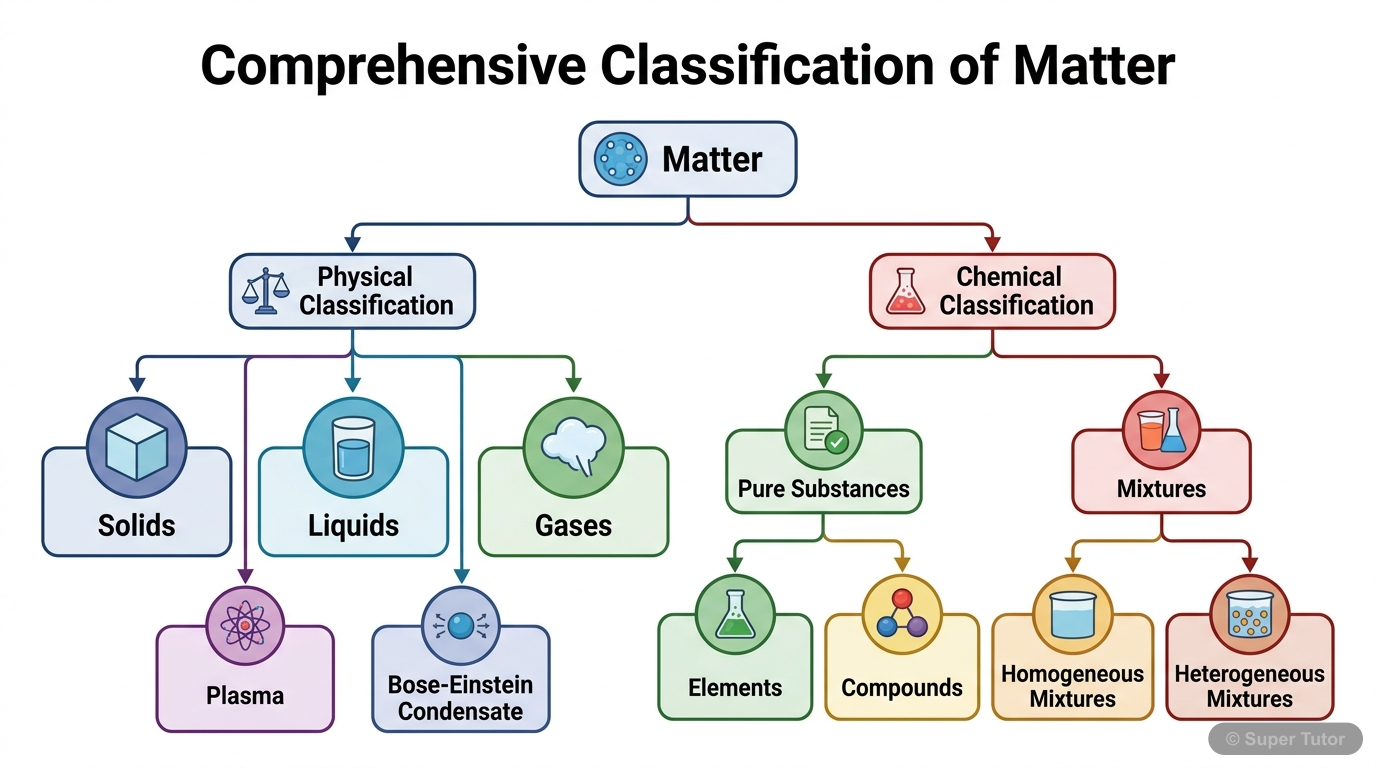
Learn better with visuals Super Tutor pairs illustrations like this with notes and quizzes for Matter In Our Surroundinges.
Overview
Matter is anything that has mass and occupies space. The chapter explains how matter exists around us, how it behaves in different states, how it changes with temperature and pressure, and how it is classified as elements, compounds, and mixtures. It also covers solutions, suspensions, and common me
Key Concepts
Matter is anything that has mass
Matter is anything that has mass and occupies space. All solids, liquids, and gases are matter.
Matter is made of tiny particles
Matter is made of tiny particles. Some ancient thinkers believed matter is continuous, while the atomic view says matter is made of very small indivis
Matter is classified by physical state
Matter is classified by physical state as solid, liquid, or gas. Solid has definite shape and volume, liquid has definite volume but no definite shape
Heating can change solid into liquid
Heating can change solid into liquid and liquid into gas. Cooling can reverse these changes. Pressure has negligible effect on solids and liquids, but
An element is a basic form
An element is a basic form of matter that cannot be chemically broken down. A compound is a pure substance made from two or more elements chemically c
Learning Objectives
- Define matter and describe its particulate nature.
- Differentiate between solid, liquid, and gas.
- Explain the effect of temperature and pressure on states of matter.
- Describe interconversion between solid, liquid, and gas.
- Classify matter as element, compound, or mixture.
Frequently Asked Questions
What are the important topics in Matter In Our Surroundinges for NIOS Class 10 Science & Tech?
How should I revise Matter In Our Surroundinges for the NIOS Class 10 board exam?
Sources & Official References
Content is aligned to the official syllabus. Refer to the board website for the latest curriculum.
More resources for Matter In Our Surroundinges
For serious students
Get the full Matter In Our Surroundinges chapter — start free.
Quizzes, flashcards, an AI doubt solver and a study plan for NIOS Class 10 Science & Tech. Free to start, no card needed.