Control and Coordination — Chapter Summary
NIOS · Class 10 · Science & Tech
Summary of Control and Coordination for NIOS Class 10 Science & Tech. Part of the NIOS Class 10 Science & Tech syllabus.
Interactive on Super Tutor
Studying Control and Coordination? Get the full interactive chapter.
Quizzes, flashcards, AI doubt-solver and a step-by-step study plan — built for chapter summary and more.
Free trial, no card needed.
Learn better with visuals Super Tutor pairs illustrations like this with notes and quizzes for Control and Coordination.
Overview
Control and coordination in the human body are managed mainly by the nervous system and the endocrine system. The nervous system gives quick responses through nerve impulses, while the endocrine system provides slower but long-lasting control through hormones carried in blood. Together, they help th
Key Concepts
A stimulus is an agent
A stimulus is an agent or environmental change that can start a response in the body. Responses may be voluntary, involuntary, or reflex in nature.
A neuron is the basic structural
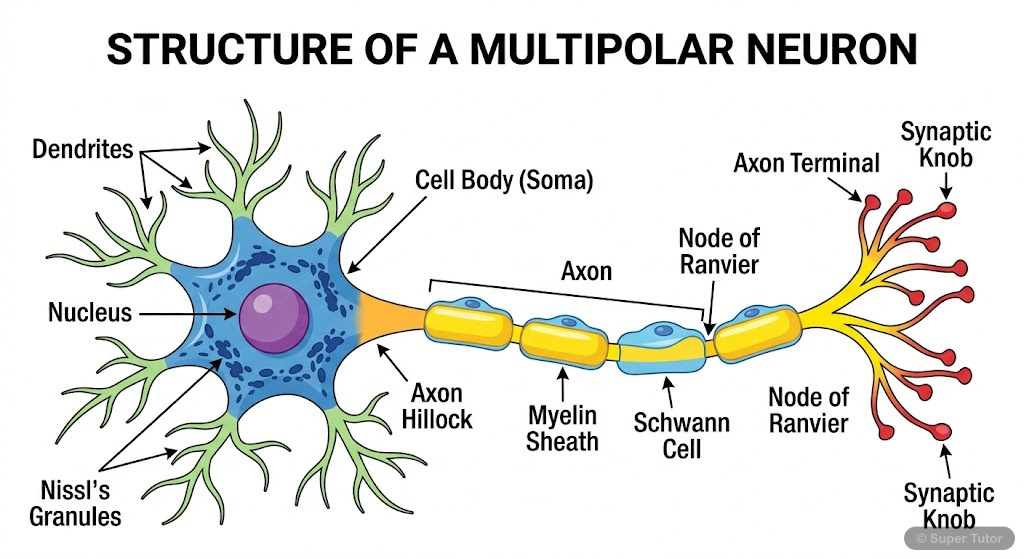
A neuron is the basic structural and functional unit of the nervous system. It has dendrites, a cell body with nucleus and cytoplasm, and an axon that
A synapse is the junction between
A synapse is the junction between two neurons. The impulse passes from one neuron to another through neurotransmitters across the synaptic cleft.
Sensory neurons carry impulses from receptors
Sensory neurons carry impulses from receptors to the central nervous system. Motor neurons carry impulses from the central nervous system to muscles o
Nerves are thread
Nerves are thread-like structures that emerge from the brain and spinal cord. The nervous system has two main divisions: the central nervous system an
Learning Objectives
- Understand the role of the nervous system and endocrine system in body control and coordination.
- Identify the main parts of a neuron and explain how nerve impulses move.
- Describe the structure and functions of the brain and spinal cord.
- Explain reflex action and the reflex arc.
- Distinguish between sensory, motor and association neurons, and between sensory, motor and mixed nerves.
Frequently Asked Questions
What are the important topics in Control and Coordination for NIOS Class 10 Science & Tech?
How should I revise Control and Coordination for the NIOS Class 10 board exam?
Sources & Official References
Content is aligned to the official syllabus. Refer to the board website for the latest curriculum.
More resources for Control and Coordination
For serious students
Get the full Control and Coordination chapter — start free.
Quizzes, flashcards, an AI doubt solver and a study plan for NIOS Class 10 Science & Tech. Free to start, no card needed.