Matter In Our Surroundinges
NIOS · Class 10 · Science & Tech
Most important questions from Matter In Our Surroundinges for NIOS Class 10 Science & Tech board exam 2026. MCQs, short answer, and long answer questions with marks.
Interactive on Super Tutor
Studying Matter In Our Surroundinges? Get the full interactive chapter.
Quizzes, flashcards, AI doubt-solver and a step-by-step study plan — built for important questions and more.
1,000+ Class 10 students started this chapter today
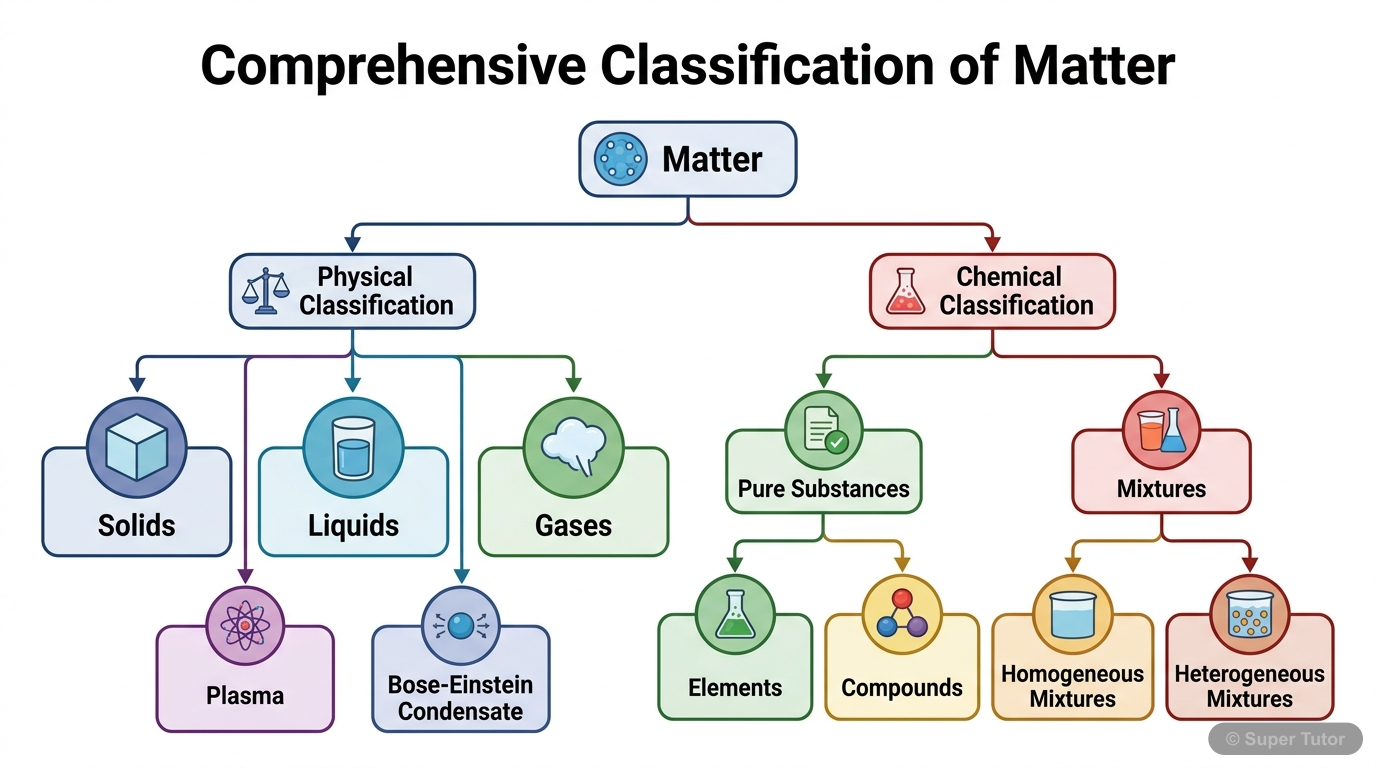
Super Tutor has 9+ illustrations like this for Matter In Our Surroundinges alone — flashcards, concept maps, and step-by-step visuals.
See them allSample Questions
What is a compound?
Show answer
A pure substance made from two or more elements chemically combined
A compound is formed when two or more elements chemically combine in a definite proportion. Step 1: Elements must be chemically bonded together, not just mixed physically. Step 2: The elements combine in a fixed ratio by mass (definite proportion). Step 3: The compound has different properties from the individual elements. Step 4: For example, water (H2O) is a compound of hydrogen and oxygen with completely different properties. Step 5: Mixtures are not compounds as components retain individual properties.
Which method would you use to separate salt from salt water?
Show answer
Evaporation
Evaporation is the best method to separate salt from salt water. Step 1: Salt water is a homogeneous solution where salt is completely dissolved. Step 2: When heated, water evaporates and turns into water vapor. Step 3: Salt has a much higher boiling point than water, so it remains behind as solid crystals. Step 4: This method recovers the salt in solid form while water vapor can be condensed if needed. Step 5: Other methods won't work as salt is completely dissolved and not magnetic.
What is the solvent in a sugar solution?
Show answer
Water
In a sugar solution, water is the solvent and sugar is the solute. Step 1: A solution has two components - solute and solvent. Step 2: The solute is the substance that gets dissolved (sugar in this case). Step 3: The solvent is the substance that does the dissolving (water in this case). Step 4: Generally, the component present in larger quantity is the solvent. Step 5: Water is called the universal solvent because it dissolves many substances.
Which state of matter is highly compressible?
Show answer
Gas
Gases are highly compressible due to large spaces between particles. Step 1: In gases, particles are far apart with weak intermolecular forces. Step 2: Large spaces between particles allow them to be pushed closer together when pressure is applied. Step 3: This is why we can compress natural gas for CNG and cooking gas for LPG cylinders. Step 4: Solids and liquids have particles close together, making compression difficult. Step 5: This property of gases makes them useful for storage and transportation.
+40 more questions available
Practice AllFrequently Asked Questions
What are the important topics in Matter In Our Surroundinges for NIOS Class 10 Science & Tech?
How to score full marks in Matter In Our Surroundinges — NIOS Class 10 Science & Tech?
How many important questions are there in Matter In Our Surroundinges?
Sources & Official References
Content is aligned to the official syllabus. Refer to the board website for the latest curriculum.
More resources for Matter In Our Surroundinges
Practice Quiz
Test yourself with a quick quiz
Revision Notes
Key points for last-minute revision
Formula Sheet
All formulas in one place
Chapter Summary
Understand the chapter at a glance
Concept Maps
See how topics connect visually
Study Plan
Step-by-step plan to ace this chapter
Flashcards
Quick-fire cards for active recall
Syllabus
What topics to cover
NCERT Solutions
Every textbook question solved step by step
For serious students
Get the full Matter In Our Surroundinges chapter — for free.
Quizzes, flashcards, AI doubt-solver and a step-by-step study plan for NIOS Class 10 Science & Tech.