Periodic Classification of Elements
NIOS · Class 10 · Science & Tech
Most important questions from Periodic Classification of Elements for NIOS Class 10 Science & Tech board exam 2026. MCQs, short answer, and long answer questions with marks.
Interactive on Super Tutor
Studying Periodic Classification of Elements? Get the full interactive chapter.
Quizzes, flashcards, AI doubt-solver and a step-by-step study plan — built for important questions and more.
1,000+ Class 10 students started this chapter today
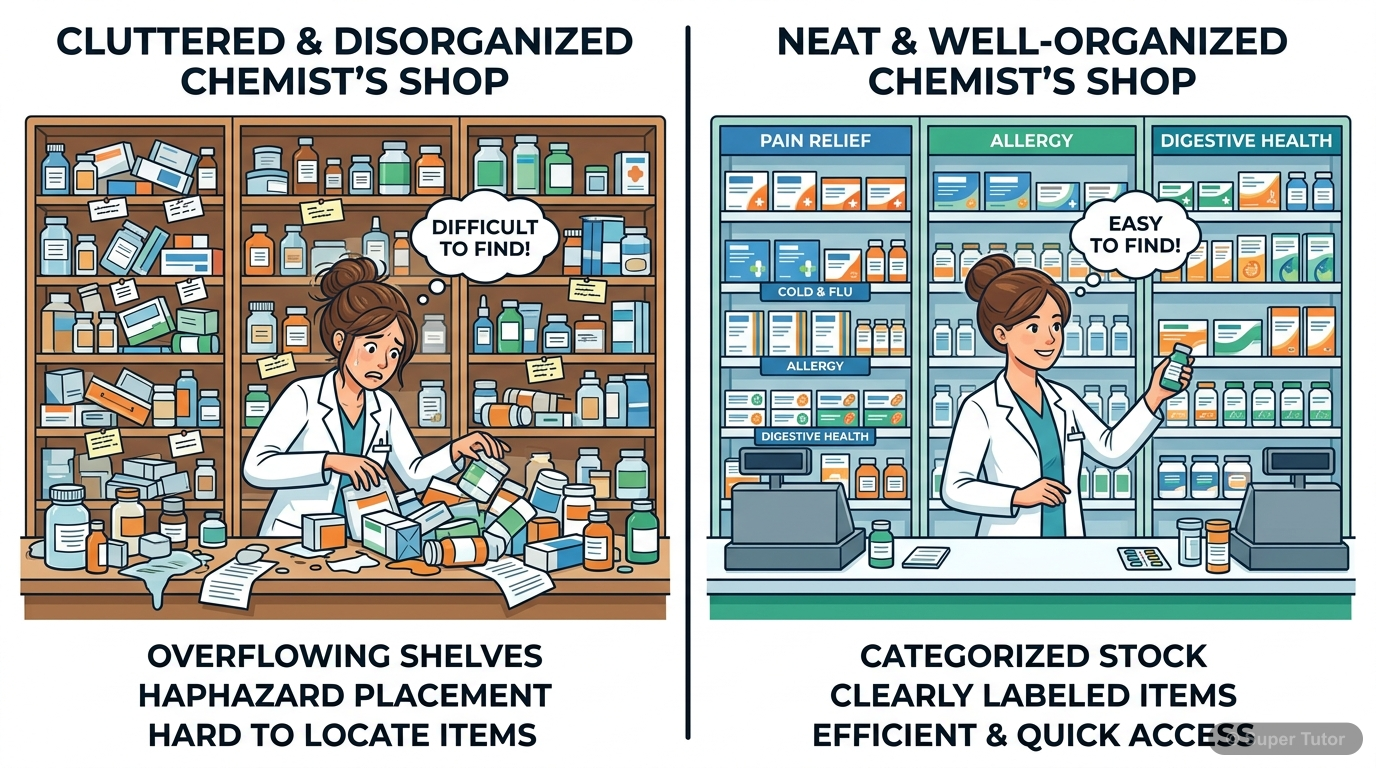
Super Tutor has 15+ illustrations like this for Periodic Classification of Elements alone — flashcards, concept maps, and step-by-step visuals.
See them allSample Questions
How many groups are there in the modern periodic table?
Show answer
18
Step 1: The modern periodic table has 18 vertical columns called groups. Step 2: Groups are numbered from 1 to 18 using Arabic numerals. Step 3: Elements in the same group have the same number of valence electrons. Step 4: This is different from Mendeleev's table which had 8 groups with subgroups A and B.
Which period contains only 2 elements?
Show answer
First period
Step 1: The first period contains only hydrogen (H) and helium (He). Step 2: This is the shortest period in the periodic table. Step 3: Second and third periods have 8 elements each (short periods). Step 4: Fourth and fifth periods have 18 elements each (long periods).
What happens to atomic size as we move from left to right in a period?
Show answer
Decreases
Step 1: As we move left to right in a period, nuclear charge increases. Step 2: More protons in the nucleus attract electrons more strongly. Step 3: Electrons are pulled closer to the nucleus, reducing atomic size. Step 4: This trend is observed in all periods, for example, Li > Be > B > C in period 2.
Which group contains alkali metals?
Show answer
Group 1
Step 1: Group 1 elements (except hydrogen) are called alkali metals. Step 2: These include lithium (Li), sodium (Na), potassium (K), rubidium (Rb), cesium (Cs), and francium (Fr). Step 3: They all have one valence electron and are highly reactive. Step 4: Group 2 has alkaline earth metals, Group 17 has halogens, and Group 18 has noble gases.
+40 more questions available
Practice AllFrequently Asked Questions
What are the important topics in Periodic Classification of Elements for NIOS Class 10 Science & Tech?
How to score full marks in Periodic Classification of Elements — NIOS Class 10 Science & Tech?
How many important questions are there in Periodic Classification of Elements?
Sources & Official References
Content is aligned to the official syllabus. Refer to the board website for the latest curriculum.
More resources for Periodic Classification of Elements
Practice Quiz
Test yourself with a quick quiz
Revision Notes
Key points for last-minute revision
Formula Sheet
All formulas in one place
Chapter Summary
Understand the chapter at a glance
Concept Maps
See how topics connect visually
Study Plan
Step-by-step plan to ace this chapter
Flashcards
Quick-fire cards for active recall
Syllabus
What topics to cover
NCERT Solutions
Every textbook question solved step by step
For serious students
Get the full Periodic Classification of Elements chapter — for free.
Quizzes, flashcards, AI doubt-solver and a step-by-step study plan for NIOS Class 10 Science & Tech.