Atoms and Molecules — Flashcards
NIOS · Class 10 · Science & Tech
42 flashcards for Atoms and Molecules (NIOS Class 10 Science & Tech) to test yourself on key terms and facts. Sample: "What is the law of conservation.
Interactive on Super Tutor
Studying Atoms and Molecules? Get the full interactive chapter.
Quizzes, flashcards, AI doubt-solver and a step-by-step study plan — built for flashcards and more.
Free trial, no card needed.
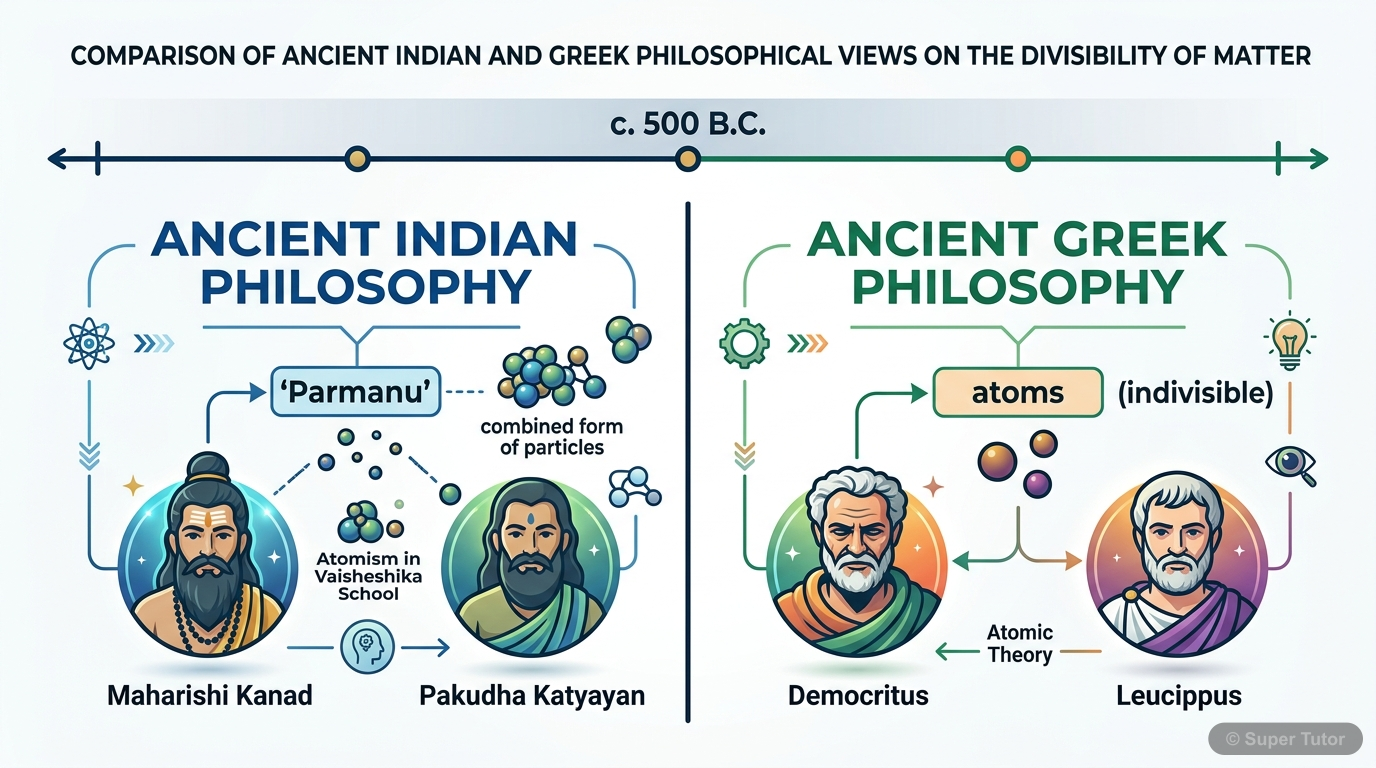
One of 13 illustrations for Atoms and Molecules in Super Tutor — alongside flashcards, concept maps and practice questions.
What is the law of conservation of mass?
Answer
In every chemical reaction, the total mass of reactants is equal to the total mass of products. Lavoisier established this by heating mercury in a sealed flask and comparing the masses before and afte…
What is the law of definite or constant proportions?
Answer
A pure compound always contains the same elements combined in the same fixed proportion by mass, no matter where it comes from or how it is prepared. For example, pure water always has hydrogen and ox…
Why does pure water always have hydrogen and oxygen in the ratio 1:8 by mass?
Answer
Because water is a pure compound with a fixed composition. Its mass composition is always 11.11% hydrogen and 88.89% oxygen, so the mass ratio of hydrogen to oxygen remains 1:8.
A sample of water gives 9.0 g on decomposition. How much hydrogen and oxygen are present?
Answer
In pure water, hydrogen and oxygen are in the mass ratio 1:8. So 9.0 g of water contains 1.0 g hydrogen and 8.0 g oxygen.
What did Lavoisier conclude from his mercury heating experiment?
Answer
He concluded that total mass remains unchanged in a chemical reaction. When mercury was heated in air, mercury(II) oxide formed, and on strong heating it broke into mercury and oxygen. The mass of pro…
How did Proust support the law of constant proportions?
Answer
Proust showed that a given compound always has a fixed composition by mass. He demonstrated this in 1808 for compounds such as pure water and sodium chloride.
What is Dalton's atomic theory?
Answer
Dalton arranged earlier ideas into a theory in 1803. Its main postulates are: matter consists of indivisible atoms; atoms of the same element are identical in mass and properties; atoms of different e…
Why did Dalton's theory help explain chemical laws?
Answer
It explained the law of conservation of mass because atoms are rearranged, not created or destroyed in a reaction. It also explained the law of constant proportions because atoms combine in fixed whol…
+34 more flashcards
Practise AllFrequently Asked Questions
What are the important topics in Atoms and Molecules for NIOS Class 10 Science & Tech?
How many flashcards are available for Atoms and Molecules?
How should I revise Atoms and Molecules for the NIOS Class 10 board exam?
Sources & Official References
Content is aligned to the official syllabus. Refer to the board website for the latest curriculum.
More resources for Atoms and Molecules
Practice Quiz
Test yourself with a quick quiz
Important Questions
Exam-style questions with answers
Revision Notes
Key points for last-minute revision
Formula Sheet
The chapter's formulas in one place
Chapter Summary
Understand the chapter at a glance
Concept Maps
See how topics connect
Study Plan
Step-by-step plan for this chapter
Syllabus
What topics to cover
For serious students
Get the full Atoms and Molecules chapter — start free.
Quizzes, flashcards, an AI doubt solver and a study plan for NIOS Class 10 Science & Tech. Free to start, no card needed.