Atoms and Molecules
NIOS · Class 10 · Science & Tech
Most important questions from Atoms and Molecules for NIOS Class 10 Science & Tech board exam 2026. MCQs, short answer, and long answer questions with marks.
Interactive on Super Tutor
Studying Atoms and Molecules? Get the full interactive chapter.
Quizzes, flashcards, AI doubt-solver and a step-by-step study plan — built for important questions and more.
1,000+ Class 10 students started this chapter today
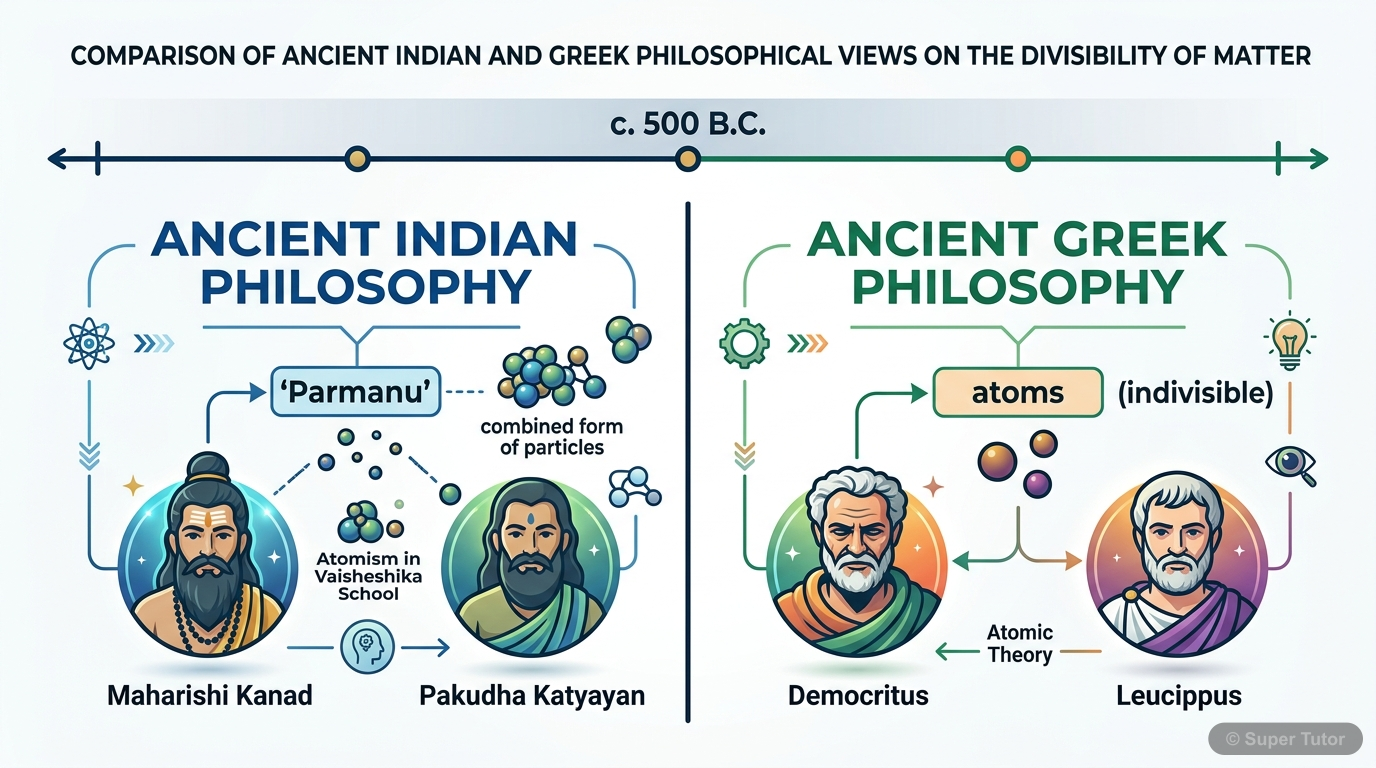
Learn better with visuals Super Tutor has hundreds of illustrations like this across every chapter — all free to try.
Get startedSample Questions
How many atoms are present in exactly 12 grams of carbon-12?
Show answer
6.02 × 10²³
Step 1: The mole is defined as the amount of substance containing as many particles as there are atoms in exactly 12g of carbon-12. Step 2: This number of atoms in 12g of carbon-12 is experimentally determined to be 6.02 × 10²³. Step 3: This number is called Avogadro's number and represents one mole of any substance. Step 4: Therefore, exactly 12g of carbon-12 contains 6.02 × 10²³ atoms by definition. Other options are either too large or too small for this fundamental constant.
What is the valency of oxygen?
Show answer
2
Step 1: Valency is the combining capacity of an element with other elements. Step 2: Oxygen typically forms two bonds with other atoms to achieve a stable configuration. Step 3: In compounds like H2O, oxygen combines with 2 hydrogen atoms, and in CO2, oxygen needs 2 bonds with carbon. Step 4: Therefore, oxygen has a valency of 2. Valencies of 1, 3, or 4 would not match oxygen's typical bonding pattern in common compounds.
Which of the following represents isotopes of hydrogen?
Show answer
¹H, ²H, ³H
Step 1: Isotopes are atoms of the same element with the same atomic number but different mass numbers. Step 2: Hydrogen has atomic number 1 (1 proton) but can have different numbers of neutrons. Step 3: ¹H (protium) has 0 neutrons, ²H (deuterium) has 1 neutron, and ³H (tritium) has 2 neutrons. Step 4: All have 1 proton, making them hydrogen isotopes. H, He, Li are different elements; H⁺, H⁻, H are ions and atom; H₂, H₃, H₄ represent molecules, not isotopes.
What is the mass number of an atom?
Show answer
Number of protons + neutrons
Step 1: Mass number (A) represents the total number of particles in the nucleus of an atom. Step 2: The nucleus contains only protons and neutrons, which are called nucleons. Step 3: Both protons and neutrons have approximately the same mass (about 1 atomic mass unit each). Step 4: Therefore, mass number = number of protons + number of neutrons. Electrons have negligible mass compared to nucleons and are not included in mass number calculation.
+89 more questions available
Practice AllFrequently Asked Questions
What are the important topics in Atoms and Molecules for NIOS Class 10 Science & Tech?
How to score full marks in Atoms and Molecules — NIOS Class 10 Science & Tech?
How many important questions are there in Atoms and Molecules?
Sources & Official References
Content is aligned to the official syllabus. Refer to the board website for the latest curriculum.
More resources for Atoms and Molecules
Practice Quiz
Test yourself with a quick quiz
Revision Notes
Key points for last-minute revision
Formula Sheet
All formulas in one place
Chapter Summary
Understand the chapter at a glance
Concept Maps
See how topics connect visually
Study Plan
Step-by-step plan to ace this chapter
Flashcards
Quick-fire cards for active recall
Syllabus
What topics to cover
NCERT Solutions
Every textbook question solved step by step
For serious students
Get the full Atoms and Molecules chapter — for free.
Quizzes, flashcards, AI doubt-solver and a step-by-step study plan for NIOS Class 10 Science & Tech.