Gravitation — Chapter Summary
NIOS · Class 12 · Physics
Summary of Gravitation for NIOS Class 12 Physics. Key concepts: Every particle in the universe, The acceleration produced and At a height h above Earth's.
Interactive on Super Tutor
Studying Gravitation? Get the full interactive chapter.
Quizzes, flashcards, AI doubt-solver and a step-by-step study plan — built for chapter summary and more.
Free trial, no card needed.
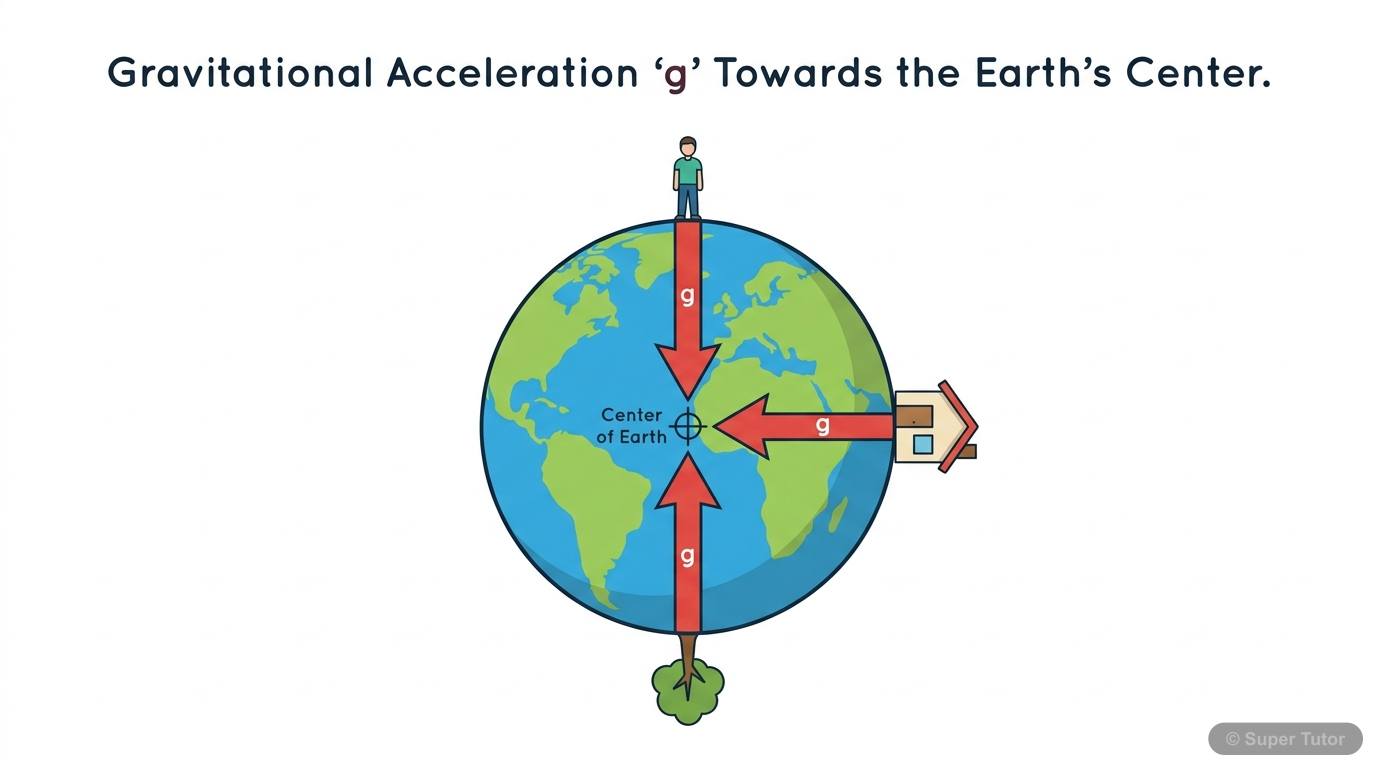
An illustration from Super Tutor's Gravitation chapter — alongside flashcards, concept maps and practice questions.
Overview
Gravitation is one of the most fundamental forces in nature. Every object in the universe attracts every other object — this is the essence of Newton's Universal Law of Gravitation. From the apple falling from a tree to the moon orbiting the Earth, and from planets revolving around the Sun to artifi
Key Concepts
Every particle in the universe attracts
Every particle in the universe attracts every other particle with a force that is directly proportional to the product of their masses and inversely p
The acceleration produced in a body
The acceleration produced in a body due to the gravitational pull of the Earth is called acceleration due to gravity (g). Using Newton's Second Law (F
At a height h above Earth's
At a height h above Earth's surface, the distance from Earth's centre becomes (R + h). Therefore: g_h = GM/(R+h)² = g/(1 + h/R)². For small heights (h
At a depth d below Earth's
At a depth d below Earth's surface, a particle is attracted only by the inner sphere of radius (R - d), as the gravitational effect of the outer shell
Earth rotates about its axis
Earth rotates about its axis, so every point on its surface (except poles) undergoes circular motion. A portion of gravity is used as centripetal forc
Learning Objectives
- State and apply Newton's Universal Law of Gravitation with its mathematical form F = Gm₁m₂/r²
- Calculate the acceleration due to gravity (g) at the surface of the Earth and other celestial bodies using g = GM/R²
- Analyse how the value of g varies with altitude (height), depth below Earth's surface, and latitude
- Distinguish clearly between gravitational potential (V = -GM/r) and gravitational potential energy (U = -GMm/r)
- Differentiate between mass and weight, and understand why weight varies while mass remains constant
Frequently Asked Questions
What are the important topics in Gravitation for NIOS Class 12 Physics?
How should I revise Gravitation for the NIOS Class 12 board exam?
Sources & Official References
Content is aligned to the official syllabus. Refer to the board website for the latest curriculum.
More resources for Gravitation
Practice Quiz
Test yourself with a quick quiz
Important Questions
Exam-style questions with answers
Revision Notes
Key points for last-minute revision
Formula Sheet
The chapter's formulas in one place
Concept Maps
See how topics connect
Study Plan
Step-by-step plan for this chapter
Flashcards
Quick-fire cards for active recall
Syllabus
What topics to cover
For serious students
Get the full Gravitation chapter — start free.
Quizzes, flashcards, an AI doubt solver and a study plan for NIOS Class 12 Physics. Free to start, no card needed.