Semiconductors and Semiconducting Devices — Flashcards
NIOS · Class 12 · Physics
30 flashcards for Semiconductors and Semiconducting Devices (NIOS Class 12 Physics) to test yourself on key terms and facts.
Interactive on Super Tutor
Studying Semiconductors and Semiconducting Devices? Get the full interactive chapter.
Quizzes, flashcards, AI doubt-solver and a step-by-step study plan — built for flashcards and more.
Free trial, no card needed.
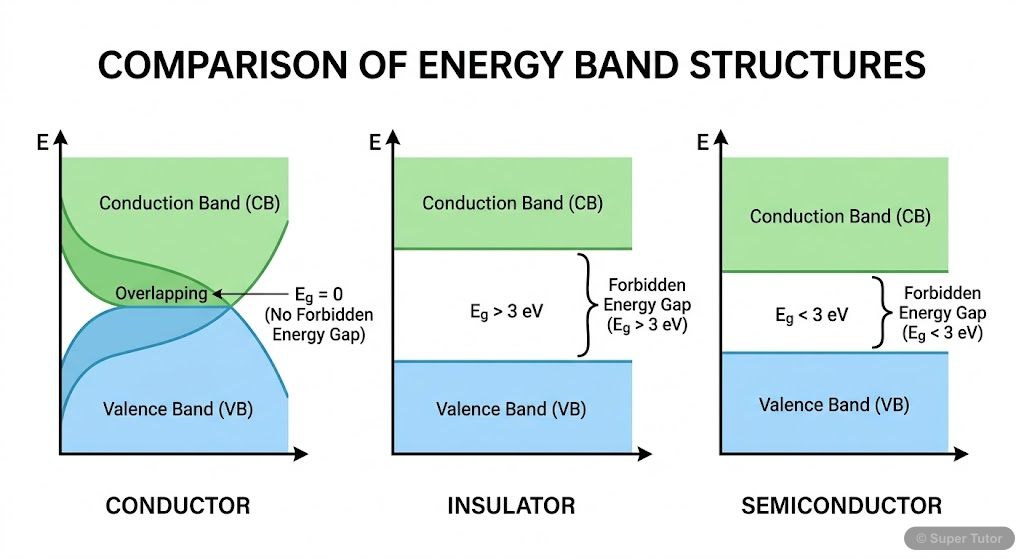
One of 12 illustrations for Semiconductors and Semiconducting Devices in Super Tutor — alongside flashcards, concept maps and practice questions.
What is an energy band in a solid? Why does it form?
Answer
In an isolated atom, electrons occupy discrete energy levels. When ~10²³ atoms come together to form a solid, each energy level splits into a large number of very closely spaced levels (spacing ~10⁻²³…
On the basis of energy bands, how are solids classified as conductors, semiconductors, and insulators?
Answer
Classification based on energy bands: 1. CONDUCTORS (Metals): • CB and VB overlap (no band gap) • Electrons are freely available for conduction at all temperatures • Example: Copper, Silver …
What is an intrinsic semiconductor? Describe the role of temperature in its conductivity.
Answer
INTRINSIC SEMICONDUCTOR: A pure semiconductor with no impurity added. Examples: Pure Silicon (Si), Pure Germanium (Ge) At 0 K (Absolute Zero): • All valence electrons are tightly held in covalent bon…
Pure silicon at 300 K has an intrinsic carrier concentration of 1.5 × 10¹⁶ m⁻³. Find the concentration of (a) electrons and (b) holes.
Answer
GIVEN: Intrinsic carrier concentration, ni = 1.5 × 10¹⁶ m⁻³ FIND: Electron concentration (ne) and hole concentration (nh) FORMULA & PRINCIPLE: In an intrinsic semiconductor, electron-hole pairs are …
What is doping? Distinguish between n-type and p-type extrinsic semiconductors.
Answer
DOPING: The process of deliberately adding a small, measured amount of impurity atoms (called dopants) to a pure semiconductor to increase its conductivity. • Dopant amount: ~1 impurity atom per 10⁸ s…
Why is an n-type semiconductor electrically neutral even though it has extra free electrons?
Answer
COMMON MISCONCEPTION: n-type semiconductor is negatively charged because it has more electrons. CORRECT EXPLANATION: When a pentavalent atom (e.g., Phosphorus) is added to Silicon: 1. The phosphorus…
Explain the formation of a p-n junction and the depletion region.
Answer
FORMATION OF p-n JUNCTION: When donor impurities are introduced on one side and acceptor impurities on the other side of a single semiconductor crystal, a p-n junction is formed. STEP-BY-STEP PROCESS…
Differentiate between forward bias and reverse bias of a p-n junction diode.
Answer
FORWARD BIAS: • Connection: +ve terminal of battery → p-side; −ve terminal → n-side • Effect on depletion region: WIDTH DECREASES (barrier reduced) • Barrier potential: External voltage opposes it → r…
+22 more flashcards
Practise AllFrequently Asked Questions
What are the important topics in Semiconductors and Semiconducting Devices for NIOS Class 12 Physics?
How many flashcards are available for Semiconductors and Semiconducting Devices?
How should I revise Semiconductors and Semiconducting Devices for the NIOS Class 12 board exam?
Sources & Official References
Content is aligned to the official syllabus. Refer to the board website for the latest curriculum.
More resources for Semiconductors and Semiconducting Devices
Practice Quiz
Test yourself with a quick quiz
Important Questions
Exam-style questions with answers
Revision Notes
Key points for last-minute revision
Formula Sheet
The chapter's formulas in one place
Chapter Summary
Understand the chapter at a glance
Concept Maps
See how topics connect
Study Plan
Step-by-step plan for this chapter
Syllabus
What topics to cover
For serious students
Get the full Semiconductors and Semiconducting Devices chapter — start free.
Quizzes, flashcards, an AI doubt solver and a study plan for NIOS Class 12 Physics. Free to start, no card needed.