Semiconductors and Semiconducting Devices — Chapter Summary
NIOS · Class 12 · Physics
Summary of Semiconductors and Semiconducting Devices for NIOS Class 12 Physics. Part of the NIOS Class 12 Physics syllabus.
Interactive on Super Tutor
Studying Semiconductors and Semiconducting Devices? Get the full interactive chapter.
Quizzes, flashcards, AI doubt-solver and a step-by-step study plan — built for chapter summary and more.
Free trial, no card needed.
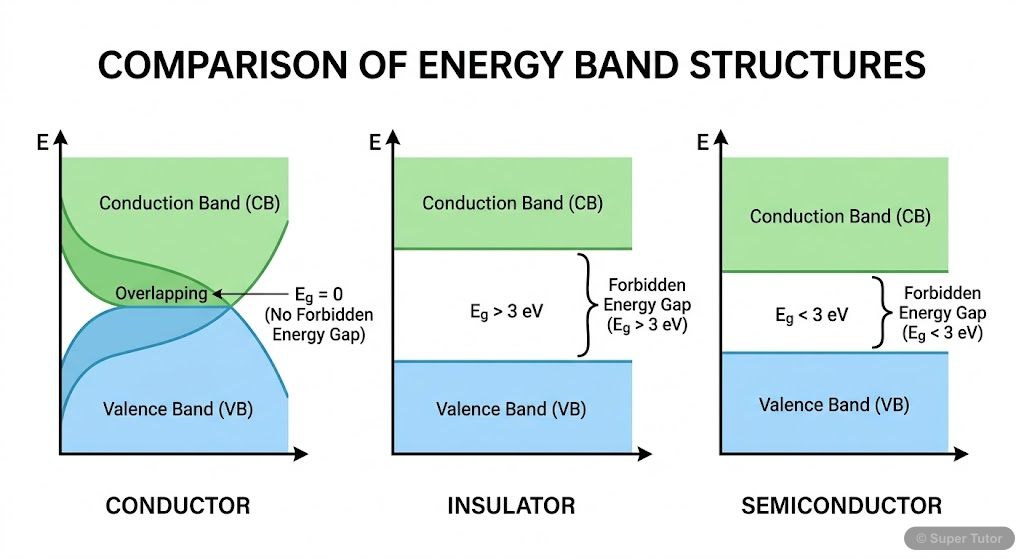
One of 12 illustrations for Semiconductors and Semiconducting Devices in Super Tutor — alongside flashcards, concept maps and practice questions.
Overview
Semiconductors form the backbone of modern electronics — from the smartphone in your pocket to the satellites orbiting Earth. This chapter explores how materials like Silicon (Si) and Germanium (Ge) have electrical conductivity that lies between conductors and insulators. By understanding energy ban
Key Concepts
In an isolated atom
In an isolated atom, electrons occupy discrete energy levels. When a very large number of atoms (~10²³ per cm³) come together to form a solid, these d
A pure semiconductor (like pure Si
A pure semiconductor (like pure Si or Ge) is called an intrinsic semiconductor. At absolute zero (0 K), all valence electrons are tightly bound in cov
To improve and control the conductivity
To improve and control the conductivity of a semiconductor, a small and controlled amount of impurity atoms is added to the pure semiconductor. This p
A p
A p-n junction is formed when one side of a single semiconductor crystal is doped to be p-type and the other side is doped to be n-type. At the moment
Biasing means applying an external voltage
Biasing means applying an external voltage to the p-n junction. FORWARD BIAS: Positive terminal of battery connected to p-side, negative terminal to n
Learning Objectives
- Explain the concept of energy bands and use them to classify solids as conductors, insulators, and semiconductors
- Differentiate between intrinsic and extrinsic semiconductors, and between n-type and p-type semiconductors
- Explain the formation of the depletion region and barrier potential in a p-n junction diode
- Describe the I-V characteristics of a p-n junction diode under forward and reverse bias
- Describe special diodes — Zener diode, LED, photodiode, and solar cell — along with their I-V characteristics and applications
Frequently Asked Questions
What are the important topics in Semiconductors and Semiconducting Devices for NIOS Class 12 Physics?
How should I revise Semiconductors and Semiconducting Devices for the NIOS Class 12 board exam?
Sources & Official References
Content is aligned to the official syllabus. Refer to the board website for the latest curriculum.
More resources for Semiconductors and Semiconducting Devices
Practice Quiz
Test yourself with a quick quiz
Important Questions
Exam-style questions with answers
Revision Notes
Key points for last-minute revision
Formula Sheet
The chapter's formulas in one place
Concept Maps
See how topics connect
Study Plan
Step-by-step plan for this chapter
Flashcards
Quick-fire cards for active recall
Syllabus
What topics to cover
For serious students
Get the full Semiconductors and Semiconducting Devices chapter — start free.
Quizzes, flashcards, an AI doubt solver and a study plan for NIOS Class 12 Physics. Free to start, no card needed.