Work, Energy and Power — Chapter Summary
NIOS · Class 12 · Physics
Summary of Work, Energy and Power for NIOS Class 12 Physics. Key concepts: In Physics, When force varies and Power is defined as the rate.
Interactive on Super Tutor
Studying Work, Energy and Power? Get the full interactive chapter.
Quizzes, flashcards, AI doubt-solver and a step-by-step study plan — built for chapter summary and more.
Free trial, no card needed.
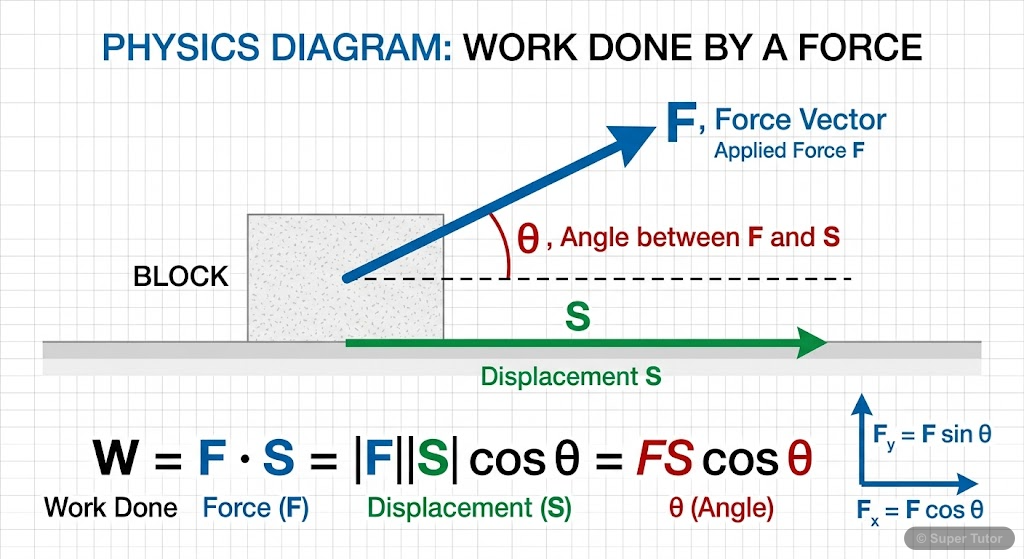
One of 3 illustrations for Work, Energy and Power in Super Tutor — alongside flashcards, concept maps and practice questions.
Overview
Work, Energy and Power are three of the most fundamental and interconnected concepts in Physics. In our daily life, we use the word 'work' loosely — studying, lifting, pushing — but in Physics, work has a very precise and specific meaning. This chapter builds on Newton's Laws of Motion and introduce
Key Concepts
In Physics
In Physics, work is done when a force causes displacement. If a constant force F acts on an object and produces a displacement d, and the angle betwee
When force varies with position (like
When force varies with position (like a spring force), we cannot directly use W = Fd cosθ. Instead, we divide the path into tiny intervals Δx where fo
Power is defined as the rate
Power is defined as the rate at which work is done. Average Power: P = ΔW/Δt. Instantaneous Power: P = dW/dt = F·v (force times instantaneous velocity
Kinetic Energy (KE) is the energy
Kinetic Energy (KE) is the energy possessed by an object due to its motion: KE = ½mv². Derivation: Using Newton's second law F = ma and the equation o
Potential Energy is energy stored by
Potential Energy is energy stored by virtue of an object's position or configuration. Gravitational Potential Energy: When a mass m is lifted through
Learning Objectives
- Define work done by a constant and variable force, and calculate it using the formula W = Fd cosθ
- Understand and apply the concept of work done by a spring using Hooke's Law: W = ½kx²
- Define power and calculate average and instantaneous power; convert between watt, kilowatt, horse power, and kWh
- State and apply the Work-Energy Theorem: Work done = Change in Kinetic Energy
- Understand kinetic energy and derive the formula KE = ½mv²
Frequently Asked Questions
What are the important topics in Work, Energy and Power for NIOS Class 12 Physics?
How should I revise Work, Energy and Power for the NIOS Class 12 board exam?
Sources & Official References
Content is aligned to the official syllabus. Refer to the board website for the latest curriculum.
More resources for Work, Energy and Power
Practice Quiz
Test yourself with a quick quiz
Important Questions
Exam-style questions with answers
Revision Notes
Key points for last-minute revision
Formula Sheet
The chapter's formulas in one place
Concept Maps
See how topics connect
Study Plan
Step-by-step plan for this chapter
Flashcards
Quick-fire cards for active recall
Syllabus
What topics to cover
For serious students
Get the full Work, Energy and Power chapter — start free.
Quizzes, flashcards, an AI doubt solver and a study plan for NIOS Class 12 Physics. Free to start, no card needed.