Work, Energy and Power — Revision Notes
NIOS · Class 12 · Physics
Work, Energy and Power revision notes for NIOS Class 12 Physics: 4 topics in quick points. Part of the NIOS Class 12 Physics syllabus.
Interactive on Super Tutor
Studying Work, Energy and Power? Get the full interactive chapter.
Quizzes, flashcards, AI doubt-solver and a step-by-step study plan — built for revision notes and more.
Free trial, no card needed.
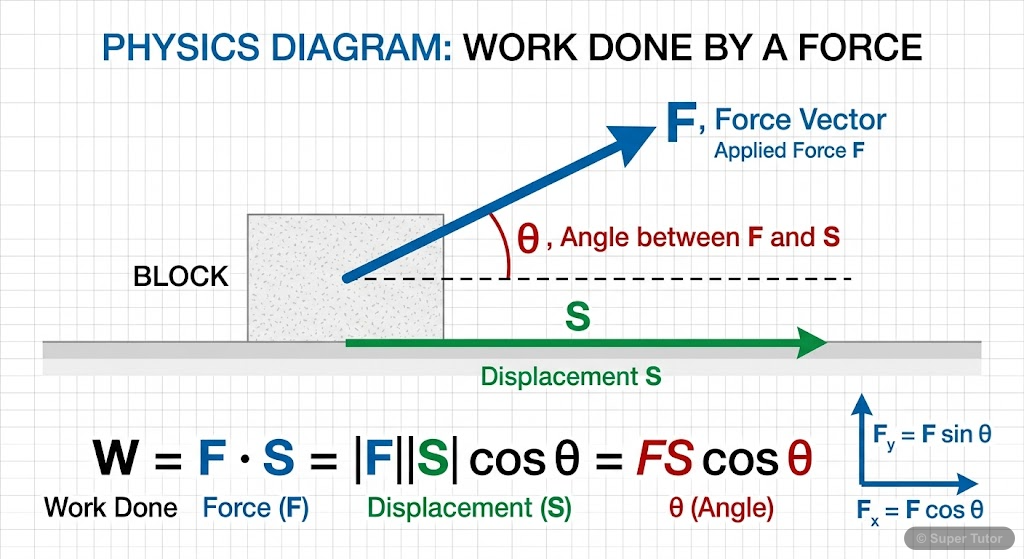
One of 3 illustrations for Work, Energy and Power in Super Tutor — alongside flashcards, concept maps and practice questions.
Key Topics to Revise
1. Work – Scientific Definition and Formula
- In science, work is done only when a force causes displacement in the object it acts upon. Thinking hard, holding a heavy bag stationary, or pushing a wall – none of these count as work in physics bec
- Work is a SCALAR quantity – it has magnitude but no direction, even though both force and displacement are vectors.
- Work = (Component of force along displacement) × (Displacement) = F cos θ × d
2. Power – Rate of Doing Work
- Power tells us HOW FAST work is being done. Two engines doing the same work may differ in the time they take – the faster one is more powerful.
- Power is a SCALAR quantity.
- Average Power = Total Work Done / Total Time Taken.
3. Kinetic Energy and the Work-Energy Theorem
- Kinetic Energy (KE) is the energy possessed by an object due to its motion. KE = ½mv².
- KE is always POSITIVE (mass is positive, v² is always positive). It can never be negative.
- KE is a scalar quantity.
4. Potential Energy – Gravitational and Elastic
- Potential Energy (PE) is the energy possessed by an object due to its position or configuration. It is stored energy that can be converted to KE.
- Two types: (1) Gravitational PE – due to height in gravitational field. (2) Elastic PE – due to deformation of elastic objects like springs.
- Gravitational PE = mgh, where h is the height above a chosen reference level (usually ground level). The reference level is ARBITRARY.
Get complete notes with diagrams and examples
Full NotesKey Concepts
Frequently Asked Questions
What are the important topics in Work, Energy and Power for NIOS Class 12 Physics?
How should I revise Work, Energy and Power for the NIOS Class 12 board exam?
Sources & Official References
Content is aligned to the official syllabus. Refer to the board website for the latest curriculum.
More resources for Work, Energy and Power
Practice Quiz
Test yourself with a quick quiz
Important Questions
Exam-style questions with answers
Formula Sheet
The chapter's formulas in one place
Chapter Summary
Understand the chapter at a glance
Concept Maps
See how topics connect
Study Plan
Step-by-step plan for this chapter
Flashcards
Quick-fire cards for active recall
Syllabus
What topics to cover
For serious students
Get the full Work, Energy and Power chapter — start free.
Quizzes, flashcards, an AI doubt solver and a study plan for NIOS Class 12 Physics. Free to start, no card needed.