Motion in a Straight Line — Revision Notes
NIOS · Class 12 · Physics
Motion in a Straight Line revision notes for NIOS Class 12 Physics: 4 topics in quick points. Part of the NIOS Class 12 Physics syllabus.
Interactive on Super Tutor
Studying Motion in a Straight Line? Get the full interactive chapter.
Quizzes, flashcards, AI doubt-solver and a step-by-step study plan — built for revision notes and more.
Free trial, no card needed.
Learn better with visuals Super Tutor pairs illustrations like this with notes and quizzes for Motion in a Straight Line.
Key Topics to Revise
Distance, Displacement, Speed, and Velocity
- Distance is the total length of the path covered by a body. It is a scalar quantity (only magnitude, no direction).
- Displacement is the shortest distance between the initial and final positions of a body, measured in a specific direction. It is a vector quantity.
- For 1D motion, the direction of displacement, velocity, and acceleration is indicated using + and − signs. No vector notation is needed.
Position-Time Graphs
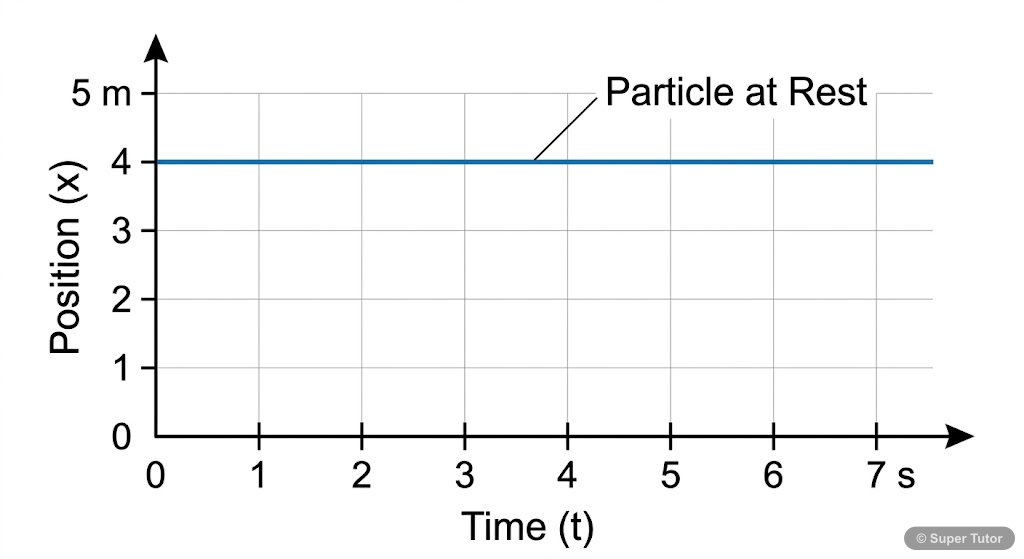
- A position-time (x-t) graph plots the position of a body on the y-axis against time on the x-axis.
- For a body at rest: the graph is a horizontal straight line parallel to the time axis (slope = 0, velocity = 0).
- For uniform motion (constant velocity): the graph is a straight line inclined to the time axis. Greater slope = greater velocity.
Velocity-Time Graphs
- A velocity-time (v-t) graph plots the velocity of a body on the y-axis against time on the x-axis.
- For uniform motion (zero acceleration): v-t graph is a straight horizontal line parallel to the time axis.
- For uniform acceleration (constant acceleration): v-t graph is a straight line inclined to the time axis. Positive slope = acceleration; negative slope = deceleration.
Equations of Motion for Uniform Acceleration
- The three equations of motion are valid ONLY for constant (uniform) acceleration along a straight line.
- Standard notation: v₀ = initial velocity (at t=0), v = final velocity (at time t), a = constant acceleration, x₀ = initial position, x = final position, s = (x − x₀) = displacement.
- First equation: v = v₀ + at — relates velocity to time. Derived from definition of acceleration.
Get complete notes with diagrams and examples
Full NotesKey Concepts
Frequently Asked Questions
What are the important topics in Motion in a Straight Line for NIOS Class 12 Physics?
How should I revise Motion in a Straight Line for the NIOS Class 12 board exam?
Sources & Official References
Content is aligned to the official syllabus. Refer to the board website for the latest curriculum.
More resources for Motion in a Straight Line
Practice Quiz
Test yourself with a quick quiz
Important Questions
Exam-style questions with answers
Formula Sheet
The chapter's formulas in one place
Chapter Summary
Understand the chapter at a glance
Concept Maps
See how topics connect
Study Plan
Step-by-step plan for this chapter
Flashcards
Quick-fire cards for active recall
Syllabus
What topics to cover
For serious students
Get the full Motion in a Straight Line chapter — start free.
Quizzes, flashcards, an AI doubt solver and a study plan for NIOS Class 12 Physics. Free to start, no card needed.