Motion in a Straight Line — Chapter Summary
NIOS · Class 12 · Physics
Summary of Motion in a Straight Line for NIOS Class 12 Physics. Part of the NIOS Class 12 Physics syllabus. Motion is the most fundamental phenomenon we.
Interactive on Super Tutor
Studying Motion in a Straight Line? Get the full interactive chapter.
Quizzes, flashcards, AI doubt-solver and a step-by-step study plan — built for chapter summary and more.
Free trial, no card needed.
Learn better with visuals Super Tutor pairs illustrations like this with notes and quizzes for Motion in a Straight Line.
Overview
Motion is the most fundamental phenomenon we observe in the physical world around us — from a moving car on a straight road to a freely falling stone, from a running athlete to a rising lift. When the motion of an object is restricted to only one direction along a straight path, it is called motion
Key Concepts
Distance is the total length
Distance is the total length of the path actually covered by a moving object, regardless of direction. It is always positive and is a scalar quantity
Speed is the rate of change
Speed is the rate of change of distance with time — it is a scalar quantity. Average Speed = Total Distance Travelled / Total Time Taken. Velocity is
Every velocity is measured with respect
Every velocity is measured with respect to some reference point. The relative velocity of object B with respect to object A is defined as: v_BA = v_B
Acceleration is defined as the rate
Acceleration is defined as the rate of change of velocity with time. It is a vector quantity with SI unit m/s² (metres per second squared). Average Ac
A position
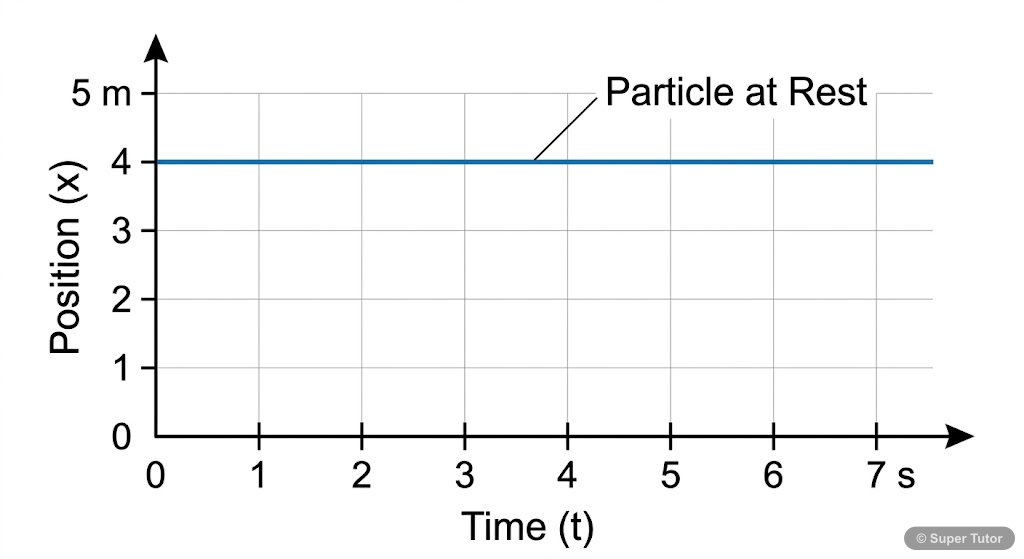
A position-time graph plots the position of an object (y-axis) against time (x-axis). Different shapes reveal different types of motion: (1) A horizon
Learning Objectives
- Distinguish between distance and displacement, and between speed and velocity with proper definitions and examples
- Explain and calculate average velocity, instantaneous velocity, and relative velocity
- Define acceleration and instantaneous acceleration with units and sign conventions
- Interpret position-time (x-t) graphs and velocity-time (v-t) graphs for uniform and non-uniform motion
- Derive the three equations of motion for uniform acceleration from first principles
Frequently Asked Questions
What are the important topics in Motion in a Straight Line for NIOS Class 12 Physics?
How should I revise Motion in a Straight Line for the NIOS Class 12 board exam?
Sources & Official References
Content is aligned to the official syllabus. Refer to the board website for the latest curriculum.
More resources for Motion in a Straight Line
Practice Quiz
Test yourself with a quick quiz
Important Questions
Exam-style questions with answers
Revision Notes
Key points for last-minute revision
Formula Sheet
The chapter's formulas in one place
Concept Maps
See how topics connect
Study Plan
Step-by-step plan for this chapter
Flashcards
Quick-fire cards for active recall
Syllabus
What topics to cover
For serious students
Get the full Motion in a Straight Line chapter — start free.
Quizzes, flashcards, an AI doubt solver and a study plan for NIOS Class 12 Physics. Free to start, no card needed.