Forest and Wildlife Resources — NCERT Solutions
Madhya Pradesh Board · Class 10 · Social Science
NCERT Solutions for Forest and Wildlife Resources, Madhya Pradesh Board Class 10 Social Science: 6 textbook questions solved step by step.
Interactive on Super Tutor
Studying Forest and Wildlife Resources? Get the full interactive chapter.
Quizzes, flashcards, AI doubt-solver and a step-by-step study plan — built for NCERT solutions and more.
Free trial, no card needed.
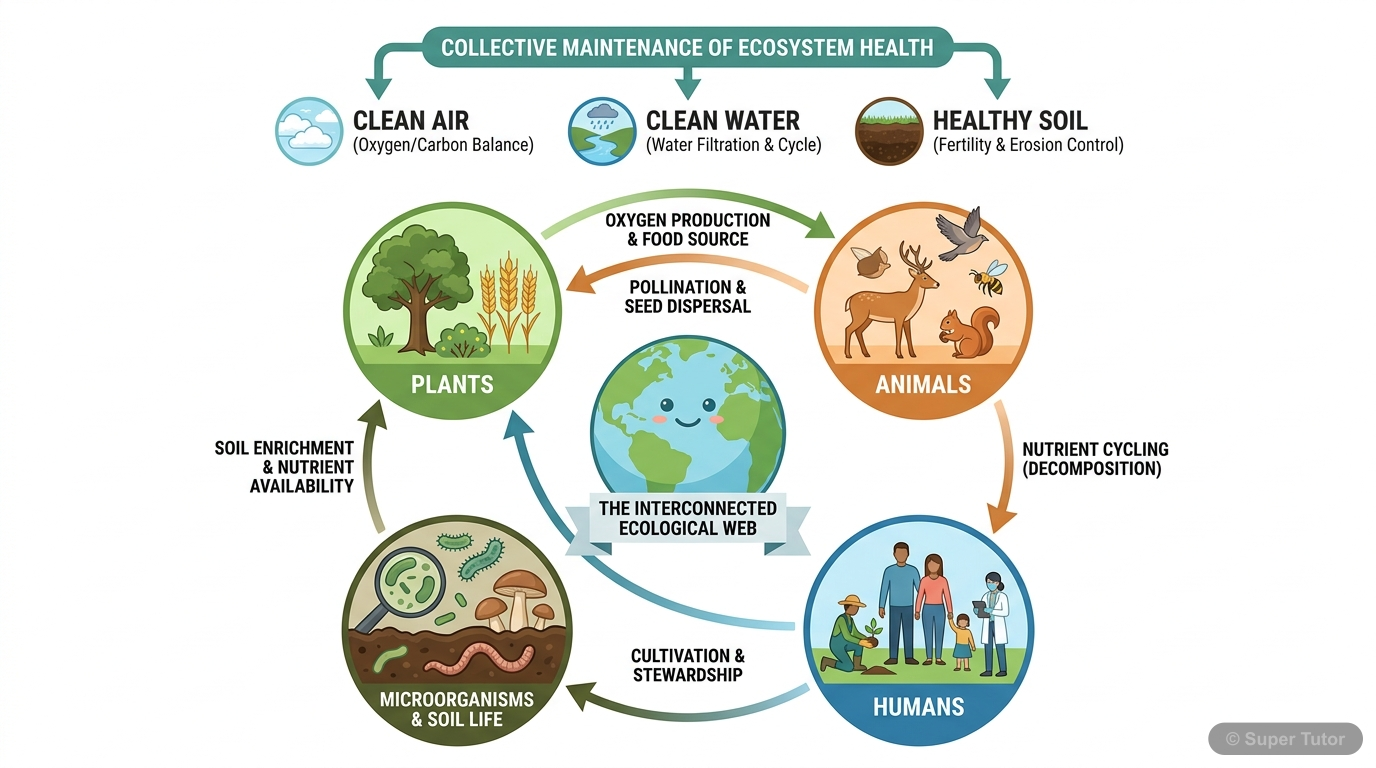
Learn better with visuals Super Tutor pairs illustrations like this with notes and quizzes for Forest and Wildlife Resources.
The first 3 solutions are open to read. The other 3 are free with a Super Tutor account.
Exercises
1(i)Which of the following conservation strategies do not directly involve community participation?
(a) Joint forest management
(b) Beej Bachao Andolan
(c) Chipko Movement
(d) Demarcation of Wildlife sanctuariesShow solution
Correct Answer: (d) Demarcation of Wildlife sanctuaries
Justification: Demarcation (marking boundaries) of Wildlife Sanctuaries is carried out by the government/state authorities as an administrative and legal process. It does not directly involve local communities in decision-making or participation. In contrast, Joint Forest Management, Beej Bachao Andolan, and the Chipko Movement are all community-driven or community-participatory conservation initiatives.
2Match the following:
- Reserved forests
- Protected forests
- Unclassed forestsShow solution
Correct Matching:
| Term | Description |
|---|---|
| Reserved forests | Forests are regarded as most valuable as far as the conservation of forest and wildlife resources. |
| Protected forests | Forest lands are protected from any further depletion. |
| Unclassed forests | Other forests and wastelands belonging to both government and private individuals and communities. |
Explanation:
- Reserved Forests are the most protected category under the Indian Forest Act; no rights are allowed to local people and they are considered most valuable for conservation.
- Protected Forests are those where the government has declared that no further depletion will be allowed; some rights of local people may be permitted.
- Unclassed Forests include all other forest and wasteland areas owned by the government, private individuals, or communities and are the least regulated category.
3(i)What is biodiversity? Why is biodiversity important for human lives?Show solution
Given/Concept: Biodiversity refers to the variety of life on Earth.
Definition: Biodiversity (or biological diversity) is the variety of all living organisms — plants, animals, micro-organisms — found in a particular habitat or on Earth as a whole, including the diversity within species, between species, and of ecosystems.
Importance for Human Lives:
- Food and nutrition: A large variety of crops, fruits, and animals provide food to humans.
- Medicine: Many life-saving medicines are derived from plants and animals (e.g., quinine from cinchona bark).
- Ecological balance: Biodiversity maintains the food chain, nutrient cycling, and climate regulation, all of which support human survival.
- Economic value: Forests and diverse species support livelihoods through timber, tourism, and agriculture.
- Cultural and aesthetic value: Biodiversity enriches human culture, recreation, and spiritual well-being.
Conclusion: Loss of biodiversity threatens the very foundation of human existence, making its conservation essential.
Free with a Super Tutor account
Free with a Super Tutor account
Free with a Super Tutor account
3 more solved questions in Forest and Wildlife Resources
They are free with a Super Tutor account, along with practice quizzes and flashcards for this chapter. Free to start, no card needed.
Frequently Asked Questions
What are the important topics in Forest and Wildlife Resources for Madhya Pradesh Board Class 10 Social Science?
Are these NCERT Solutions for Forest and Wildlife Resources free?
How should I revise Forest and Wildlife Resources for the Madhya Pradesh Board Class 10 board exam?
Sources & Official References
Content is aligned to the official syllabus. Refer to the board website for the latest curriculum.
More resources for Forest and Wildlife Resources
Practice Quiz
Test yourself with a quick quiz
Important Questions
Exam-style questions with answers
Revision Notes
Key points for last-minute revision
Chapter Summary
Understand the chapter at a glance
Concept Maps
See how topics connect
Study Plan
Step-by-step plan for this chapter
Flashcards
Quick-fire cards for active recall
Syllabus
What topics to cover
For serious students
Get the full Forest and Wildlife Resources chapter — start free.
Quizzes, flashcards, an AI doubt solver and a study plan for Madhya Pradesh Board Class 10 Social Science. Free to start, no card needed.