Globalization and the Indian Economy — NCERT Solutions
Madhya Pradesh Board · Class 10 · Social Science
NCERT Solutions for Globalization and the Indian Economy, Madhya Pradesh Board Class 10 Social Science: 39 textbook questions solved step by step.
Interactive on Super Tutor
Studying Globalization and the Indian Economy? Get the full interactive chapter.
Quizzes, flashcards, AI doubt-solver and a step-by-step study plan — built for NCERT solutions and more.
Free trial, no card needed.
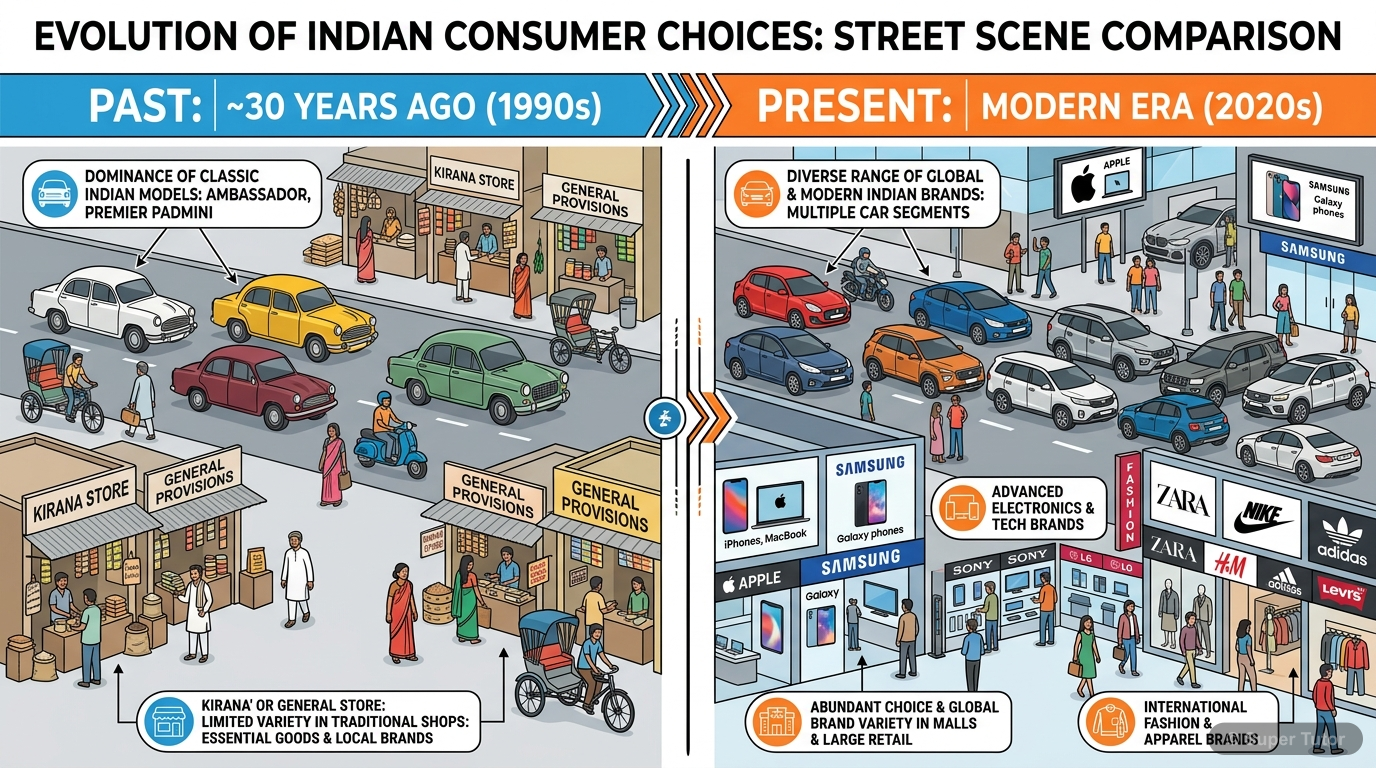
Learn better with visuals Super Tutor pairs illustrations like this with notes and quizzes for Globalization and the Indian Economy.
The first 20 solutions are open to read. The other 19 are free with a Super Tutor account.
Let's Work This Out
1Complete the following statement to show how the production process in the garment industry is spread across countries.Show solution
The garment company may, for example, get cotton fibre from Korea, buttons from France, zips from Japan, designing from the USA, and stitching done in Thailand.
Let's Work These Out
1Would you say Ford Motors is a MNC? Why?Show solution
Yes. A MNC is a company that owns or controls production in more than one nation. Ford Motors has production spread over 26 countries, including India, so it is a multinational corporation.
2What is foreign investment? How much did Ford Motors invest in India?Show solution
Investment is the money spent to buy assets such as land, buildings, machines and other equipment. When this investment is made by MNCs in another country, it is called foreign investment. Ford Motors spent Rs. 1700 crore to set up its plant near Chennai.
3By setting up their production plants in India, MNCs such as Ford Motors tap the advantage not only of the large markets that countries such as India provide, but also the lower costs of production. Explain the statement.Show solution
Ford Motors gains in two ways. First, India provides a large market with many buyers. Second, production in India can be done at lower cost because of cheaper labour and other resources. So the company can sell more and earn higher profits.
5In what ways will the production of cars by Ford Motors in India lead to interlinking of production?Show solution
It leads to interlinking of production because Ford can use Indian factories and local suppliers for parts, assemble cars in India, and then sell them in India and abroad. Thus production becomes spread across countries and connected in a single network.
6In what ways is a MNC different from other companies?Show solution
A MNC differs from other companies because it operates in more than one country and controls production across borders. It may set up factories, buy existing companies, form partnerships, or get goods produced by small producers while controlling price, quality and delivery.
7Nearly all major multinationals are American, Japanese or European, such as Nike, Coca-Cola, Pepsi, Honda, Nokia. Can you guess why?Show solution
The chapter says that many major MNCs are American, Japanese or European. A school-level reason is that these countries are economically advanced, have big companies, and have had a long history of industrial development and technology, so their firms became multinational earlier.
Let's Work These Out
1What was the main channel connecting countries in the past? How is it different now?Show solution
Earlier, trade was the main link between countries. Now, countries are linked by foreign trade, foreign investment, MNCs, and the movement of goods, services, investments and technology across borders.
3In recent years China has been importing steel from India. Explain how the import of steel by China will affect.Show solution
If China imports steel from India:
- (a) Steel companies in China face competition from imported steel and may lose sales.
- (b) Steel companies in India gain a new market and may increase output.
- (c) Industries in China using steel may get steel at lower prices and with more choice, helping their production.
Let's Work These Out
1What is the role of MNCs in the globalisation process?Show solution
MNCs are the main force behind globalisation. They set up production in different countries, invest money abroad, buy local companies, place orders with small producers, and connect countries through trade in goods and services.
3Choose the correct option.
Globalisation, by connecting countries, shall result inShow solution
Globalisation connects countries, so producers from different countries compete with one another. Therefore the correct option is greater competition among producers.
Let's Work These Out
1In the above example, underline the words describing the use of technology in production.Show solution
The words describing the use of technology in production are telecommunications, computers, Internet, satellite communication devices, e-mail, voice-mail.
2How is information technology connected with globalisation? Would globalisation have been possible without expansion of IT?Show solution
Information technology (IT) helps globalisation by making communication and transfer of information very fast and cheap. It allows designing, customer care, banking, and many services to be done across countries. Without the growth of IT, globalisation would not have developed in the same way or at the same speed.
Let's Work These Out
1What do you understand by liberalisation of foreign trade?Show solution
Liberalisation means removing the trade barriers or restrictions placed by the government. After liberalisation, businesses can decide more freely what to import and export, and foreign companies can set up production more easily.
2Tax on imports is one type of trade barrier. The government could also place a limit on the number of goods that can be imported. This is known as quotas. Can you explain, using the example of Chinese toys, how quotas can be used as trade barriers? Do you think this should be used? Discuss.Show solution
If the government fixes a quota, only a limited number of Chinese toys can enter India. Then supply will fall, Chinese toys will be less available, and Indian toy makers may face less competition. Such barriers can protect domestic producers, but whether they should be used depends on whether the aim is protection or freer competition.
Let's Work These Out
1Fill in the blanks.
WTO was started at the initiative of __________ countries. The aim of the WTO is to __________. WTO establishes rules regarding __________ for all countries, and sees that __________. In practice, trade between countries is not __________. Developing countries like India have __________, whereas developed countries, in many cases, have continued to provide protection to their producers.Show solution
Fill in the blanks as follows:
WTO was started at the initiative of developed countries. The aim of the WTO is to liberalise international trade. WTO establishes rules regarding international trade for all countries, and sees that these rules are obeyed. In practice, trade between countries is not free. Developing countries like India have reduced trade barriers, whereas developed countries, in many cases, have continued to provide protection to their producers.
2What do you think can be done so that trade between countries is more fair?Show solution
To make trade more fair, countries should have fairer WTO rules, and developed countries should stop giving huge support to their producers while asking developing countries to remove barriers. Developing countries can also work together to demand fair treatment.
3In the above example, we saw that the US government gives massive sums of money to farmers for production. At times, governments also give support to promote production of certain types of goods, such as those which are environmentally friendly. Discuss whether these are fair or not.Show solution
Such support can be justified when it promotes environmentally friendly production and serves a public interest. However, it should be fair and transparent and not become a way of unfairly helping domestic producers to dominate world markets.
Let's Work These Out
1How has competition benefited people in India?Show solution
Greater competition among local and foreign producers has helped consumers, especially the better-off urban sections. They now get more choice, improved quality and lower prices for many goods, so their standard of living has improved.
2Should more Indian companies emerge as MNCs? How would it benefit the people in the country?Show solution
Yes. If more Indian companies become MNCs, they can expand globally, improve technology, become more competitive, and create more jobs and business opportunities in India. The chapter gives examples such as Tata Motors, Infosys, Ranbaxy, Asian Paints and Sundaram Fasteners.
Free with a Super Tutor account
Let's Work These Out
Free with a Super Tutor account
Free with a Super Tutor account
- Can you explain how these three things would help Indian producers?
- Do you think MNCs will be interested in investing in these? Why?
- Do you think the government has a role in making these facilities available? Why?
- Can you think of any other step that the government could take? Discuss.
Free with a Super Tutor account
Let's Work These Out
(a) government
(b) employers at the exporting factories
(c) MNCs
(d) workers.
Free with a Super Tutor account
Free with a Super Tutor account
Exercises
Free with a Super Tutor account
Free with a Super Tutor account
Free with a Super Tutor account
Free with a Super Tutor account
Free with a Super Tutor account
Free with a Super Tutor account
Free with a Super Tutor account
Free with a Super Tutor account
Free with a Super Tutor account
Free with a Super Tutor account
Indian buyers have a greater choice of goods than they did two decades back. This is closely associated with the process of __________. Markets in India are selling goods produced in many other countries. This means there is increasing __________ with other countries. Moreover, the rising number of brands that we see in the markets might be produced by MNCs in India. MNCs are investing in India because __________. While consumers have more choices in the market, the effect of rising __________ and __________ has meant greater __________ among the producers.
Free with a Super Tutor account
(i) MNCs buy at cheap rates from small producers — (a) Automobiles
(ii) Quotas and taxes on imports are used to regulate trade — (b) Garments, footwear, sports items
(iii) Indian companies who have invested abroad — (c) Call centres
(iv) IT has helped in spreading of production of services — (d) Tata Motors, Infosys, Ranbaxy
(v) Several MNCs have invested in setting up factories in India for production — (e) Trade barriers
Free with a Super Tutor account
(i) The past two decades of globalisation has seen rapid movements in
(a) goods, services and people between countries.
(b) goods, services and investments between countries.
(c) goods, investments and people between countries.
(ii) The most common route for investments by MNCs in countries around the world is to
(a) set up new factories.
(b) buy existing local companies.
(c) form partnerships with local companies.
(iii) Globalisation has led to improvement in living conditions
(a) of all the people
(b) of people in the developed countries
(c) of workers in the developing countries
(d) none of the above
Free with a Super Tutor account
19 more solved questions in Globalization and the Indian Economy
They are free with a Super Tutor account, along with practice quizzes and flashcards for this chapter. Free to start, no card needed.
Frequently Asked Questions
What are the important topics in Globalization and the Indian Economy for Madhya Pradesh Board Class 10 Social Science?
Are these NCERT Solutions for Globalization and the Indian Economy free?
How should I revise Globalization and the Indian Economy for the Madhya Pradesh Board Class 10 board exam?
Sources & Official References
Content is aligned to the official syllabus. Refer to the board website for the latest curriculum.
More resources for Globalization and the Indian Economy
Practice Quiz
Test yourself with a quick quiz
Important Questions
Exam-style questions with answers
Revision Notes
Key points for last-minute revision
Chapter Summary
Understand the chapter at a glance
Concept Maps
See how topics connect
Study Plan
Step-by-step plan for this chapter
Flashcards
Quick-fire cards for active recall
Syllabus
What topics to cover
For serious students
Get the full Globalization and the Indian Economy chapter — start free.
Quizzes, flashcards, an AI doubt solver and a study plan for Madhya Pradesh Board Class 10 Social Science. Free to start, no card needed.