Chapter 5 of 22
NCERT Solutions

Sectors of the Indian Economy

Madhya Pradesh Board · Class 10 · Social Science

NCERT Solutions for Sectors of the Indian Economy — Madhya Pradesh Board Class 10 Social Science.

55 questions20 flashcards5 concepts

Interactive on Super Tutor

Studying Sectors of the Indian Economy? Get the full interactive chapter.

Quizzes, flashcards, AI doubt-solver and a step-by-step study plan — built for ncert solutions and more.

1,000+ Class 10 students started this chapter today

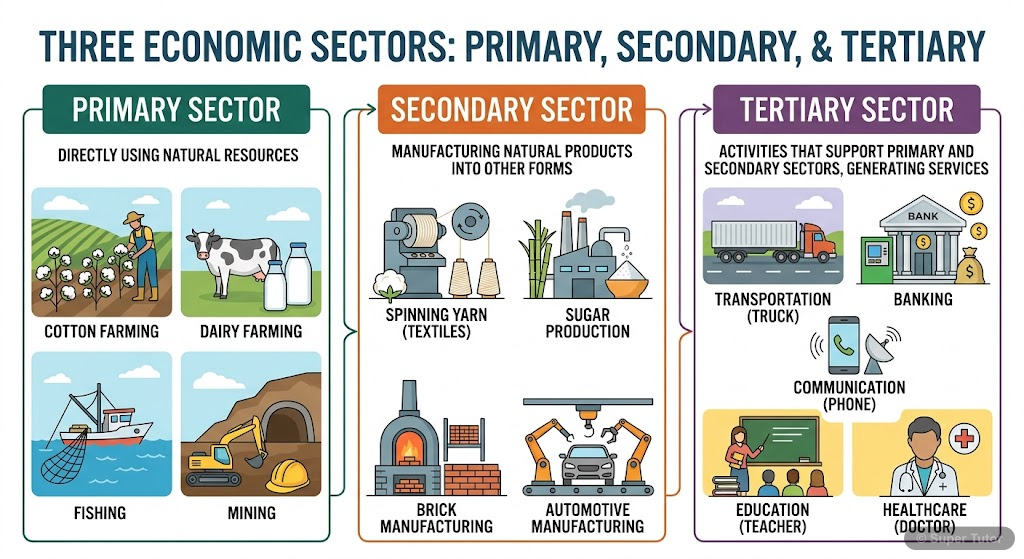
An infographic illustrating the three main sectors of economic activities: Primary, Secondary, and Tertiary, with examples for each.
Super Tutor

This is just one of 14+ visuals inside Super Tutor's Sectors of the Indian Economy chapter

Explore the full set
24 Questions Solved · 1 Section

EXERCISES

1Fill in the blanks using the correct option given in the bracket:
(i) Employment in the service sector ________ increased to the same extent as production. (has / has not)
(ii) Workers in the ________ sector do not produce goods. (tertiary / agricultural)
(iii) Most of the workers in the ________ sector enjoy job security. (organised / unorganised)
(iv) A ________ proportion of labourers in India are working in the unorganised sector. (large / small)
(v) Cotton is a ________ product and cloth is a ________ product. [natural /manufactured]
(vi) The activities in primary, secondary and tertiary sectors are ________ [independent / interdependent]
Show solution
(i) has not — Employment in the service sector has not increased to the same extent as production. While the tertiary sector's share in GDP has grown significantly, it has not generated employment in the same proportion.

(ii) tertiary — Workers in the tertiary sector do not produce goods; instead they provide services such as banking, transport, communication, etc.

(iii) organised — Most of the workers in the organised sector enjoy job security because they are registered with the government and are protected by various labour laws.

(iv) large — A large proportion of labourers in India are working in the unorganised sector, which includes small and scattered units that are largely outside the control of the government.

(v) Cotton is a natural product and cloth is a manufactured product. Cotton is obtained directly from nature (primary sector), whereas cloth is made by processing cotton in factories (secondary sector).

(vi) interdependent — The activities in primary, secondary and tertiary sectors are interdependent. For example, agriculture (primary) provides raw materials to industries (secondary), and both depend on transport and trade (tertiary).
2Choose the most appropriate answer.
(a) The sectors are classified into public and private sector on the basis of:
(i) employment conditions (ii) the nature of economic activity (iii) ownership of enterprises (iv) number of workers employed in the enterprise

(b) Production of a commodity, mostly through the natural process, is an activity in ________ sector.
(i) primary (ii) secondary (iii) tertiary (iv) information technology

(c) GDP is the total value of ________ produced during a particular year.
(i) all goods and services (ii) all final goods and services (iii) all intermediate goods and services (iv) all intermediate and final goods and services

(d) In terms of GVA the share of tertiary sector in 2017–18 is between ________ per cent.
(i) 20 to 30 (ii) 30 to 40 (iii) 50 to 60 (iv) 60 to 70
Show solution
(a) Correct option: (iii) ownership of enterprises
Justification: The basis of classification into public and private sectors is ownership. If the government owns and controls the enterprise, it belongs to the public sector; if owned by private individuals or companies, it belongs to the private sector.

(b) Correct option: (i) primary
Justification: The primary sector involves activities that are directly dependent on nature and natural processes, such as agriculture, fishing, mining, and forestry. Production here is mostly through natural processes.

(c) Correct option: (ii) all final goods and services
Justification: GDP (Gross Domestic Product) is the total monetary value of all final goods and services produced within a country in a particular year. Intermediate goods are excluded to avoid double counting.

(d) Correct option: (iv) 60 to 70
Justification: As per data for 2017–18, the tertiary (service) sector contributes the largest share to India's GVA, which is between 60 to 70 per cent, making it the dominant sector in the Indian economy.
3Match the following:
Problems faced by farming sector:
1. Unirrigated land
2. Low prices for crops
3. Debt burden
4. No job in the off season
5. Compelled to sell their grains to the local traders soon after harvest

Some possible measures:
(a) Setting up agro-based mills
(b) Cooperative marketing societies
(c) Procurement of food grains by government
(d) Construction of canals by the government
(e) Banks to provide credit with low interest
Show solution
The correct matching is as follows:

| Problem | Measure |
|---|---|
| 1. Unirrigated land | (d) Construction of canals by the government |
| 2. Low prices for crops | (b) Cooperative marketing societies |
| 3. Debt burden | (e) Banks to provide credit with low interest |
| 4. No job in the off season | (a) Setting up agro-based mills |
| 5. Compelled to sell their grains to the local traders soon after harvest | (c) Procurement of food grains by government |

Explanation:
- Unirrigated land can be solved by constructing canals to provide water for irrigation.
- Cooperative marketing societies help farmers get fair prices for their crops by eliminating middlemen.
- Easy credit from banks at low interest rates reduces the debt burden on farmers.
- Agro-based mills (e.g., sugar mills, rice mills) near villages provide employment during the off season.
- Government procurement at Minimum Support Price (MSP) protects farmers from being forced to sell cheaply to local traders.
4Find the odd one out and say why.
(i) Tourist guide, dhobi, tailor, potter
(ii) Teacher, doctor, vegetable vendor, lawyer
(iii) Postman, cobbler, soldier, police constable
(iv) MTNL, Indian Railways, Air India, Jet Airways, All India Radio
Show solution
(i) Tourist guide, dhobi, tailor, potter
Odd one out: Potter
Reason: A potter is engaged in the secondary sector as he/she transforms raw material (clay) into a finished product (pots). All others — tourist guide, dhobi (washerman), and tailor — provide services and belong to the tertiary sector.

(ii) Teacher, doctor, vegetable vendor, lawyer
Odd one out: Vegetable vendor
Reason: A vegetable vendor is engaged in selling agricultural produce and belongs to the primary/tertiary sector dealing with goods. All others — teacher, doctor, and lawyer — provide professional services and are part of the organised tertiary sector. Alternatively, the vegetable vendor is the only one likely working in the unorganised sector, while the others generally work in the organised sector.

(iii) Postman, cobbler, soldier, police constable
Odd one out: Cobbler
Reason: A cobbler works in the unorganised/private sector and is self-employed. All others — postman, soldier, and police constable — are employed by the government (public sector) and belong to the organised sector.

(iv) MTNL, Indian Railways, Air India, Jet Airways, All India Radio
Odd one out: Jet Airways
Reason: Jet Airways is/was a private sector enterprise. All others — MTNL, Indian Railways, Air India, and All India Radio — are owned and operated by the government, i.e., they belong to the public sector.
5A research scholar looked at the working people in the city of Surat and found the following. Complete the table. What is the percentage of workers in the unorganised sector in this city?

| Place of work | Nature of employment | Percentage of working people |
|---|---|---|
| In offices and factories registered with the government | Organised | 15 |
| Own shops, office, clinics in marketplaces with formal license | | 15 |
| People working on the street, construction workers, domestic workers | | 20 |
| Working in small workshops usually not registered with the government | | |
Show solution
Completing the table:

The total percentage must add up to 100%.
- Workers in small workshops (unregistered) = 100 − 15 − 15 − 20 = 50%

| Place of work | Nature of employment | Percentage of working people |
|---|---|---|
| In offices and factories registered with the government | Organised | 15 |
| Own shops, offices, clinics in marketplaces with formal license | Organised | 15 |
| People working on the street, construction workers, domestic workers | Unorganised | 20 |
| Working in small workshops usually not registered with the government | Unorganised | 50 |

Percentage of workers in the unorganised sector:
=20+50=70%= 20 + 50 = \textbf{70\%}

Percentage of workers in the organised sector:
=15+15=30%= 15 + 15 = 30\%

Conclusion: A large majority (70%) of workers in Surat work in the unorganised sector, which means they lack job security, regular wages, and social security benefits. Only 30% are in the organised sector and enjoy formal employment conditions.
6Do you think the classification of economic activities into primary, secondary and tertiary is useful? Explain how.Show solution
Yes, the classification of economic activities into primary, secondary, and tertiary sectors is very useful. The reasons are as follows:

1. Understanding the structure of the economy:
This classification helps us understand how the economy is organised — how much is produced by agriculture, industry, and services — and how the structure changes over time.

2. Measuring GDP and contribution of each sector:
By classifying activities, we can calculate the contribution (GVA/GDP) of each sector to national income. For example, in India, the tertiary sector contributes about 60–70% of GDP.

3. Identifying employment patterns:
It helps us understand where most people are employed. In India, a large proportion of workers are still in the primary sector despite its lower contribution to GDP, indicating disguised unemployment.

4. Policy formulation:
Governments use this classification to frame targeted policies. For example, if the primary sector is lagging, the government can invest in irrigation, credit facilities, and MSP for farmers.

5. Tracking development:
As an economy develops, the share of primary sector decreases and that of secondary and tertiary sectors increases. This shift helps track the level of economic development of a country.

6. Identifying interdependence:
The classification shows how the three sectors are interdependent — agriculture provides raw materials to industry, and both depend on services like transport, banking, and communication.

Thus, this classification is a very useful analytical tool for economists, planners, and policymakers.
7For each of the sectors that we came across in this chapter why should one focus on employment and GVA? Could there be other issues which should be examined? Discuss.Show solution
Why focus on Employment and GVA (Gross Value Added)?

Employment tells us:
- How many people are working in each sector.
- Whether the sector is generating enough jobs for the growing population.
- The quality of employment (organised vs. unorganised, regular vs. seasonal).
- The problem of disguised unemployment, especially in the primary sector.

GVA (Gross Value Added) tells us:
- The economic contribution of each sector to national income.
- How the structure of the economy is changing over time.
- Which sector is growing faster and driving economic development.

For example, in India, the tertiary sector has a high share in GVA (~60–70%) but does not employ as many people proportionately, while the primary sector employs the most people but contributes less to GVA. This mismatch is an important policy concern.

Other issues that should also be examined:

1. Quality of employment — Are jobs permanent, well-paid, and with social security, or are they casual and exploitative?
2. Working conditions — Safety, health, and welfare of workers, especially in the unorganised sector.
3. Wages and income inequality — Are workers being paid fair wages? Is there a wide gap between rich and poor?
4. Environmental impact — Industrial and agricultural activities can cause pollution and environmental degradation.
5. Gender participation — Are women equally represented in all sectors?
6. Regional disparities — Are all regions of the country developing equally?
7. Technological advancement — Is the sector adopting modern technology to improve productivity?

Thus, while employment and GVA are the primary indicators, a comprehensive analysis must also consider these other dimensions.
8Make a long list of all kinds of work that you find adults around you doing for a living. In what way can you classify them? Explain your choice.Show solution
List of work done by adults around us:

Farmer, vegetable vendor, fisherman, carpenter, weaver, tailor, blacksmith, potter, factory worker, construction worker, plumber, electrician, mechanic, shopkeeper, teacher, doctor, nurse, bank employee, postman, police officer, soldier, bus driver, auto-rickshaw driver, domestic worker, cook, sweeper, software engineer, journalist, lawyer, accountant, trader, insurance agent, etc.

Classification:

These activities can be classified in the following ways:

1. On the basis of the nature of activity (Primary, Secondary, Tertiary):
- Primary sector: Farmer, fisherman, vegetable grower — activities directly dependent on nature.
- Secondary sector: Carpenter, weaver, factory worker, blacksmith, potter — activities involving manufacturing and processing.
- Tertiary sector: Teacher, doctor, bank employee, driver, lawyer, postman — activities providing services.

2. On the basis of employment conditions (Organised vs. Unorganised):
- Organised sector: Bank employee, teacher in a registered school, government officer, soldier — have job security, fixed wages, and social security.
- Unorganised sector: Domestic worker, construction worker, street vendor, small tailor — lack job security and social protection.

3. On the basis of ownership (Public vs. Private):
- Public sector: Postman, police officer, government school teacher, railway employee.
- Private sector: Software engineer in a private firm, shopkeeper, private doctor.

My choice of classification: The primary/secondary/tertiary classification is most useful because it helps us understand the nature of economic activity and the level of development of the economy. The organised/unorganised classification is also important as it highlights the conditions of workers and the need for labour protection.
9How is the tertiary sector different from other sectors? Illustrate with a few examples.Show solution
Tertiary Sector — Meaning:
The tertiary sector includes activities that provide services rather than producing goods. It supports the primary and secondary sectors and directly serves consumers.

Differences from Primary and Secondary Sectors:

| Basis | Primary Sector | Secondary Sector | Tertiary Sector |
|---|---|---|---|
| Nature of activity | Extraction/production from nature | Manufacturing/processing of goods | Provision of services |
| Output | Natural goods (wheat, fish, coal) | Manufactured goods (cloth, steel, bread) | Intangible services (education, banking) |
| Examples | Farming, fishing, mining | Weaving, steel making, baking | Teaching, banking, transport |
| Dependence | Directly dependent on nature | Dependent on primary sector for raw materials | Supports both primary and secondary sectors |

Key features of the Tertiary Sector:
1. It does not produce a tangible commodity — it provides services.
2. Services are consumed at the time of production (e.g., a haircut, a doctor's consultation).
3. It acts as an aid or support to the other two sectors.

Examples of Tertiary Sector activities:
- Transport: Trucks carry wheat from farms to flour mills; railways transport coal to factories.
- Banking: Banks provide loans to farmers and industrialists.
- Communication: Telephone and internet services connect businesses and consumers.
- Trade: Shopkeepers and traders help in buying and selling goods.
- Education and Health: Teachers and doctors provide essential services to society.
- IT services: Software companies provide technology solutions.

Thus, the tertiary sector is distinct because it creates value through services rather than goods, and it is essential for the smooth functioning of the entire economy.
10What do you understand by disguised unemployment? Explain with an example each from the urban and rural areas.Show solution
Disguised Unemployment — Definition:
Disguised unemployment refers to a situation where more people are employed in a job than actually required. The extra workers appear to be employed but their marginal productivity is zero — meaning if they were removed, the total output would not decrease. It is also called hidden unemployment.

Key features:
- Workers appear to be employed but are actually underemployed.
- Their contribution to production is negligible or zero.
- It is different from open unemployment where a person has no work at all.

Example from Rural Areas (Agriculture):
Suppose a small farm requires only 3 workers to carry out all agricultural activities efficiently. However, 6 family members are working on the same farm. The extra 3 workers are not really needed — if they were removed, the farm's output would remain the same. These 3 extra workers are disguisedly unemployed. This is very common in Indian agriculture, especially during the non-sowing and non-harvesting seasons.

Example from Urban Areas:
In cities, we often see a small shop or a roadside stall where 4–5 family members are working together, even though the work could easily be managed by 1 or 2 people. The extra members are not contributing meaningfully to the business. Similarly, in some government offices, there may be more staff than required for the actual workload — the extra employees are disguisedly unemployed.

Conclusion:
Disguised unemployment is a serious problem in India, particularly in the agricultural sector. It leads to low productivity and low income. The solution lies in creating alternative employment opportunities in industry and services so that surplus workers can be productively employed.
11Distinguish between open unemployment and disguised unemployment.Show solution
Distinction between Open Unemployment and Disguised Unemployment:

| Basis | Open Unemployment | Disguised Unemployment |
|---|---|---|
| Meaning | A situation where a person is willing to work but cannot find any job. | A situation where more people are employed than actually needed; extra workers have zero marginal productivity. |
| Visibility | It is visible — the person is clearly without work. | It is hidden — the person appears to be working but is not contributing meaningfully. |
| Productivity | The unemployed person produces nothing. | The disguisedly unemployed person appears to produce but their marginal contribution is zero. |
| Where found | More common in urban areas among educated youth and unskilled workers. | More common in rural areas, especially in agriculture and family-run businesses. |
| Nature | Person has no work at all. | Person has some work but is underemployed. |
| Example | An educated youth who has passed Class 12 but cannot find a job. | Five family members working on a farm that only needs three workers. |
| Solution | Creating more jobs through industrialisation and skill development. | Shifting surplus workers to other productive sectors; diversifying rural economy. |

Summary:
- In open unemployment, the person is visibly without a job.
- In disguised unemployment, the person seems employed but is actually surplus to requirements.

Both are serious problems in India and require targeted government policies to address them.
12"Tertiary sector is not playing any significant role in the development of Indian economy." Do you agree? Give reasons in support of your answer.Show solution
No, I do not agree with this statement. The tertiary sector is playing a very significant and growing role in the development of the Indian economy. The following reasons support this view:

1. Largest contributor to GDP:
The tertiary sector contributes approximately 60–70% of India's GVA (Gross Value Added). It has overtaken both the primary and secondary sectors in terms of economic contribution, making it the backbone of the Indian economy.

2. Rapid growth:
The service sector has been growing at a faster rate than the other two sectors. India is now recognised globally as a major hub for IT, software, and business process outsourcing (BPO) services.

3. Employment generation:
The tertiary sector employs a large and growing number of people in areas like banking, insurance, retail, education, health, transport, communication, and IT.

4. Support to other sectors:
The tertiary sector provides essential support services to the primary and secondary sectors. For example:
- Transport carries agricultural produce and industrial goods.
- Banking provides credit to farmers and industrialists.
- Communication connects producers and consumers.

5. Essential services:
Services like education, healthcare, and public administration are vital for human development and social welfare. Without these, economic development would be impossible.

6. IT and global recognition:
India's IT sector (Infosys, TCS, Wipro) has earned global recognition and brings in significant foreign exchange earnings, boosting the economy.

7. Infrastructure development:
Services like electricity, water supply, and telecommunications are part of the tertiary sector and form the foundation for all economic activities.

Conclusion:
The tertiary sector is not only significant but is the most dominant sector in India's economy today. It drives growth, generates employment, supports other sectors, and contributes to human development. The statement is therefore incorrect.
13Service sector in India employs two different kinds of people. Who are these?Show solution
The service sector in India employs two very different kinds of people:

1. Highly skilled and educated workers (in the organised/formal service sector):
These include professionals such as:
- Software engineers and IT professionals
- Doctors, lawyers, chartered accountants
- Teachers and professors in reputed institutions
- Bankers, managers, and corporate executives
- Journalists and media professionals

These workers are well-paid, enjoy job security, and work in the organised sector. They contribute significantly to India's GDP and are part of the growing knowledge economy.

2. Low-skilled and poorly paid workers (in the unorganised/informal service sector):
These include workers such as:
- Street vendors and small shopkeepers
- Domestic workers (maids, cooks, drivers)
- Rickshaw pullers and casual transport workers
- Small repair workers (cobblers, cycle repairers)
- Construction helpers and daily wage labourers in service activities

These workers are poorly paid, lack job security, and work in the unorganised sector without any social security benefits.

Conclusion:
This sharp divide between the two groups reflects the inequality in the Indian service sector. While one group enjoys the benefits of a growing economy, the other remains vulnerable and exploited. Government policies need to focus on improving the conditions of the second group through minimum wage laws, social security, and skill development programmes.
14Workers are exploited in the unorganised sector. Do you agree with this view? Give reasons in support of your answer.Show solution
Yes, I strongly agree that workers are exploited in the unorganised sector. The following reasons support this view:

1. Low and irregular wages:
Workers in the unorganised sector are often paid wages below the minimum wage fixed by the government. Their income is irregular and uncertain, making it difficult to meet basic needs.

2. No job security:
Workers can be dismissed at any time without notice or compensation. They have no legal protection against arbitrary dismissal.

3. Long working hours:
These workers are often made to work for 10–12 hours a day without any overtime pay. There is no fixed working hour limit enforced.

4. No social security benefits:
Unlike organised sector workers, they do not receive provident fund, pension, gratuity, health insurance, or paid leave. In case of illness, accident, or old age, they have no financial support.

5. Unsafe working conditions:
Workers in construction sites, small factories, and workshops are exposed to health and safety hazards without any protective equipment or medical facilities.

6. Child labour:
Children are sometimes employed in small workshops, domestic work, and roadside stalls at very low wages, depriving them of education and a healthy childhood.

7. Bonded labour:
In some rural areas, poor farmers and labourers are trapped in debt bondage and are forced to work for landlords or moneylenders at exploitative terms.

Examples:
- A construction worker who is paid daily wages with no guarantee of work the next day.
- A domestic worker who works long hours with no weekly off or medical benefits.
- A child working in a roadside dhaba for very little pay.

Conclusion:
Workers in the unorganised sector are indeed exploited in multiple ways. The government must enforce labour laws strictly, provide social security, and create awareness among workers about their rights to protect them from exploitation.
15How are the activities in the economy classified on the basis of employment conditions?Show solution
On the basis of employment conditions, economic activities are classified into two sectors:

1. Organised Sector:
- This sector comprises enterprises or places of work that are registered with the government and have to follow its rules and regulations.
- Workers in this sector enjoy job security — they cannot be dismissed without valid reason and proper procedure.
- They work for fixed hours (usually 8 hours a day) and are entitled to overtime pay for extra work.
- They receive several social security benefits such as:
- Provident Fund (PF)
- Pension
- Gratuity
- Paid leave (sick leave, casual leave, earned leave)
- Health insurance and medical benefits
- Examples: Government employees, bank employees, teachers in registered schools, workers in large factories.

2. Unorganised Sector:
- This sector consists of small and scattered units that are largely outside the control of the government.
- Workers do not have job security and can be asked to leave at any time.
- They often work for long hours without overtime pay.
- They receive low wages, often below the minimum wage.
- There are no social security benefits — no PF, pension, paid leave, or health insurance.
- Employment is often seasonal or irregular.
- Examples: Street vendors, domestic workers, construction workers, agricultural labourers, workers in small workshops.

Conclusion:
The organised sector provides better working conditions and security, while the unorganised sector is characterised by exploitation and vulnerability. In India, a large majority of workers (about 90%) are employed in the unorganised sector.
16Compare the employment conditions prevailing in the organised and unorganised sectors.Show solution
Comparison of Employment Conditions in Organised and Unorganised Sectors:

| Basis of Comparison | Organised Sector | Unorganised Sector |
|---|---|---|
| Registration | Registered with the government; follows rules and regulations. | Not registered; largely outside government control. |
| Job security | Workers have job security; cannot be dismissed without valid reason. | No job security; can be dismissed at any time without notice. |
| Working hours | Fixed working hours (usually 8 hours); overtime is paid. | Long and irregular working hours; no overtime pay. |
| Wages | Regular and fixed wages, usually above minimum wage. | Low and irregular wages, often below minimum wage. |
| Social security | Provident fund, pension, gratuity, health insurance, paid leave. | No social security benefits. |
| Leave | Paid sick leave, casual leave, and earned leave are provided. | No paid leave; absence means loss of wages. |
| Working conditions | Safe and regulated working environment. | Often unsafe and hazardous working conditions. |
| Nature of employment | Permanent and regular employment. | Casual, seasonal, or temporary employment. |
| Examples | Government employees, bank staff, factory workers in large industries. | Domestic workers, street vendors, construction workers, agricultural labourers. |
| Proportion of workers | About 10% of India's workforce. | About 90% of India's workforce. |

Conclusion:
The organised sector provides much better employment conditions compared to the unorganised sector. Workers in the unorganised sector are vulnerable and need government protection through strict enforcement of labour laws, minimum wage regulations, and social security schemes.
17Explain the objective of implementing the MGNREGA 2005 or Viksit Bharat-G RAM G 2025.Show solution
MGNREGA 2005 (Mahatma Gandhi National Rural Employment Guarantee Act):

Full name: Mahatma Gandhi National Rural Employment Guarantee Act, 2005.

Main Objectives:

1. Guarantee of employment: To provide at least 100 days of guaranteed wage employment in a financial year to every rural household whose adult members volunteer to do unskilled manual work.

2. Reducing poverty: To provide a source of income to the rural poor, especially during lean agricultural seasons, thereby reducing rural poverty.

3. Reducing disguised unemployment: To absorb surplus agricultural workers who are disguisedly unemployed and provide them with productive work.

4. Creation of durable assets: The work done under MGNREGA involves construction of roads, canals, ponds, wells, and other infrastructure, which creates durable community assets in rural areas.

5. Empowerment of rural people: To strengthen the livelihood security of rural households, especially Scheduled Castes, Scheduled Tribes, and women.

6. Reducing rural-urban migration: By providing employment in villages, it aims to reduce the migration of rural workers to cities in search of work.

7. Legal right to work: For the first time, employment was made a legal right — if the government fails to provide work within 15 days, the worker is entitled to an unemployment allowance.

Significance:
MGNREGA is one of the largest employment guarantee programmes in the world. It has helped millions of rural poor, especially women and marginalised communities, to earn a livelihood and improve their standard of living.

Note: If the question refers to Viksit Bharat-G RAM G 2025, it is a more recent initiative aimed at comprehensive rural development and employment generation as part of India's vision of becoming a developed nation by 2047. Its objectives include rural infrastructure development, skill enhancement, and sustainable livelihood creation for rural communities.
18Using examples from your area compare and contrast the activities and functions of private and public sectors.Show solution
Public Sector — Meaning:
Enterprises owned, managed, and controlled by the government (central, state, or local) are called public sector enterprises. The primary motive is social welfare, not profit.

Private Sector — Meaning:
Enterprises owned and managed by private individuals or companies are called private sector enterprises. The primary motive is profit maximisation.

Comparison using examples from a typical area:

| Basis | Public Sector | Private Sector |
|---|---|---|
| Ownership | Government (e.g., Government Hospital, Post Office, Government School) | Private individuals/companies (e.g., Private Hospital, Courier Company, Private School) |
| Objective | Social welfare and public service | Profit maximisation |
| Funding | Funded by tax revenue and government budget | Funded by private capital and profits |
| Pricing | Services provided at subsidised or low cost (e.g., government bus at low fare) | Services priced at market rates (e.g., private bus at higher fare) |
| Employment | Provides stable, secure jobs with social benefits | Employment may be less secure in small private firms |
| Areas of operation | Operates in areas where private sector may not invest (e.g., defence, railways, remote area hospitals) | Operates where profit can be made (e.g., urban hospitals, private schools) |
| Accountability | Accountable to the public and parliament | Accountable to shareholders and owners |
| Examples | Indian Railways, Government Primary Health Centre, Municipal Water Supply, Public Library | Reliance Industries, Apollo Hospital, Private Schools, Local Grocery Shops |

Conclusion:
Both sectors are important for the economy. The public sector ensures that essential services reach all citizens, including the poor, while the private sector drives innovation, efficiency, and economic growth. A healthy mix of both is necessary for balanced development.
19Discuss and fill the following table giving one example each from your area.

| | Well managed organisation | Badly managed organisation |
|---|---|---|
| Public sector | | |
| Private Sector | | |
Show solution
Discussion:
Both public and private sector organisations can be well-managed or badly managed depending on factors like leadership, accountability, resources, and governance.

Filled Table (with examples):

| | Well managed organisation | Badly managed organisation |
|---|---|---|
| Public sector | Indian Railways — Runs one of the largest rail networks in the world, provides affordable transport to millions, has improved punctuality and cleanliness in recent years. | Some State Electricity Boards (SEBs) — Suffer from high transmission losses, frequent power cuts, poor billing systems, and financial losses due to mismanagement. |
| Private Sector | Tata Group / Infosys — Known for good corporate governance, quality products/services, employee welfare, and consistent profitability. | Some local private schools or clinics — May charge high fees but provide poor quality education or healthcare; lack trained staff and proper infrastructure. |

Note: Students should fill this table with examples from their own area/city. For instance:
- A well-managed public sector example could be a clean and efficient government hospital in their district.
- A badly managed public sector example could be a poorly maintained government school with absent teachers.
- A well-managed private sector example could be a reputed private school or hospital in their city.
- A badly managed private sector example could be a local private factory with poor working conditions.

Conclusion:
Management quality depends not on whether an organisation is public or private, but on accountability, transparency, and commitment to service. Both sectors need to be monitored and improved continuously.
20Give a few examples of public sector activities and explain why the government has taken them up.Show solution
Examples of Public Sector Activities:

1. Indian Railways — Provides rail transport across the country.
2. Post Offices — Provides postal and financial services in remote areas.
3. Government Hospitals and Primary Health Centres — Provides healthcare at low or no cost.
4. Government Schools and Universities — Provides education at subsidised rates.
5. ONGC (Oil and Natural Gas Corporation) — Explores and produces oil and gas.
6. BHEL (Bharat Heavy Electricals Limited) — Manufactures heavy electrical equipment.
7. Municipal Water Supply — Provides drinking water to households.
8. Defence (Army, Navy, Air Force) — Protects the nation's borders.
9. Electricity generation (NTPC) — Produces and distributes electricity.
10. All India Radio and Doordarshan — Provides public broadcasting services.

Why has the government taken up these activities?

1. Large investment required:
Some activities require huge amounts of capital investment that private individuals or companies cannot afford. For example, building railways, dams, and power plants requires massive funds that only the government can mobilise.

2. Long gestation period:
Some projects take many years to generate returns. Private investors are unwilling to wait so long. The government undertakes such projects for long-term national benefit.

3. Social welfare and equity:
The government provides essential services like healthcare, education, and water supply at low cost to ensure that even the poor have access to them. Private sector would charge high prices, making these unaffordable for the poor.

4. National security:
Activities like defence, atomic energy, and space research are too sensitive to be left to private hands. The government must control them for national security.

5. Preventing monopoly and exploitation:
In sectors like electricity and water supply, private monopolies could exploit consumers. Government control ensures fair pricing and universal access.

6. Regional development:
The government invests in backward and remote areas where private sector would not go due to low profitability, ensuring balanced regional development.

Conclusion:
The government takes up public sector activities to ensure social welfare, national security, equitable development, and to fill the gaps left by the private sector.
21Explain how public sector contributes to the economic development of a nation.Show solution
The public sector plays a crucial role in the economic development of a nation. Its contributions can be explained as follows:

1. Development of infrastructure:
The government builds roads, railways, bridges, dams, ports, and airports. These form the backbone of the economy and enable the growth of agriculture, industry, and trade. For example, Indian Railways connects the entire country and facilitates the movement of goods and people.

2. Provision of essential services:
The public sector provides essential services like education, healthcare, water supply, and electricity at affordable rates. This improves the quality of life and human development index of the country.

3. Employment generation:
The public sector is a major employer. Government offices, public enterprises, schools, hospitals, railways, and defence forces provide employment to millions of people, reducing unemployment.

4. Balanced regional development:
The government invests in backward and underdeveloped regions where private investors are reluctant to go. This helps reduce regional disparities and promotes balanced development across the country.

5. Capital formation:
The government mobilises savings through taxes and invests in productive activities, contributing to capital formation and economic growth.

6. Welfare of the poor:
Through schemes like MGNREGA, PDS (Public Distribution System), and subsidised housing, the government protects the poor and vulnerable sections of society.

7. Regulation and stability:
The public sector regulates the economy, controls inflation, and maintains economic stability. The Reserve Bank of India (RBI), for example, manages monetary policy.

8. Strategic industries:
The government controls strategic industries like defence production, atomic energy, and space research, which are vital for national security and technological advancement.

9. Filling market gaps:
The private sector avoids areas with low profitability. The public sector fills these gaps, ensuring that all necessary goods and services are available in the economy.

Conclusion:
The public sector is indispensable for economic development. It creates the conditions necessary for private sector growth, ensures social justice, and provides the infrastructure and services that form the foundation of a modern economy.
22The workers in the unorganised sector need protection on the following issues: wages, safety and health. Explain with examples.Show solution
Workers in the unorganised sector are highly vulnerable and need protection on the following issues:

1. Wages:

Problem: Workers in the unorganised sector are often paid wages below the minimum wage fixed by the government. Their wages are irregular and uncertain. They have no bargaining power and are at the mercy of employers.

Examples:
- Agricultural labourers in villages are paid very low daily wages, often less than the government-prescribed minimum wage, especially during the non-harvest season.
- Domestic workers (maids, cooks) in cities work long hours but are paid very little with no guarantee of regular payment.
- Construction workers are paid daily wages and have no income on days when there is no work.

Protection needed: Strict enforcement of minimum wage laws, regular payment of wages, and legal recourse for workers who are underpaid.

2. Safety:

Problem: Workers in the unorganised sector often work in dangerous conditions without any safety equipment or precautions. There are no regulations enforced to protect them from accidents.

Examples:
- Construction workers work at great heights without helmets, safety harnesses, or nets. Falls and accidents are common.
- Workers in small chemical factories or dyeing units are exposed to toxic substances without protective gear.
- Miners in small illegal mines work without proper ventilation or safety equipment, risking cave-ins and lung diseases.

Protection needed: Enforcement of safety regulations, provision of protective equipment, and compensation for accidents and injuries.

3. Health:

Problem: Workers in the unorganised sector have no health insurance or medical benefits. They cannot afford medical treatment when they fall ill, and illness means loss of income.

Examples:
- Bidi workers and workers in dusty environments suffer from respiratory diseases but have no access to free medical care.
- Domestic workers who fall ill have no paid sick leave and lose their daily wages.
- Street food vendors work in unhygienic conditions and are exposed to various health risks.

Protection needed: Health insurance schemes, free or subsidised medical care, and paid sick leave for unorganised sector workers.

Conclusion:
The government must take strong measures to protect unorganised sector workers through strict enforcement of labour laws, social security schemes, health insurance, and awareness programmes. Schemes like ESIC (Employees' State Insurance Corporation) and PM Jan Arogya Yojana should be extended to cover all unorganised sector workers.
23A study in Ahmedabad found that out of 15,00,000 workers in the city, 11,00,000 worked in the unorganised sector. The total income of the city in this year (1997-1998) was Rs 60,000 million. Out of this Rs 32,000 million was generated in the organised sector. Present this data as a table. What kind of ways should be thought of for generating more employment in the city?Show solution
Data presented as a Table:

| Sector | Number of Workers | Percentage of Workers | Income Generated (Rs million) | Percentage of Income |
|---|---|---|---|---|
| Organised Sector | 4,00,000 | 26.7% | 32,000 | 53.3% |
| Unorganised Sector | 11,00,000 | 73.3% | 28,000 | 46.7% |
| Total | 15,00,000 | 100% | 60,000 | 100% |

Calculations:
- Workers in organised sector = 15,00,000 − 11,00,000 = 4,00,000
- Income in unorganised sector = 60,000 − 32,000 = Rs 28,000 million
- % of workers in organised sector = 4,00,00015,00,000×100=26.7%\frac{4,00,000}{15,00,000} \times 100 = 26.7\%
- % of workers in unorganised sector = 11,00,00015,00,000×100=73.3%\frac{11,00,000}{15,00,000} \times 100 = 73.3\%

Observation from the table:
Although 73.3% of workers are in the unorganised sector, they generate only 46.7% of the city's income. The organised sector with only 26.7% of workers generates 53.3% of income. This shows the low productivity and poor wages in the unorganised sector.

Ways to generate more employment in the city:

1. Promotion of small-scale industries and handicrafts: Setting up small manufacturing units can absorb a large number of workers at low capital cost.

2. Development of the service sector: Expanding services like tourism, healthcare, education, retail, and IT can create many new jobs.

3. Skill development programmes: Training workers in new skills (vocational training, computer literacy) makes them employable in better-paying jobs.

4. Support to self-employment: Providing easy credit, training, and market linkages to small entrepreneurs and street vendors can help them expand their businesses and employ more people.

5. Investment in infrastructure: Construction of roads, buildings, and public facilities creates both direct and indirect employment.

6. Encouraging private investment: Creating a business-friendly environment to attract private companies that will set up factories and offices, generating employment.

7. Extending social security to unorganised workers: This will improve their productivity and purchasing power, stimulating demand and economic activity.

8. Government schemes: Implementing schemes like PMEGP (Prime Minister's Employment Generation Programme) and Startup India to support new businesses and employment creation.
24The following table gives the GVA in Rupees (Crores) by the three sectors:

| Year | Primary | Secondary | Tertiary |
|---|---|---|---|
| 2001-02 | 13,23,000 | 10,40,000 | 19,31,000 |
| 2021-22 | 24,79,400 | 40,73,000 | 73,25,000 |

(i) Calculate the share of the three sectors in GDP for 2001-02 and 2021-22.
(ii) Show the data as a bar diagram similar to Graph 2 in the chapter.
(iii) What conclusions can we draw from the bar graph?
Show solution
(i) Calculation of share of three sectors in GDP:

For 2001-02:

Total GVA = 13,23,000 + 10,40,000 + 19,31,000 = Rs 42,94,000 crores

Share of Primary sector=13,23,00042,94,000×100=30.8%\text{Share of Primary sector} = \frac{13,23,000}{42,94,000} \times 100 = \mathbf{30.8\%}

Share of Secondary sector=10,40,00042,94,000×100=24.2%\text{Share of Secondary sector} = \frac{10,40,000}{42,94,000} \times 100 = \mathbf{24.2\%}

Share of Tertiary sector=19,31,00042,94,000×100=45.0%\text{Share of Tertiary sector} = \frac{19,31,000}{42,94,000} \times 100 = \mathbf{45.0\%}

For 2021-22:

Total GVA = 24,79,400 + 40,73,000 + 73,25,000 = Rs 1,38,77,400 crores

Share of Primary sector=24,79,4001,38,77,400×100=17.9%\text{Share of Primary sector} = \frac{24,79,400}{1,38,77,400} \times 100 = \mathbf{17.9\%}

Share of Secondary sector=40,73,0001,38,77,400×100=29.3%\text{Share of Secondary sector} = \frac{40,73,000}{1,38,77,400} \times 100 = \mathbf{29.3\%}

Share of Tertiary sector=73,25,0001,38,77,400×100=52.8%\text{Share of Tertiary sector} = \frac{73,25,000}{1,38,77,400} \times 100 = \mathbf{52.8\%}

Summary Table:

| Sector | Share in 2001-02 (%) | Share in 2021-22 (%) |
|---|---|---|
| Primary | 30.8 | 17.9 |
| Secondary | 24.2 | 29.3 |
| Tertiary | 45.0 | 52.8 |
| Total | 100 | 100 |

(ii) Bar Diagram:

Students should draw a bar diagram with the following features:
- X-axis: The three sectors (Primary, Secondary, Tertiary)
- Y-axis: Percentage share in GDP (0 to 60%)
- Two bars for each sector: one for 2001-02 (shown in one colour/pattern) and one for 2021-22 (shown in another colour/pattern)
- Title: Share of Three Sectors in GDP — 2001-02 and 2021-22

Approximate bar heights:

| Sector | 2001-02 | 2021-22 |
|---|---|---|
| Primary | 30.8% | 17.9% |
| Secondary | 24.2% | 29.3% |
| Tertiary | 45.0% | 52.8% |

*(Note: Draw grouped/clustered bars with a legend distinguishing the two years.)*

(iii) Conclusions from the bar graph:

1. Decline of the primary sector: The share of the primary sector in GDP has declined significantly from about 30.8% in 2001-02 to 17.9% in 2021-22. This indicates that agriculture and allied activities are contributing less to national income over time.

2. Growth of the secondary sector: The share of the secondary sector has increased from 24.2% to 29.3%, indicating growth in manufacturing and industrial activities.

3. Dominance of the tertiary sector: The tertiary (service) sector has the highest share in both years and has grown further from 45.0% to 52.8%. This confirms that services are the most important and fastest-growing sector of the Indian economy.

4. Structural transformation: The Indian economy is undergoing a structural transformation — shifting from an agriculture-dominated economy to a service-dominated economy, which is a characteristic of economic development.

5. Mismatch between employment and output: Despite the declining share of the primary sector in GDP, a large proportion of India's workforce is still employed in agriculture. This indicates the presence of disguised unemployment and low productivity in the primary sector.

6. Need for balanced growth: The rapid growth of the tertiary sector has not been matched by adequate employment generation. There is a need to develop the secondary sector further to absorb the surplus labour from agriculture.

Stuck on a step?

Ask Super Tutor AI to explain any solution on this page in a simpler way — free, 24x7.

Ask a Doubt Free

Frequently Asked Questions

What are the important topics in Sectors of the Indian Economy for Madhya Pradesh Board Class 10 Social Science?
Sectors of the Indian Economy covers several key topics that are frequently asked in Madhya Pradesh Board Class 10 board exams. Focus on the core concepts listed on this page and practise related questions to build confidence.
How to score full marks in Sectors of the Indian Economy — Madhya Pradesh Board Class 10 Social Science?
Understand the core concepts first, then work through the 55 practice questions available for this chapter. Revise formulas and definitions regularly, and use flashcards for quick recall before the exam.
Where can I get free NCERT Solutions for Sectors of the Indian Economy Class 10 Social Science?
This page has free step-by-step NCERT Solutions for every exercise question in Sectors of the Indian Economy (Madhya Pradesh Board Class 10 Social Science) — written the way examiners award marks: given, formula, working, answer.

Sources & Official References

Content is aligned to the official syllabus. Refer to the board website for the latest curriculum.

For serious students

Get the full Sectors of the Indian Economy chapter — for free.

Quizzes, flashcards, AI doubt-solver and a step-by-step study plan for Madhya Pradesh Board Class 10 Social Science.