Resources and Development — NCERT Solutions
Madhya Pradesh Board · Class 10 · Social Science
NCERT Solutions for Resources and Development, Madhya Pradesh Board Class 10 Social Science: 10 textbook questions solved step by step.
Interactive on Super Tutor
Studying Resources and Development? Get the full interactive chapter.
Quizzes, flashcards, AI doubt-solver and a step-by-step study plan — built for NCERT solutions and more.
Free trial, no card needed.
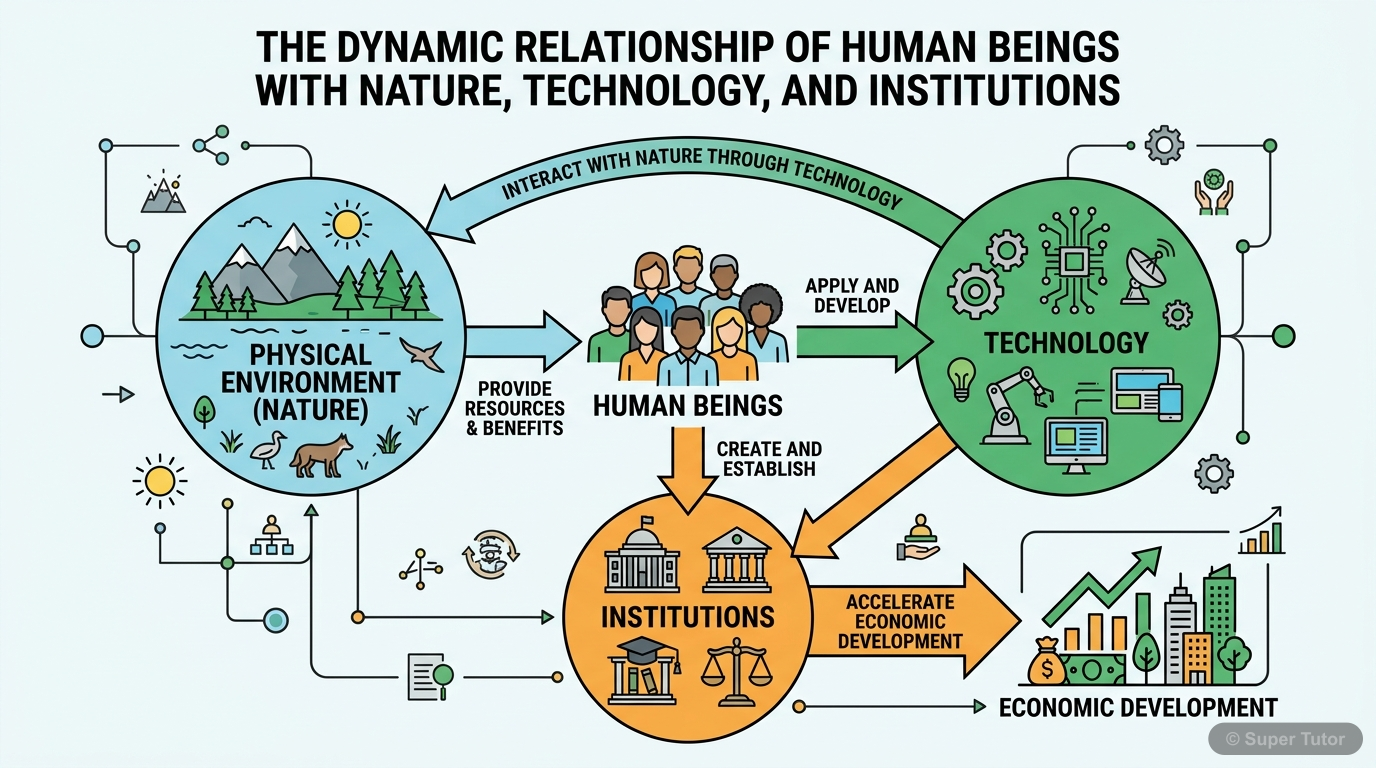
One of 23 illustrations for Resources and Development in Super Tutor — alongside flashcards, concept maps and practice questions.
The first 5 solutions are open to read. The other 5 are free with a Super Tutor account.
Exercises
1(i)Which one of the following is the main cause of land degradation in Punjab?
(a) Intensive cultivation
(b) Deforestation
(c) Over irrigation
(d) OvergrazingShow solution
Correct option: (c) Over irrigation
Justification: In Punjab, the excessive use of irrigation water has led to waterlogging and salinisation of the soil. The accumulation of salts on the surface makes the land unfit for cultivation, making over irrigation the main cause of land degradation in Punjab.
1(ii)In which one of the following states is terrace cultivation practised?
(a) Punjab
(b) Plains of Uttar Pradesh
(c) Haryana
(d) UttarakhandShow solution
Correct option: (d) Uttarakhand
Justification: Terrace cultivation is practised in hilly and mountainous regions where slopes are cut into step-like terraces to create flat land for farming and to reduce surface run-off and soil erosion. Uttarakhand, being a hilly state in the Himalayas, is well known for this practice.
1(iii)In which of the following states black soil is predominantly found?
(a) Uttar Pradesh
(b) Maharashtra
(c) Rajasthan
(d) JharkhandShow solution
Correct option: (b) Maharashtra
Justification: Black soil (also called Regur soil) is predominantly found in the Deccan Plateau region, which includes Maharashtra, Madhya Pradesh, and parts of Gujarat. Maharashtra has the largest coverage of black soil, which is ideal for cotton cultivation.
3Imagine if oil supplies get exhausted, how will this affect our life style?Show solution
If oil supplies get exhausted, our life style would be greatly affected because oil is used in transport, industry and many daily activities. There would be a shortage of petrol and diesel for vehicles, which would disturb travel and trade. Many machines and industries depending on oil would slow down. Prices of goods could rise, and people would have to depend more on alternative sources of energy and conserve fuel more carefully.
EXERCISES — Short Answer Questions (About 30 words)
2(i)Name three states having black soil and the crop which is mainly grown in it.Show solution
Given: Information about black soil distribution in India.
Answer:
Three states having black soil are:
- Maharashtra
- Madhya Pradesh
- Gujarat
Black soil has high moisture-retaining capacity and is rich in calcium carbonate, magnesium, potash, and lime. The crop mainly grown in black soil is cotton. It is therefore also called 'Black Cotton Soil' or Regur soil.
Free with a Super Tutor account
Free with a Super Tutor account
EXERCISES — Long Answer Questions (About 120 words)
Free with a Super Tutor account
Free with a Super Tutor account
PROJECT/ACTIVITY — Puzzle Solutions
(i) Natural endowments in the form of land, water, vegetation and minerals.
(ii) A type of non-renewable resource.
(iii) Soil with high water retaining capacity.
(iv) Intensively leached soils of the monsoon climate.
(v) Plantation of trees on a large scale to check soil erosion.
(vi) The Great Plains of India are made up of these soils.
Free with a Super Tutor account
5 more solved questions in Resources and Development
They are free with a Super Tutor account, along with practice quizzes and flashcards for this chapter. Free to start, no card needed.
Frequently Asked Questions
What are the important topics in Resources and Development for Madhya Pradesh Board Class 10 Social Science?
Are these NCERT Solutions for Resources and Development free?
How should I revise Resources and Development for the Madhya Pradesh Board Class 10 board exam?
Sources & Official References
Content is aligned to the official syllabus. Refer to the board website for the latest curriculum.
More resources for Resources and Development
Practice Quiz
Test yourself with a quick quiz
Important Questions
Exam-style questions with answers
Revision Notes
Key points for last-minute revision
Chapter Summary
Understand the chapter at a glance
Concept Maps
See how topics connect
Study Plan
Step-by-step plan for this chapter
Flashcards
Quick-fire cards for active recall
Syllabus
What topics to cover
For serious students
Get the full Resources and Development chapter — start free.
Quizzes, flashcards, an AI doubt solver and a study plan for Madhya Pradesh Board Class 10 Social Science. Free to start, no card needed.