Consumer Rights — NCERT Solutions
Madhya Pradesh Board · Class 10 · Social Science
NCERT Solutions for Consumer Rights, Madhya Pradesh Board Class 10 Social Science: 27 textbook questions solved step by step.
Interactive on Super Tutor
Studying Consumer Rights? Get the full interactive chapter.
Quizzes, flashcards, AI doubt-solver and a step-by-step study plan — built for NCERT solutions and more.
Free trial, no card needed.
Learn better with visuals Super Tutor pairs illustrations like this with notes and quizzes for Consumer Rights.
The first 14 solutions are open to read. The other 13 are free with a Super Tutor account.
Let's Work These Out
1What are the various ways by which people may be exploited in the market?Show solution
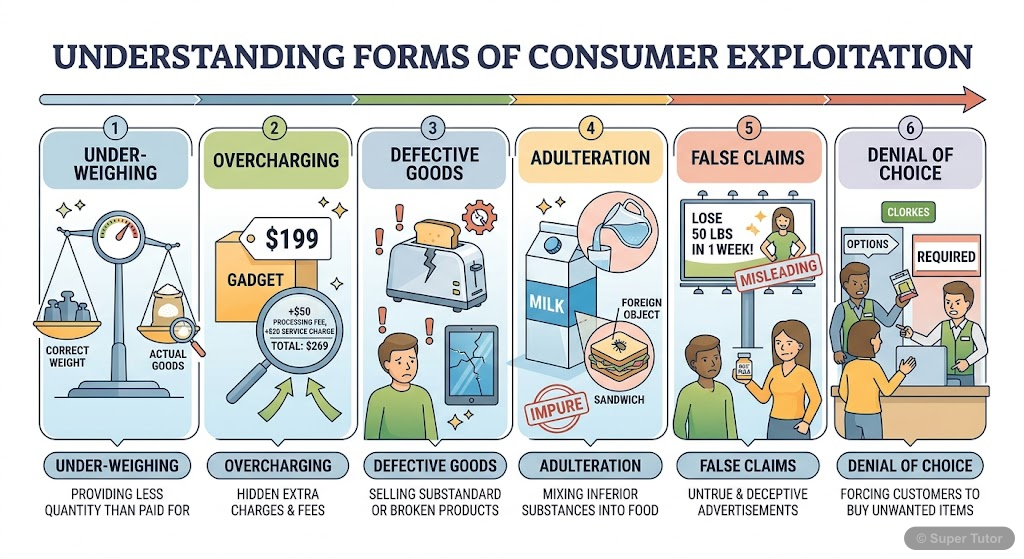
People may be exploited in the market in several ways: shopkeepers may weigh less than they should, extra charges may be added that were not told before, and adulterated or defective goods may be sold. Big companies may also manipulate the market by giving false information through media and other sources, so consumers are misled.
2Think of one example from your experience where you thought that there was some 'cheating' in the market. Discuss in the classroom.Show solution
An example from daily life could be when a shopkeeper charges more than the MRP, gives short weight, or sells a defective item and refuses to replace it. In class, one can discuss such a case and explain how the consumer was cheated.
3What do you think should be the role of government to protect consumers?Show solution
The government should make and enforce rules and regulations to protect consumers, ensure safety of goods and services, stop unfair trade practices, and provide a system for redressal when consumers are cheated. It should also spread consumer awareness and support consumer organisations.
Let's Work These Out
1What could have been the steps taken by consumer groups?Show solution
Consumer groups could have created awareness among people, written articles, held exhibitions, formed groups to check malpractices in ration shops and road passenger transport, and taken up complaints before consumer courts. They also could guide consumers on how to use legal remedies.
2There may be rules and regulations but they are often not followed. Why? Discuss.Show solution
Rules and regulations are often not followed because supervision is weak, the consumer movement is not strong enough, and people or firms may ignore laws if they think they can get away with it. In many places, enforcement of laws is poor, so violations continue.
Let's Work These Out
1For the following (you can add to the list) products/services discuss what safety rules should be observed by the producer?Show solution
Producers should observe safety rules such as:
- LPG cylinder: no leakage, proper valve, correct pressure, certified quality.
- Cinema theatre: safe exits, fire safety, crowd control.
- Circus: safe equipment, trained staff, protection against accidents.
- Medicines: correct dose, expiry date, directions for use, warning of side effects.
- Edible oil: no adulteration, proper quality standards, safe packing.
- Marriage pandal: strong structure, fire safety, safe electrical wiring.
- High-rise building: strong construction, quality materials, fire exits, earthquake safety where needed.
2Find out any case of accident or negligence from people around you, where you think that the responsibility lay with the producer. Discuss.Show solution
One example could be an accident caused by a faulty electrical appliance or a defective gas cylinder. In such cases, if the producer failed to maintain safety and quality, the responsibility lies with the producer because consumers have the right to safety and the producer must follow required safety rules.
Let's Work These Out
1When we buy commodities we find that the price charged is sometimes higher or lower than the Maximum Retail Price printed on the pack. Discuss the possible reasons. Should consumer groups do something about this?Show solution
The price may be higher than MRP if the seller illegally overcharges, or lower than MRP because of discounts, sales, or bargaining. Sometimes the market price may differ due to transport costs or competition, but charging above MRP is unfair. Consumer groups should definitely act against overcharging and spread awareness so consumers can complain.
2Pick up a few packaged goods that you want to buy and examine the information given. In what ways are they useful? Is there some information that you think should be given on those packaged goods but is not? Discuss.Show solution
Packaged goods usually show ingredients, price, batch number, date of manufacture, expiry date, and manufacturer’s address. For medicines, they may also show directions for use and side effects; for garments, washing instructions. These details help consumers make informed choices and seek replacement or complaint if needed. It would also be useful to have clearer information on nutritional value, adulterants, and more warning labels where necessary.
3People make complaints about the lack of civic amenities such as bad roads or poor water and health facilities but no one listens. Now the RTI Act gives you the power to question. Do you agree? Discuss.Show solution
Yes. The RTI Act gives citizens the right to ask questions and get information from government departments. So if people face bad roads, poor water supply, or weak health services, they can use RTI to demand answers and know the reasons for delay or negligence. This helps people question authorities and seek accountability.
Let's Work This Out
1The following are some of the catchy advertisements of products that we purchase from the market. Which of the following offers would really benefit consumers? Discuss.Show solution
Offers that really benefit consumers are those that give actual value and are not misleading. For example, 15 gm more in every 500 gm pack and buy shoes worth Rs 2000 and get one pair worth Rs 500 free may benefit consumers if the offer is genuine. Offers like scratch and win, gold coin inside a pack, or a gift at the end of a year may be attractive, but the real benefit depends on the terms and may be less certain. Consumers should judge carefully whether the offer is truly useful.
Let's Work These Out
3What is the difference between consumer protection council and Consumer Disputes Redressal Commission?Show solution
A consumer protection council guides consumers, creates awareness, and helps them understand how to file cases. A Consumer Disputes Redressal Commission is a quasi-judicial body that hears consumer complaints and gives decisions or compensation. So, councils mainly advise and support, while commissions settle disputes and give verdicts.
4The Consumer Protection Act 1986 ensures the following as rights which every consumer in India should possess
(i) Right to choice.
(ii) Right to information.
(iii) Right to redressal.
(iv) Right to representation.
(v) Right to safety.
(vi) Right to consumer education.
Categorise the following cases under different heads and mark against each in brackets.Show solution
The correct heads are:
- (a) Right to safety
- (b) Right to redressal / representation
- (c) Right to redressal
- (d) Right to information
- (e) Right to choice
- (f) Right to redressal / representation
From the chapter’s listed rights, the relevant matching is:
- Lata got an electric shock from a newly purchased iron → Right to safety
- John files a case in the District Level Consumer Commission → Right to representation
- Sold expired medicine and advised to complain → Right to redressal
- Scans particulars on the pack → Right to information
- Unable to switch cable operator → Right to choice
- Complains persistently to the head office about defective camera → Right to redressal
5If the standardisation ensures the quality of a commodity, why are many goods available in the market without ISI or Agmark certification?Show solution
Although standardisation ensures quality, many goods are sold without ISI or Agmark certification because it is not compulsory for all products. Only some products affecting health and safety or mass consumption, like LPG cylinders, food colours and additives, cement, and packaged drinking water, must be certified. For many other goods, producers may sell without certification, and enforcement may also be weak.
Exercises
Free with a Super Tutor account
Free with a Super Tutor account
Free with a Super Tutor account
Free with a Super Tutor account
Free with a Super Tutor account
Free with a Super Tutor account
Free with a Super Tutor account
Free with a Super Tutor account
Free with a Super Tutor account
Free with a Super Tutor account
Free with a Super Tutor account
(i) Availing details of ingredients of a product
(ii) Agmark
(iii) Accident due to faulty engine in a scooter
(iv) District Consumer Commission
(v) Food fortification
(vi) Consumers International
(vii) Bureau of Indian Standards
(a) Right to safety
(b) Dealing with consumer cases
(c) Certification of edible oil and cereals
(d) Agency that develop standards for goods and services
(e) Right to information
(f) Global level institution of consumer welfare organisations
(g) Addition of key nutrients to staple foods
Free with a Super Tutor account
(i) COPRA applies only to goods.
(ii) India is one of the many countries in the world which has exclusive authorities established for consumer disputes redressal.
(iii) When a consumer feels that he has been exploited, he must file a case in the District Consumer Commission.
(iv) It is worthwhile to move to consumer commissions only if the damages incurred are of high value.
(v) Hallmark is the certification maintained for standardisation of jewellery.
(vi) The consumer redressal process is very simple and quick.
(vii) A consumer has the right to get compensation depending on the degree of the damage.
Free with a Super Tutor account
13 more solved questions in Consumer Rights
They are free with a Super Tutor account, along with practice quizzes and flashcards for this chapter. Free to start, no card needed.
Frequently Asked Questions
What are the important topics in Consumer Rights for Madhya Pradesh Board Class 10 Social Science?
Are these NCERT Solutions for Consumer Rights free?
How should I revise Consumer Rights for the Madhya Pradesh Board Class 10 board exam?
Sources & Official References
Content is aligned to the official syllabus. Refer to the board website for the latest curriculum.
More resources for Consumer Rights
Practice Quiz
Test yourself with a quick quiz
Important Questions
Exam-style questions with answers
Revision Notes
Key points for last-minute revision
Chapter Summary
Understand the chapter at a glance
Concept Maps
See how topics connect
Study Plan
Step-by-step plan for this chapter
Flashcards
Quick-fire cards for active recall
Syllabus
What topics to cover
For serious students
Get the full Consumer Rights chapter — start free.
Quizzes, flashcards, an AI doubt solver and a study plan for Madhya Pradesh Board Class 10 Social Science. Free to start, no card needed.