Water Resources — NCERT Solutions
Madhya Pradesh Board · Class 10 · Social Science
NCERT Solutions for Water Resources, Madhya Pradesh Board Class 10 Social Science: 8 textbook questions solved step by step.
Interactive on Super Tutor
Studying Water Resources? Get the full interactive chapter.
Quizzes, flashcards, AI doubt-solver and a step-by-step study plan — built for NCERT solutions and more.
Free trial, no card needed.
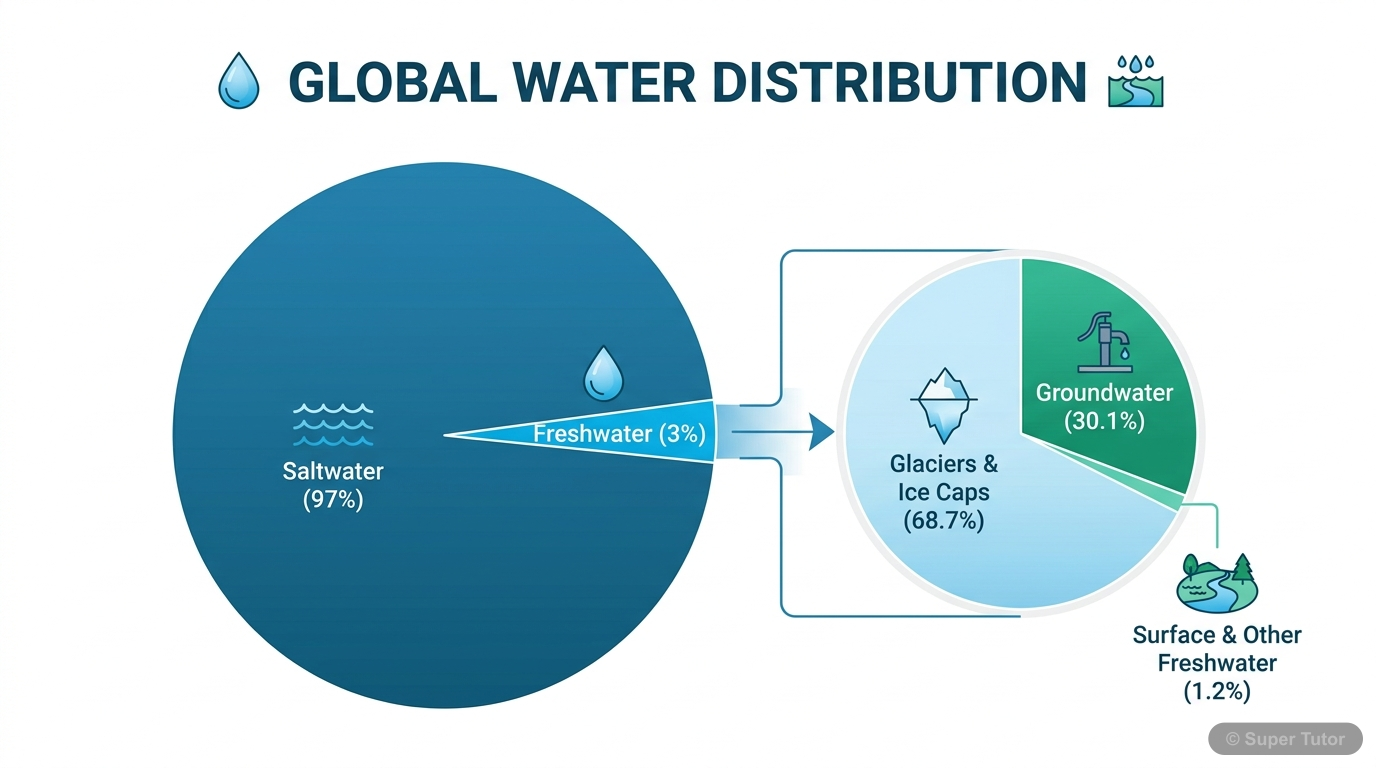
One of 12 illustrations for Water Resources in Super Tutor — alongside flashcards, concept maps and practice questions.
The first 4 solutions are open to read. The other 4 are free with a Super Tutor account.
EXERCISES — Water Resources (Class 10 Geography)
1(i)Based on the information given below classify each of the situations as 'suffering from water scarcity' or 'not suffering from water scarcity'.
(a) Region with high annual rainfall.
(b) Region having high annual rainfall and large population.
(c) Region having high annual rainfall but water is highly polluted.
(d) Region having low rainfall and low population.Show solution
Classification:
(a) Region with high annual rainfall:
➤ Not suffering from water scarcity.
High rainfall means abundant water availability and the population pressure is not mentioned, so water is sufficient.
(b) Region having high annual rainfall and large population:
➤ Suffering from water scarcity.
Even though rainfall is high, the very large population creates excessive demand, leading to over-exploitation and scarcity.
(c) Region having high annual rainfall but water is highly polluted:
➤ Suffering from water scarcity.
Polluted water is unfit for use. Despite high rainfall, the lack of clean/usable water means the region effectively suffers from water scarcity.
(d) Region having low rainfall and low population:
➤ Not suffering from water scarcity.
Although rainfall is low, the population is also low, so the demand is minimal and the available water is sufficient to meet needs.
1(ii)Which one of the following statements is not an argument in favour of multi-purpose river projects?
(a) Multi-purpose projects bring water to those areas which suffer from water scarcity.
(b) Multi-purpose projects by regulating water flow helps to control floods.
(c) Multi-purpose projects lead to large scale displacements and loss of livelihood.
(d) Multi-purpose projects generate electricity for our industries and our homes.Show solution
Correct Answer: (c) Multi-purpose projects lead to large scale displacements and loss of livelihood.
Justification: Options (a), (b), and (d) are all benefits/arguments in favour of multi-purpose river projects. Option (c) is actually a disadvantage (argument against) such projects — large-scale displacement of local communities and loss of their livelihoods is a major criticism, not a point in favour.
1(iii)Here are some false statements. Identify the mistakes and rewrite them correctly.
(a) Multiplying urban centres with large and dense populations and urban lifestyles have helped in proper utilisation of water resources.
(b) Regulating and damming of rivers does not affect the river's natural flow and its sediment flow.
(c) Today in Rajasthan, the practice of rooftop rainwater harvesting has gained popularity despite high water availability due to the Indira Gandhi Canal.Show solution
(a) False Statement: Multiplying urban centres with large and dense populations and urban lifestyles have helped in proper utilisation of water resources.
Corrected Statement: Multiplying urban centres with large and dense populations and urban lifestyles have led to over-exploitation and mismanagement of water resources, creating water scarcity in many regions.
(b) False Statement: Regulating and damming of rivers does not affect the river's natural flow and its sediment flow.
Corrected Statement: Regulating and damming of rivers does affect the river's natural flow and its sediment flow — it fragments rivers, reduces sediment transport downstream, and disrupts aquatic ecosystems.
(c) False Statement: Today in Rajasthan, the practice of rooftop rainwater harvesting has gained popularity despite high water availability due to the Indira Gandhi Canal.
Corrected Statement: Today in Rajasthan, the practice of rooftop rainwater harvesting has declined (lost popularity) because of the availability of water through the Indira Gandhi Canal, as people now depend on canal water instead of traditional harvesting methods.
2(i)Explain how water becomes a renewable resource.Show solution
Given: We need to explain the renewable nature of water.
Concept: The Water Cycle (Hydrological Cycle)
Answer:
Water is a renewable resource because of the continuous hydrological (water) cycle. Solar energy heats surface water in oceans, rivers, and lakes, causing evaporation. Water vapour rises, cools, and condenses to form clouds (condensation). This water returns to the Earth's surface as precipitation (rain, snow, etc.). It then flows into rivers, lakes, and groundwater reserves, replenishing them. This endless cycle of evaporation → condensation → precipitation continuously renews the Earth's water supply, making it a renewable resource.
Free with a Super Tutor account
Free with a Super Tutor account
Free with a Super Tutor account
Free with a Super Tutor account
4 more solved questions in Water Resources
They are free with a Super Tutor account, along with practice quizzes and flashcards for this chapter. Free to start, no card needed.
Frequently Asked Questions
What are the important topics in Water Resources for Madhya Pradesh Board Class 10 Social Science?
Are these NCERT Solutions for Water Resources free?
How should I revise Water Resources for the Madhya Pradesh Board Class 10 board exam?
Sources & Official References
Content is aligned to the official syllabus. Refer to the board website for the latest curriculum.
More resources for Water Resources
Practice Quiz
Test yourself with a quick quiz
Important Questions
Exam-style questions with answers
Revision Notes
Key points for last-minute revision
Chapter Summary
Understand the chapter at a glance
Concept Maps
See how topics connect
Study Plan
Step-by-step plan for this chapter
Flashcards
Quick-fire cards for active recall
Syllabus
What topics to cover
For serious students
Get the full Water Resources chapter — start free.
Quizzes, flashcards, an AI doubt solver and a study plan for Madhya Pradesh Board Class 10 Social Science. Free to start, no card needed.