Thermodynamics — Chapter Summary
NIOS · Class 12 · Physics
Summary of Thermodynamics for NIOS Class 12 Physics. Key concepts: Heat is the form of energy, A thermodynamic system is and An indicator diagram is.
Interactive on Super Tutor
Studying Thermodynamics? Get the full interactive chapter.
Quizzes, flashcards, AI doubt-solver and a step-by-step study plan — built for chapter summary and more.
Free trial, no card needed.
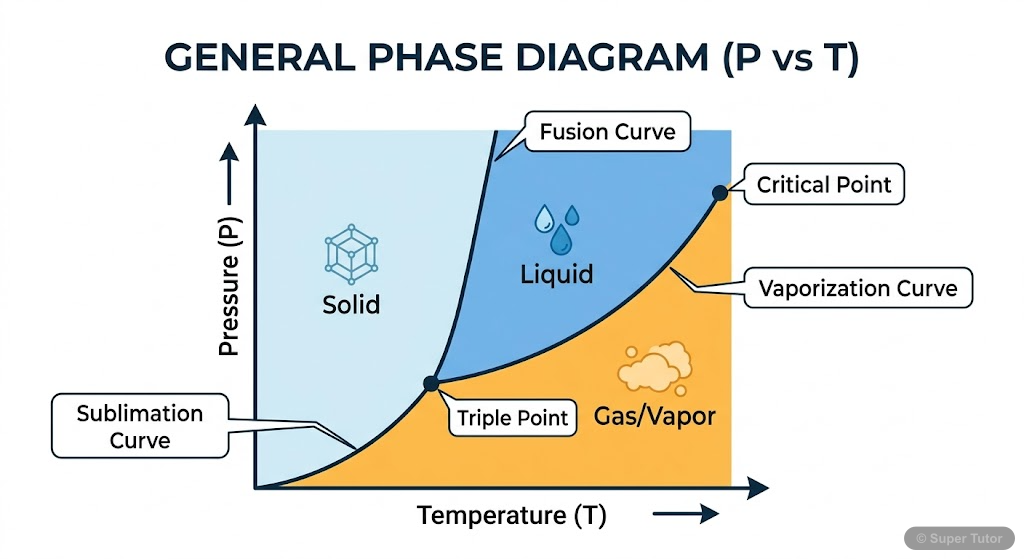
One of 7 illustrations for Thermodynamics in Super Tutor — alongside flashcards, concept maps and practice questions.
Overview
Thermodynamics is the branch of physics that deals with the relationship between heat, work, temperature, and the internal energy of systems. When you rub your hands together, the mechanical work you do produces heat — this simple observation captures the essence of thermodynamics. The subject is bu
Key Concepts
Heat is the form of energy
Heat is the form of energy that flows from a body at higher temperature to a body at lower temperature due to the temperature difference between them.
A thermodynamic system is a definite
A thermodynamic system is a definite quantity of matter separated from its surroundings by a boundary. Three types exist: (1) Open System – exchanges
An indicator diagram is a graph
An indicator diagram is a graph of Pressure (P) on the y-axis versus Volume (V) on the x-axis for a thermodynamic process. The KEY result is: Work don
A system is in thermodynamic equilibrium
A system is in thermodynamic equilibrium when it simultaneously achieves: (a) Thermal equilibrium – uniform temperature throughout, (b) Mechanical equ
Five major processes
Five major processes: (1) Isothermal: Temperature is constant (T = const). The system is in contact with a heat reservoir. Both ΔQ, ΔU, and ΔW are non
Learning Objectives
- Draw and interpret indicator (P-V) diagrams for different thermodynamic processes and calculate the work done as the area under the curve
- Understand thermodynamic equilibrium and state the Zeroth Law of thermodynamics clearly
- Define internal energy and explain its two components — internal kinetic energy and internal potential energy
- State and apply the First Law of Thermodynamics (ΔQ = ΔU + ΔW) with correct sign conventions
- Identify the limitations of the First Law of Thermodynamics
Frequently Asked Questions
What are the important topics in Thermodynamics for NIOS Class 12 Physics?
How should I revise Thermodynamics for the NIOS Class 12 board exam?
Sources & Official References
Content is aligned to the official syllabus. Refer to the board website for the latest curriculum.
More resources for Thermodynamics
Practice Quiz
Test yourself with a quick quiz
Important Questions
Exam-style questions with answers
Revision Notes
Key points for last-minute revision
Formula Sheet
The chapter's formulas in one place
Concept Maps
See how topics connect
Study Plan
Step-by-step plan for this chapter
Flashcards
Quick-fire cards for active recall
Syllabus
What topics to cover
For serious students
Get the full Thermodynamics chapter — start free.
Quizzes, flashcards, an AI doubt solver and a study plan for NIOS Class 12 Physics. Free to start, no card needed.