Thermodynamics — Revision Notes
NIOS · Class 12 · Physics
Thermodynamics revision notes for NIOS Class 12 Physics: 4 topics in quick points. Part of the NIOS Class 12 Physics syllabus.
Interactive on Super Tutor
Studying Thermodynamics? Get the full interactive chapter.
Quizzes, flashcards, AI doubt-solver and a step-by-step study plan — built for revision notes and more.
Free trial, no card needed.
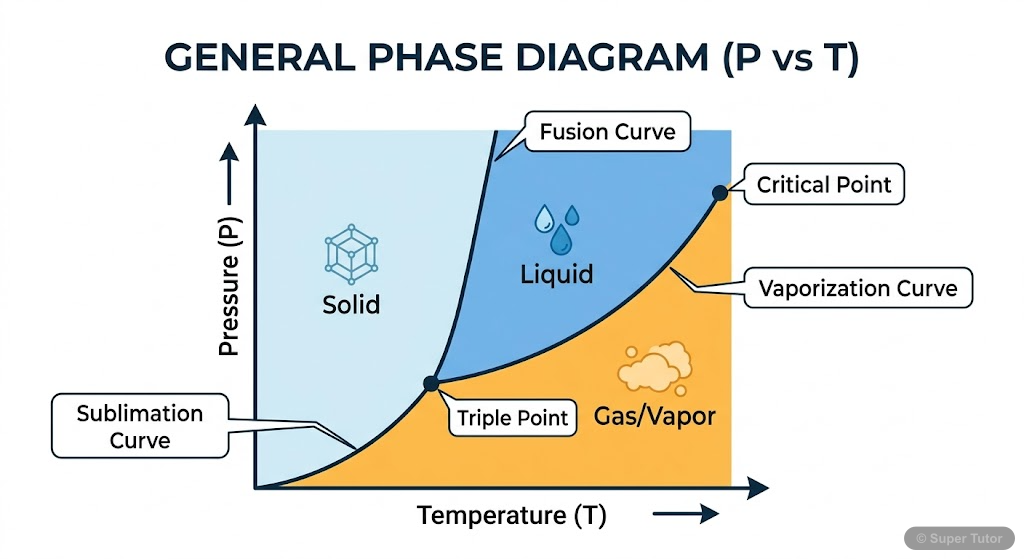
One of 7 illustrations for Thermodynamics in Super Tutor — alongside flashcards, concept maps and practice questions.
Key Topics to Revise
Basic Concepts: Heat, Temperature, and Thermodynamic Systems
- Heat is a form of energy that flows from a body at higher temperature to a body at lower temperature due to a temperature difference. It is NOT the same as internal energy.
- Temperature is the property that determines whether two bodies are in thermal equilibrium. Two bodies in thermal equilibrium have the same temperature.
- Unit of heat: 1 calorie = 4.18 Joules; 1 kcal = 1000 cal = 4180 J.
Thermodynamic Processes
- Isothermal Process: Temperature is constant (ΔT = 0). Occurs in perfectly conducting cylinders. ΔQ, ΔU, and ΔW are all finite. For an ideal gas, ΔU = 0, so ΔQ = ΔW.
- Adiabatic Process: No heat exchange (ΔQ = 0). Occurs in perfectly insulating cylinders. From First Law: ΔU = −ΔW. If gas is compressed, work is done ON the gas, ΔU increases (gas heats up). If gas exp
- Isobaric Process: Pressure is constant (ΔP = 0). Example: Heating water under atmospheric pressure. Work done W = PΔV is non-zero.
Zeroth Law of Thermodynamics and Triple Point
- Zeroth Law of Thermodynamics: If two bodies A and B are separately in thermal equilibrium with a third body C, then A and B are also in thermal equilibrium with each other.
- The Zeroth Law introduces the concept of TEMPERATURE as a fundamental property. It is the scientific basis for thermometers.
- Practical significance: A thermometer (body C) reads the same temperature when placed in contact with different bodies (A and B) that are in mutual thermal equilibrium.
Internal Energy and First Law of Thermodynamics
- Internal Energy (U) is the sum of kinetic energy (random molecular motion) and potential energy (intermolecular forces) of all molecules in the system.
- Internal energy is a STATE function — it depends only on the state (P, V, T) of the system, NOT on the path by which the state was reached.
- Internal energy can be increased by: (1) Adding heat to the system, or (2) Doing work ON the system.
Get complete notes with diagrams and examples
Full NotesKey Concepts
Frequently Asked Questions
What are the important topics in Thermodynamics for NIOS Class 12 Physics?
How should I revise Thermodynamics for the NIOS Class 12 board exam?
Sources & Official References
Content is aligned to the official syllabus. Refer to the board website for the latest curriculum.
More resources for Thermodynamics
Practice Quiz
Test yourself with a quick quiz
Important Questions
Exam-style questions with answers
Formula Sheet
The chapter's formulas in one place
Chapter Summary
Understand the chapter at a glance
Concept Maps
See how topics connect
Study Plan
Step-by-step plan for this chapter
Flashcards
Quick-fire cards for active recall
Syllabus
What topics to cover
For serious students
Get the full Thermodynamics chapter — start free.
Quizzes, flashcards, an AI doubt solver and a study plan for NIOS Class 12 Physics. Free to start, no card needed.