Motion of Rigid Body — Revision Notes
NIOS · Class 12 · Physics
Motion of Rigid Body revision notes for NIOS Class 12 Physics: 4 topics in quick points. Part of the NIOS Class 12 Physics syllabus.
Interactive on Super Tutor
Studying Motion of Rigid Body? Get the full interactive chapter.
Quizzes, flashcards, AI doubt-solver and a step-by-step study plan — built for revision notes and more.
Free trial, no card needed.
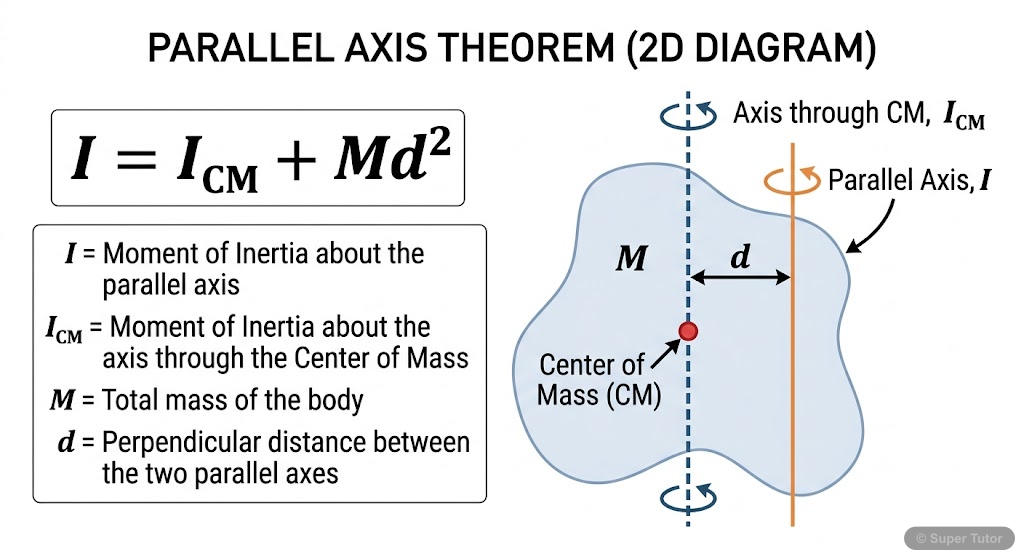
One of 8 illustrations for Motion of Rigid Body in Super Tutor — alongside flashcards, concept maps and practice questions.
Key Topics to Revise
1. Rigid Body – Definition and Concept
- A rigid body is a system of particles where the separation between any two particles does NOT change during motion.
- Shape and size of a rigid body remain preserved during its motion.
- In reality, no perfectly rigid body exists — it is an idealisation. Solid objects like cricket balls, steel discs, and wooden blocks are good approximations.
2. Centre of Mass (CM)
- Centre of Mass (CM) is a mathematical point where the entire mass of the body can be assumed to be concentrated for the purpose of studying translational motion.
- The CM may lie outside the physical body — for example, the CM of a ring lies at its geometric centre, which is empty space.
- For a two-particle system with masses m₁ and m₂ at positions z₁ and z₂: z_cm = (m₁z₁ + m₂z₂)/(m₁ + m₂)
3. Translational vs Rotational Motion
- TRANSLATIONAL MOTION: All particles of the body move along parallel paths with equal displacements. The motion of a wooden block pushed across a floor is purely translational.
- ROTATIONAL MOTION: All particles describe concentric circular paths about a fixed axis. Example: a grinding stone rotating about its central axis.
- ROLLING MOTION: Combination of both translational and rotational motions. Example: a cylinder rolling on the floor.
4. Moment of Inertia
- Moment of Inertia (I) is the rotational analogue of mass. It measures the resistance of a body to changes in its rotational motion.
- Definition: I = Σmᵢrᵢ², where rᵢ is the perpendicular distance of the iᵗʰ particle from the axis of rotation.
- SI Unit of Moment of Inertia: kg·m²
Get complete notes with diagrams and examples
Full NotesKey Concepts
Frequently Asked Questions
What are the important topics in Motion of Rigid Body for NIOS Class 12 Physics?
How should I revise Motion of Rigid Body for the NIOS Class 12 board exam?
Sources & Official References
Content is aligned to the official syllabus. Refer to the board website for the latest curriculum.
More resources for Motion of Rigid Body
Practice Quiz
Test yourself with a quick quiz
Important Questions
Exam-style questions with answers
Formula Sheet
The chapter's formulas in one place
Chapter Summary
Understand the chapter at a glance
Concept Maps
See how topics connect
Study Plan
Step-by-step plan for this chapter
Flashcards
Quick-fire cards for active recall
Syllabus
What topics to cover
For serious students
Get the full Motion of Rigid Body chapter — start free.
Quizzes, flashcards, an AI doubt solver and a study plan for NIOS Class 12 Physics. Free to start, no card needed.