Motion of Rigid Body — Chapter Summary
NIOS · Class 12 · Physics
Summary of Motion of Rigid Body for NIOS Class 12 Physics. Key concepts: A rigid body is a system, The Centre of Mass is and Translational motion occurs.
Interactive on Super Tutor
Studying Motion of Rigid Body? Get the full interactive chapter.
Quizzes, flashcards, AI doubt-solver and a step-by-step study plan — built for chapter summary and more.
Free trial, no card needed.
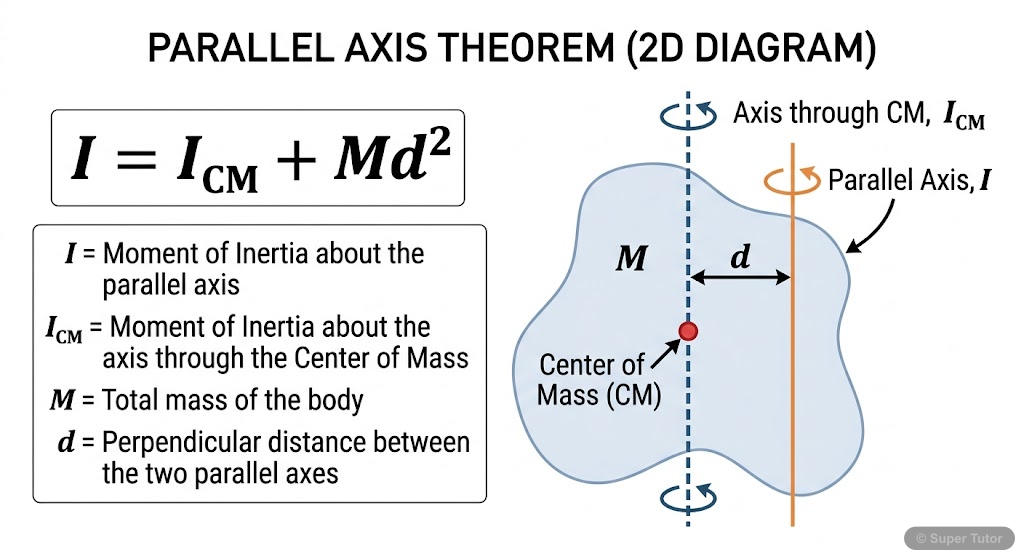
One of 8 illustrations for Motion of Rigid Body in Super Tutor — alongside flashcards, concept maps and practice questions.
Overview
In our everyday life, we deal with objects that are not just simple point masses — they are extended bodies with shape and size. When we study the motion of such objects, we need to account for both their translational motion (moving from one place to another) and rotational motion (spinning about a
Key Concepts
A rigid body is a system
A rigid body is a system of particles in which the distance between any two particles remains fixed, regardless of the forces applied. This means the
The Centre of Mass is
The Centre of Mass is a mathematical point that represents the average position of the mass distribution of a body or a system of particles. For a sys
Translational motion occurs when all particles
Translational motion occurs when all particles of a rigid body move along parallel paths with the same velocity — the entire body moves without rotati
Moment of Inertia is the rotational
Moment of Inertia is the rotational analogue of mass. It measures how difficult it is to change the rotational state of a body about a given axis. Mat
Two theorems help calculate moment
Two theorems help calculate moment of inertia about different axes: (1) Parallel Axes Theorem: I = I_C + Md², where I_C is the moment of inertia about
Learning Objectives
- Define a rigid body and explain why it is an idealization of real objects
- Define and calculate the Centre of Mass (CM) of a system of particles and rigid bodies
- Distinguish between translational and rotational motion of a rigid body
- Define Moment of Inertia and explain its physical significance as the rotational analogue of mass
- State and apply the theorems of Parallel Axes and Perpendicular Axes to calculate moment of inertia
Frequently Asked Questions
What are the important topics in Motion of Rigid Body for NIOS Class 12 Physics?
How should I revise Motion of Rigid Body for the NIOS Class 12 board exam?
Sources & Official References
Content is aligned to the official syllabus. Refer to the board website for the latest curriculum.
More resources for Motion of Rigid Body
Practice Quiz
Test yourself with a quick quiz
Important Questions
Exam-style questions with answers
Revision Notes
Key points for last-minute revision
Formula Sheet
The chapter's formulas in one place
Concept Maps
See how topics connect
Study Plan
Step-by-step plan for this chapter
Flashcards
Quick-fire cards for active recall
Syllabus
What topics to cover
For serious students
Get the full Motion of Rigid Body chapter — start free.
Quizzes, flashcards, an AI doubt solver and a study plan for NIOS Class 12 Physics. Free to start, no card needed.