Magnetism and Magnetic Effect of Electric Current — Revision Notes
NIOS · Class 12 · Physics
Magnetism and Magnetic Effect of Electric Current revision notes for NIOS Class 12 Physics: 4 topics in quick points.
Interactive on Super Tutor
Studying Magnetism and Magnetic Effect of Electric Current? Get the full interactive chapter.
Quizzes, flashcards, AI doubt-solver and a step-by-step study plan — built for revision notes and more.
Free trial, no card needed.
Learn better with visuals Super Tutor pairs illustrations like this with notes and quizzes for Magnetism and Magnetic Effect of Electric Current.
Key Topics to Revise
Magnets, Their Properties, and Magnetic Field Lines
- Every magnet has two poles — North (N) and South (S) — which are always inseparable. Even if you break a magnet, each piece has both poles. This is a fundamental difference from electric charges.
- Directive Property: A freely suspended bar magnet always aligns itself in the geographical North-South direction. This is because Earth itself acts as a giant magnet.
- Attractive Property: A magnet attracts magnetic materials (iron, nickel, cobalt). Attraction is strongest at the poles.
Earth's Magnetic Field and Its Elements
- Earth behaves as if a large bar magnet is placed inside it. The South pole of this imaginary magnet is near the geographical North Pole and the North pole is near the geographical South Pole.
- The magnetic axis of Earth does NOT coincide with its geographical (rotation) axis — they are tilted by about 11.5°.
- The magnetic North Pole (where Earth's South magnetic pole is) is located near Hudson Bay in Canada, about 650 km from the geographical North Pole.
Oersted's Experiment and Biot-Savart's Law
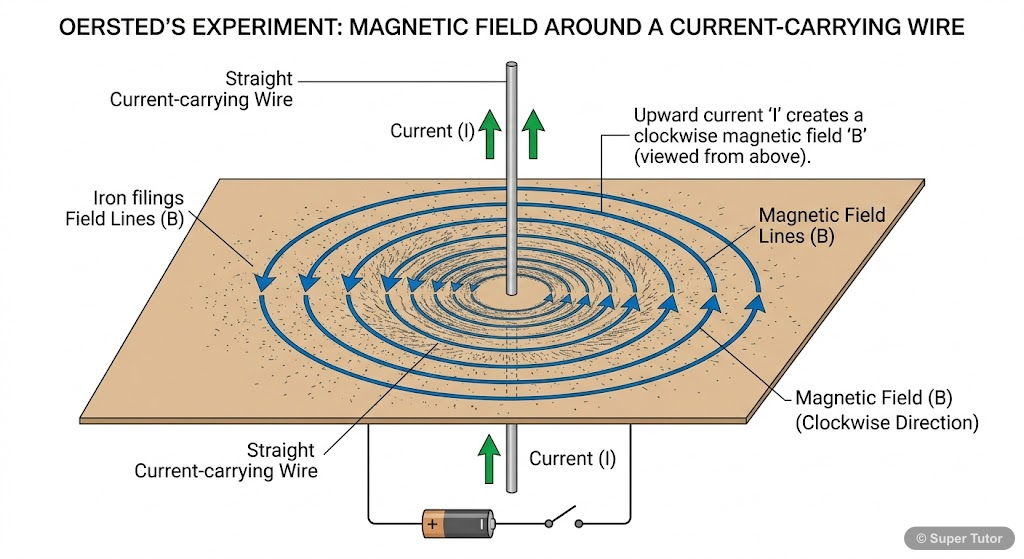
- Oersted's Discovery (1820): Hans Christian Oersted showed that a current-carrying conductor deflects a nearby compass needle, proving that electric current produces a magnetic field around it.
- When current flows north in a wire above a compass needle: N pole deflects west. When current is reversed: N pole deflects east. When no current: no deflection.
- Magnetic field lines around a straight current-carrying conductor are concentric circles, with the wire at the centre.
Ampere's Circuital Law and Its Applications
- Ampere's Circuital Law: The line integral of the magnetic field B around any closed loop (Amperian loop) is equal to μ₀ times the total current enclosed by the loop.
- Mathematically: ∮ B·dl = μ₀I. This is independent of the shape or size of the closed loop chosen.
- APPLICATION 1 — Straight Infinite Wire: B = μ₀I / 2πr. The field decreases with increasing distance r from the wire.
Get complete notes with diagrams and examples
Full NotesKey Concepts
Frequently Asked Questions
What are the important topics in Magnetism and Magnetic Effect of Electric Current for NIOS Class 12 Physics?
How should I revise Magnetism and Magnetic Effect of Electric Current for the NIOS Class 12 board exam?
Sources & Official References
Content is aligned to the official syllabus. Refer to the board website for the latest curriculum.
More resources for Magnetism and Magnetic Effect of Electric Current
Practice Quiz
Test yourself with a quick quiz
Important Questions
Exam-style questions with answers
Formula Sheet
The chapter's formulas in one place
Chapter Summary
Understand the chapter at a glance
Concept Maps
See how topics connect
Study Plan
Step-by-step plan for this chapter
Flashcards
Quick-fire cards for active recall
Syllabus
What topics to cover
For serious students
Get the full Magnetism and Magnetic Effect of Electric Current chapter — start free.
Quizzes, flashcards, an AI doubt solver and a study plan for NIOS Class 12 Physics. Free to start, no card needed.