Simple Harmonic Motion — Revision Notes
NIOS · Class 12 · Physics
Simple Harmonic Motion revision notes for NIOS Class 12 Physics: 4 topics in quick points. Part of the NIOS Class 12 Physics syllabus.
Interactive on Super Tutor
Studying Simple Harmonic Motion? Get the full interactive chapter.
Quizzes, flashcards, AI doubt-solver and a step-by-step study plan — built for revision notes and more.
Free trial, no card needed.
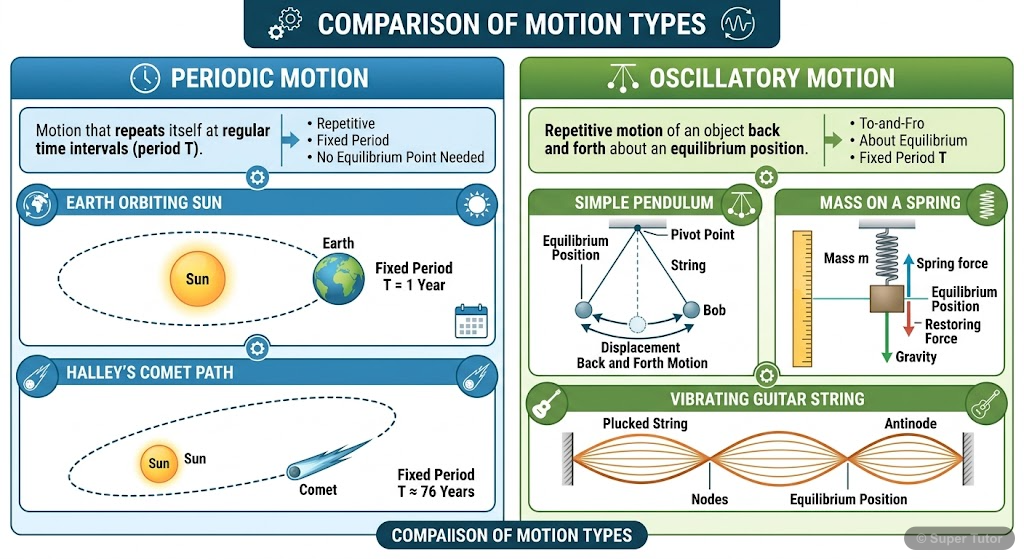
Learn better with visuals Super Tutor pairs illustrations like this with notes and quizzes for Simple Harmonic Motion.
Key Topics to Revise
1. Periodic Motion and Oscillatory Motion
- A motion that repeats itself after a fixed interval of time is called Periodic Motion. Example: revolution of Earth around the Sun, motion of clock hands.
- Oscillatory Motion is a to-and-fro motion about a fixed mean (equilibrium) position. Example: swinging pendulum, vibrating tuning fork.
- Key Rule: Every oscillatory motion is periodic, but every periodic motion is NOT necessarily oscillatory.
2. Simple Harmonic Motion – Definition, Equation and Circle of Reference
- SHM is defined as the oscillatory motion in which the restoring force acting on the particle is directly proportional to its displacement from the mean position and is always directed towards the mean
- Mathematically: F = –kx, where k is the force constant (also called spring constant). The negative sign shows the force is always opposite to displacement.
- SHM can be understood as the projection of uniform circular motion on the diameter of the circle. This is called the 'Circle of Reference' or 'Reference Circle' concept.
3. Time Period of Common SHM Systems
- The time period formula T = 2π√(m/k) applies to all spring-mass systems (horizontal and vertical).
- For a simple pendulum: T = 2π√(l/g). Note that the time period depends only on length l and acceleration due to gravity g — NOT on mass of the bob or amplitude (for small oscillations).
- For vertical oscillations of a spring-mass system: T = 2π√(m/k). Gravity does NOT affect the time period of vertical spring oscillations because the equilibrium position shifts but the restoring force
4. Energy in Simple Harmonic Motion
- The total mechanical energy of a simple harmonic oscillator is constant (conserved) and equals E = ½mω²a² = ½ka².
- Kinetic Energy (K) at displacement y: K = ½mω²(a² – y²). Maximum at y = 0 (mean position) and zero at y = ±a (extreme positions).
- Potential Energy (U) at displacement y: U = ½mω²y² = ½ky². Minimum (zero) at mean position and maximum at extreme positions.
Get complete notes with diagrams and examples
Full NotesKey Concepts
Frequently Asked Questions
What are the important topics in Simple Harmonic Motion for NIOS Class 12 Physics?
How should I revise Simple Harmonic Motion for the NIOS Class 12 board exam?
Sources & Official References
Content is aligned to the official syllabus. Refer to the board website for the latest curriculum.
More resources for Simple Harmonic Motion
Practice Quiz
Test yourself with a quick quiz
Important Questions
Exam-style questions with answers
Formula Sheet
The chapter's formulas in one place
Chapter Summary
Understand the chapter at a glance
Concept Maps
See how topics connect
Study Plan
Step-by-step plan for this chapter
Flashcards
Quick-fire cards for active recall
Syllabus
What topics to cover
For serious students
Get the full Simple Harmonic Motion chapter — start free.
Quizzes, flashcards, an AI doubt solver and a study plan for NIOS Class 12 Physics. Free to start, no card needed.