Magnetism and Magnetic Effect of Electric Current — Chapter Summary
NIOS · Class 12 · Physics
Summary of Magnetism and Magnetic Effect of Electric Current for NIOS Class 12 Physics. Key concepts: All magnets, Earth behaves as a giant and In 1820.
Interactive on Super Tutor
Studying Magnetism and Magnetic Effect of Electric Current? Get the full interactive chapter.
Quizzes, flashcards, AI doubt-solver and a step-by-step study plan — built for chapter summary and more.
Free trial, no card needed.
Learn better with visuals Super Tutor pairs illustrations like this with notes and quizzes for Magnetism and Magnetic Effect of Electric Current.
Overview
Magnetism is one of the most fascinating phenomena in physics. From ancient Greeks who discovered that magnetite (Fe₃O₄) attracts iron, to Oersted's revolutionary discovery in 1820 that electric current produces magnetism, we have come a long way in understanding how electricity and magnetism are de
Key Concepts
All magnets
All magnets — natural or artificial — possess the following key properties: (1) Directive Property: A freely suspended bar magnet always aligns in the
Earth behaves as a giant magnet
Earth behaves as a giant magnet with its magnetic south pole near the geographic north pole. Three quantities completely describe Earth's magnetic fie
In 1820
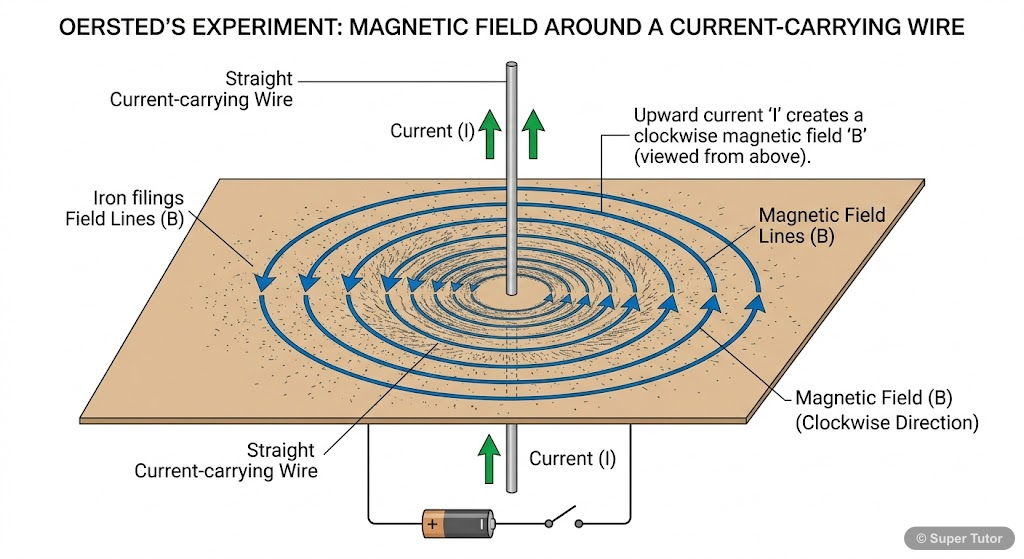
In 1820, Hans Christian Oersted discovered that a compass needle deflects when placed near a current-carrying wire. This proved that electric current
Biot
Biot-Savart's Law gives the magnetic field dB produced at a point P due to a small current element I·dℓ of a current-carrying conductor. The formula i
Ampere's Circuital Law states
Ampere's Circuital Law states: The line integral of the magnetic field B around any closed loop (Amperian loop) equals μ₀ times the total current I en
Learning Objectives
- Define magnetic field (B) and state its SI unit — Tesla (T)
- List the three elements of Earth's magnetic field: Declination, Inclination (Dip), and Horizontal Component, and write the mathematical relations between them
- Describe Oersted's experiment and explain how electric current produces a magnetic field
- State Biot-Savart's Law and apply it to find the magnetic field at the centre of a circular coil carrying current
- State Ampere's Circuital Law and apply it to find the magnetic field due to an infinitely long straight wire, a solenoid, and a toroid
Frequently Asked Questions
What are the important topics in Magnetism and Magnetic Effect of Electric Current for NIOS Class 12 Physics?
How should I revise Magnetism and Magnetic Effect of Electric Current for the NIOS Class 12 board exam?
Sources & Official References
Content is aligned to the official syllabus. Refer to the board website for the latest curriculum.
More resources for Magnetism and Magnetic Effect of Electric Current
Practice Quiz
Test yourself with a quick quiz
Important Questions
Exam-style questions with answers
Revision Notes
Key points for last-minute revision
Formula Sheet
The chapter's formulas in one place
Concept Maps
See how topics connect
Study Plan
Step-by-step plan for this chapter
Flashcards
Quick-fire cards for active recall
Syllabus
What topics to cover
For serious students
Get the full Magnetism and Magnetic Effect of Electric Current chapter — start free.
Quizzes, flashcards, an AI doubt solver and a study plan for NIOS Class 12 Physics. Free to start, no card needed.