Simple Harmonic Motion — Flashcards
NIOS · Class 12 · Physics
37 flashcards for Simple Harmonic Motion (NIOS Class 12 Physics) to test yourself on key terms and facts. Sample: "State the definition and mathematical"
Interactive on Super Tutor
Studying Simple Harmonic Motion? Get the full interactive chapter.
Quizzes, flashcards, AI doubt-solver and a step-by-step study plan — built for flashcards and more.
Free trial, no card needed.
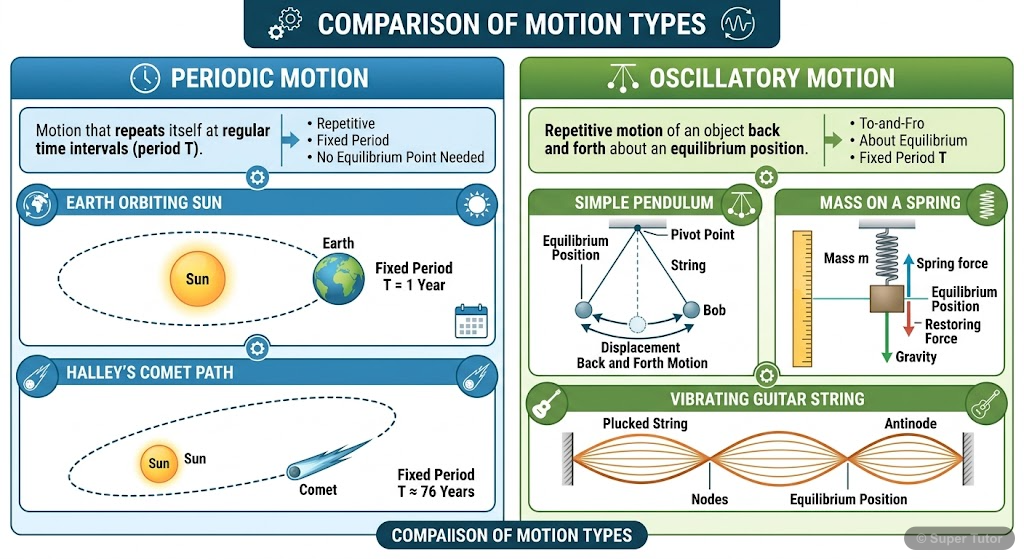
Learn better with visuals Super Tutor pairs illustrations like this with notes and quizzes for Simple Harmonic Motion.
State the definition and mathematical condition for Simple Harmonic Motion (SHM).
Answer
Definition: A particle executes SHM if it moves to and fro about a fixed mean position under a restoring force that is directly proportional to its displacement from the mean position and is always di…
What is the difference between periodic motion and oscillatory motion? Give one example of each.
Answer
Periodic Motion: Any motion that repeats itself after a fixed interval of time (time period T). → Example: Revolution of Earth around the Sun (repeats every 365 days) — Non-oscillatory periodic motion…
Write the general equations representing displacement in SHM and define each term.
Answer
General Equations of SHM: y = a sin(ωt + φ₀) OR y = a cos(ωt + φ₀) Where: • y = displacement from mean position at time t (m) • a = amplitude (maximum displacement) (m) • ω = angular frequency…
Derive the expression for the time period T of a simple harmonic oscillator using the circle of reference method.
Answer
Derivation Using Circle of Reference: Step 1: Consider a point M moving with constant speed v in a circle of radius a (amplitude). At t=0, M is at X. The phasor OM rotates with angular velocity ω = v…
A tray of mass 9 kg oscillates with time period 1.0 s on a spring. When a block of mass M is placed on it, the period becomes 2.0 s. Find the mass M of the block.
Answer
Given: • Mass of tray, m₁ = 9 kg, T₁ = 1.0 s • Mass of tray + block, m₂ = 9 + M, T₂ = 2.0 s Formula: T = 2π√(m/k) → T² = 4π²m/k → m = kT²/4π² Step 1: For empty tray: 9 = k(1)²/4π² → k = …
A spring of force constant 1600 N/m has a mass of 4.0 kg attached to it. It is pulled 4.0 cm and released. Calculate: (i) Frequency (ii) Maximum acceleration (iii) Maximum speed
Answer
Given: • k = 1600 N/m • m = 4.0 kg • Amplitude a = 4.0 cm = 0.04 m Step 1 – Angular Frequency: ω = √(k/m) = √(1600/4) = √400 = 20 rad/s Step 2 – Frequency: ν = ω/2π = 20/2π = 20/6.28 ≈ 3.18 Hz Step…
Derive the expression for the time period of a simple pendulum.
Answer
Derivation: Setup: A bob of mass m hangs from a string of length l. It is displaced by a small angle θ from vertical. Step 1: Forces on bob: • Weight mg (downward) • Tension T (along string, upward)…
Why is the time period of a simple pendulum independent of the mass of the bob? What factors does it depend on?
Answer
Why independent of mass: Restoring force F = −mg sinθ ≈ −(mg/l)x Acceleration a = F/m = −(g/l)x The mass m cancels out. So acceleration (and hence ω and T) does not depend on mass. T = 2π√(l/g) Fac…
+29 more flashcards
Practise AllFrequently Asked Questions
What are the important topics in Simple Harmonic Motion for NIOS Class 12 Physics?
How many flashcards are available for Simple Harmonic Motion?
How should I revise Simple Harmonic Motion for the NIOS Class 12 board exam?
Sources & Official References
Content is aligned to the official syllabus. Refer to the board website for the latest curriculum.
More resources for Simple Harmonic Motion
Practice Quiz
Test yourself with a quick quiz
Important Questions
Exam-style questions with answers
Revision Notes
Key points for last-minute revision
Formula Sheet
The chapter's formulas in one place
Chapter Summary
Understand the chapter at a glance
Concept Maps
See how topics connect
Study Plan
Step-by-step plan for this chapter
Syllabus
What topics to cover
For serious students
Get the full Simple Harmonic Motion chapter — start free.
Quizzes, flashcards, an AI doubt solver and a study plan for NIOS Class 12 Physics. Free to start, no card needed.