Carbon and Its Compounds — Flashcards
NIOS · Class 10 · Science & Tech
46 flashcards for Carbon and Its Compounds (NIOS Class 10 Science & Tech) to test yourself on key terms and facts.
Interactive on Super Tutor
Studying Carbon and Its Compounds? Get the full interactive chapter.
Quizzes, flashcards, AI doubt-solver and a step-by-step study plan — built for flashcards and more.
Free trial, no card needed.
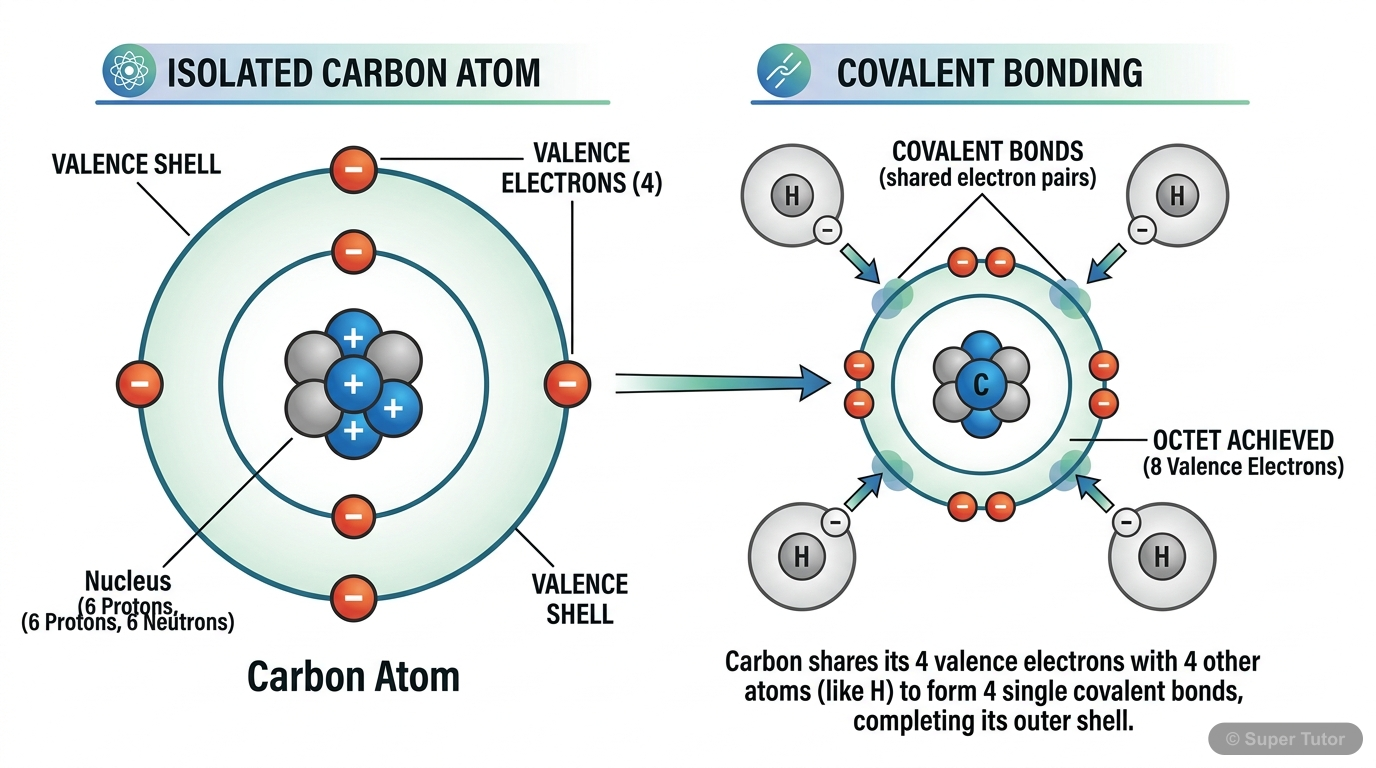
One of 14 illustrations for Carbon and Its Compounds in Super Tutor — alongside flashcards, concept maps and practice questions.
Why can carbon form so many compounds?
Answer
Carbon forms so many compounds because it is tetravalent, it forms strong covalent bonds, and it shows catenation, which means carbon atoms can link with one another to form long chains, branches, and…
What is catenation?
Answer
Catenation is the unique property of carbon to form long chains of carbon atoms. This property helps create a large variety of organic compounds.
What is the electronic configuration of carbon and its valency?
Answer
The electronic configuration of carbon is 2,4. Its valency is 4 because it needs four more electrons to complete its octet.
Why does carbon form covalent bonds instead of ionic bonds easily?
Answer
Carbon does not easily gain four electrons or lose four electrons because both processes need a lot of energy. So carbon usually shares electrons and forms covalent bonds.
What are the three naturally occurring isotopes of carbon?
Answer
The three naturally occurring isotopes of carbon are 12C, 13C, and 14C. Carbon-14 is radioactive and has a half-life of 5730 years.
How is carbon-14 used in dating old remains?
Answer
Carbon-14 is used in radiocarbon dating. Since its half-life is 5730 years, the amount remaining in once-living material helps estimate its age.
What are allotropes of carbon?
Answer
Allotropes are different forms of the same element in the same physical state. Carbon has three natural allotropes: diamond, graphite, and fullerene.
Why is diamond so hard?
Answer
Diamond has a three-dimensional tetrahedral network of carbon atoms. Each carbon atom is bonded to four others by strong covalent bonds, so the structure is very rigid and hard.
+38 more flashcards
Practise AllFrequently Asked Questions
What are the important topics in Carbon and Its Compounds for NIOS Class 10 Science & Tech?
How many flashcards are available for Carbon and Its Compounds?
How should I revise Carbon and Its Compounds for the NIOS Class 10 board exam?
Sources & Official References
Content is aligned to the official syllabus. Refer to the board website for the latest curriculum.
More resources for Carbon and Its Compounds
Practice Quiz
Test yourself with a quick quiz
Important Questions
Exam-style questions with answers
Revision Notes
Key points for last-minute revision
Formula Sheet
The chapter's formulas in one place
Chapter Summary
Understand the chapter at a glance
Concept Maps
See how topics connect
Study Plan
Step-by-step plan for this chapter
Syllabus
What topics to cover
For serious students
Get the full Carbon and Its Compounds chapter — start free.
Quizzes, flashcards, an AI doubt solver and a study plan for NIOS Class 10 Science & Tech. Free to start, no card needed.